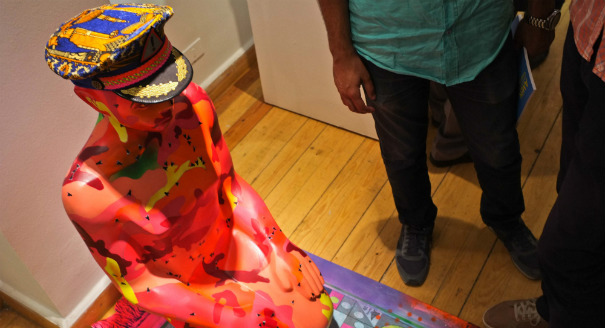
The brightly colored sculpture painted by Egyptian artist Ammar Abo Bakr for the 2014 CARAVAN group exhibition AMEN – A Prayer for the World debuted in Cairo in June at El Bab Gallery of the Museum of Modern Art. The sculpture’s camouflage pattern comes from a November 2013 mural painted on Mohamed Mahmoud Street near Tahrir Square. The sculpture breaks an institutional barrier for new artistic practices by presenting images from Cairo’s iconic street art in the gallery space. Photo by Amanda Mustard
CARAVAN–an art nonprofit founded in 2009 by U.S. Episcopal priest Paul Gordon Chandler–tasked each artist with painting a life-sized sculpture in various positions of prayer. Ammar Abo Bakr’s figure prays on a prayer mat painted to resemble a popular board game, with an anonymous general at the helm, a comment on how religion is used as a kind of game by those in power. Photo by Amanda Mustard
The sculpture grapples with symbols of authoritarianism, wearing the general’s hat and standing in for anyone who “worships strongmen”, explained artist Ammar Abo Bakr. The patch with the exclamation mark sown onto the hat aims to capture the audience’s attention. Since the army’s ousting of President Mohamed Morsi following mass protests in June 2013, Egyptian media has heralded the military as the country’s saviors from the Islamists in hyper-‐ nationalistic reporting that overlooked human rights abuses and the crackdown on dissent. Photo by Amanda Mustard
Artist Ammar Abo Bakr works on his sculpture for the CARAVAN group exhibition in his atelier. “I didn’t paint something beautiful, but something that people should see now,” the artist said. Photo by Amanda Mustard
Artists at the Mohamed Mahmoud mural near Tahrir Square back in November 2013, when the wall’s previous murals were whitewashed in pink camouflage. Renowned Egyptian artist Ganzeer painted the soldier atop the mound of skulls. The mural has become part of the collective memory of events over the past eight months, photographed countless times and shared online via social media. For the first time, the pink camouflage motif has now entered the gallery space with the CARAVAN group exhibition AMEN – A Prayer for the World. Photo by Abdelrahman Zin Eldin
Forlorn, eerie, and even gaudy, Ammar Abo Bakr’s sculpture for the CARAVAN group exhibition that debuted in Cairo and is set to tour the US cities of Washington, D.C. and New York City from August 30 is a surrealistic work where symbols call on the audience to consider how disparate events are related. Photo by Angela Boskovitch
The figure of the “praying” sculpture is pasted with finely drawn flies, a comment on how corruption and lack of accountability and public oversight dirty everything, like the meat left out to rot which draws flies. Estimates say anywhere from 5 to 60 percent of the country’s economy is controlled by the army, whose companies are active in nearly every sector but whose budget remains unknown and without civilian oversight. Photo by Angela Boskovitch
The flag of Saudi Arabia is stenciled on the figure’s back as a kind of brand label, a remark on Saudi-Egyptian relations. Many high-ranking officials from the Mubarak regime fled to Saudi Arabia after his ousting in 2011 and Saudi-Egyptian joint ventures for mega development projects have resulted in luxury tourist resorts and residential housing complexes with allegations of corruption and the giveaway of state land and assets. Photo by Angela Boskovitch
Ammar Abo Bakr’s figure debuted in Cairo with the CARAVAN group exhibition together with sculptures painted by 29 other Egyptian artists. For its U.S. tour, the exhibition will also include eighteen similarly painted figures by Western artists. Ammar Abo Bakr’s sculpture is the only one that used images from Cairo’s iconic murals, which have come to hold a visual memory of events. Photo by Angela Boskovitch
A poster (at far left), designed by Egyptian artists Aya Tarek and Ammar Abo Bakr, features a digitally manipulated portrait of an Egyptian excavator. The artwork was part of the “Money Makes Visible” public art event that covered billboards throughout Austria. Designed by Austrian artist Josef Danner, the project aimed to break the commercial advertising monopoly over the public space. “As an artist you want to break clichés and deconstruct thought patterns in a way that makes people curious,” he said. Photo by Josef Danner
A poster (at far right), designed by Egyptian artists Aya Tarek and Ammar Abo Bakr, features a digitally manipulated portrait of an Egyptian excavator next to a poster designed by an Austrian political party. The artwork was part of the “Money Makes Visible” public art project that covered billboards throughout Austria. “When you present art in the public space you don’t know how it will be received by the community,” Danner said. “That means things happen more by chance that you can’t control, but that make working in the public space very exciting.” Photo by Josef Danner
Ammar Abo Bakr’s brightly colored sculpture is in stark contrast to the other figures painted for a 2014 exhibition AMEN – A Prayer for the World. Although all the artists were similarly tasked with painting a life-sized “praying” sculpture, Abo Bakr’s work is unique in bringing images from Egypt’s vibrant street art inside the gallery, challenging audiences to consider the relation between authoritarianism, religion in politics, and elite corruption.
Abo Bakr was an assistant professor of fine arts before the events of January 2011, when he turned the city walls into his canvas and the street into a kind of open-air classroom. “When you fight with the regime, you fight with yourself and your profession too, because art institutions are really lacking here,” he said. It’s not uncommon for public museums to be closed for years in Egypt with no planned reopening. The famed Mohamed Mahmoud Khalil Museum has been closed since 2010, when a prized Van Gogh painting was stolen. Twenty-five other museums were subsequently closed due to security concerns raised by the theft, and though some have since reopened, they conduct little public educational outreach and are largely not visited by locals. Artists and independent cultural actors have stepped in to fill the void with street art projects and independent cultural spaces.
Prior to his participation in Amen, a CARAVAN group exhibition, Abo Bakr’s work has been featured in several other exhibitions and murals since the events of 2011. Egyptian artwork over this period, documented in countless photographs shared by social media users, has created a kind of visual memory of the revolution. Murals and graffiti have recorded events as they happened; for example, a mural on Mohamed Mahmoud Street done in February 2012 displayed the portraits of those killed in the Port Said football massacre. And in November 2013, the revolutionaries and artists painted a pink camouflage mural as a commentary about authoritarian leaders who act with impunity, disputing the official narrative that conflated all protesters with supporters of Mohamed Morsi, the deposed Muslim Brotherhood president.
For this sculpture, Abo Bakr took the pink camouflage motif he and others painted last year as his starting point. The figure kneels on a prayer mat designed to resemble a popular board game with the image of an anonymous general at the helm. “Religion is part of the game of power here in Egypt,” the artist said. Referring to his sculpture, he adds “I didn’t paint something beautiful, but something that people should see now. This figure represents anyone who worships strongmen.” Abo Bakr’s praying figure prompts viewers to reexamine President Abdel Fattah el-Sisi’s statements and question how religious arguments are used by political figures to gain popular support.
During media and campaign appearances, Sisi has leveraged the Islamist dialogue with frequent references to God and morality. In his first ever TV interview broadcast on May 5, then-candidate Sisi said he was “an Egyptian Muslim who loves his country, religion, and people” and reminisced about growing up in an old Cairo quarter where Jews, Christians, and Muslims lived together. The former military head billed himself as the defender of “moderate Islam,” implying that religious discourse of groups such as the Muslim Brotherhood had “robbed Islam of its humanity.” Before that pre-recorded interview aired, Sisi met with members of the media in a forum on May 3 where he talked of his unwavering faith, saying that God wouldn’t abandon Egyptians after all they’d gone through, and that as president he’d only be accountable to God and the Egyptian people.
Abo Bakr’s CARAVAN sculpture also wears a military-style hat. At the center of it is a triangular sign with an exclamation mark that one encounters on the road warning of dangers ahead—this is intended to jolt the audience. “The idea is to wake people up and link events happening around them,” Abo Bakr explained.
The statue is also peppered with finely drawn small flies representing corruption, a reference to the military-owned companies that operate in nearly every sector without effective oversight or transparency. Despite the country experiencing daily power cuts, $10 billion in gas revenues had been lost between 2005 and 2011 in corrupt contracts that underpriced exports, and citizens are still paying the price for elite networks of corruption.
Also in keeping with his cartoonist-like commentary, Abo Bakr stenciled the flag of Saudi Arabia as a kind of brand label on his sculpture’s back—referencing the growing influence of the kingdom on the Egyptian state. Saudi-Egyptian joint ventures carry out mega development projects throughout the country, often on state-owned land, and the kingdom has granted Egypt more than $12 billion in much-needed aid after the overthrow of President Mohamed Morsi. King Abdullah’s first visit to Egypt since Mubarak’s ouster came on June 20, 2014—a way to congratulate the former defense minister who once served as military attaché in Riyadh on winning the presidency. When Sisi then visited Saudi Arabia on August 10, he was awarded the King Abdulaziz Necklace, the country’s highest and most prestigious medal.
The inclusion of the symbolically painted sculpture in the CARAVAN exhibition is a testament to the work of a new generation of Egyptian artists. “The country’s younger artists are using an international code of language,” explained Josef Danner, who included the artwork of young Egyptian artists in his 2013 poster project that covered billboards around Austria. “They pick up ready-made images that are part of the collective identity and then rework and combine them surrealistically using new technologies in a way that really shocks the older generation of artists.”
Many younger artists like Abo Bakr say they’ve chosen to leave the constraining hierarchy of art academies and institutions in order to contribute critical media at a pivotal time in history. Ironically, this artwork has now made it back into the more traditional art space.
Angela Boskovitch is a Cairo-based writer, researcher, and cultural producer.