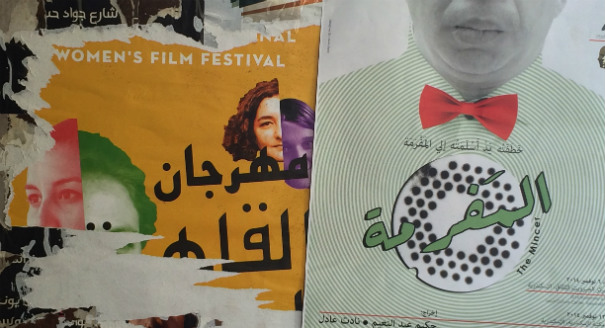
Flyers on a Downtown Cairo wall advertise cultural events, including the 7th Cairo International Women’s Film Festival (left) and the experimental theater play The Mincer (right), whose visual skits explore how the inertia of everyday life, particularly in a patriarchal society, makes social changes difficult if not impossible. Photo by Angela Boskovitch
Billboards for a selection of commercial Egyptian films at Cairo’s historic Rivoli Cinema.
The Blue Elephant (left), the story of a psychotherapist treating the criminally insane at a Cairo hospital, praised by critics and audiences alike for how it dealt with taboo topics. An advertisement for the box-office hit
Omar we Salwa (middle), a comedy-musical typical of many commercially produced films portraying local urban culture with brash music and flashy characters. Photo by Angela Boskovitch
Cinema Odeon screens mostly commercial films around the corner from Zawya, a single-screen cinema showing films it says “don’t make it to the cinema.” An advertisement for
The Island II (middle), a sequel to the 2007 box-office hit
The Island, a film that featured a few noteworthy scenes critical of the police.
The Island II follows the story of a Godfather-like family of drug farmers in Egypt’s neglected, impoverished south. With scenes showing the police fighting alongside local villagers against Islamists, it is also critical of the January 25 Revolution, often mocking its street chants. Photo by Angela Boskovitch
Zawya, a one-screen, 170-seat theater that opened in March 2014, shows Egyptian and foreign films that otherwise do not have access to the commercial market. Zawya, which means “perspective,” has its own entrance and divides its programming between theatrical releases, festivals, and events. Their “Education and Cinema Program” for local schools and universities organizes film screenings and discussions in other Egyptian cities. Photo by Angela Boskovitch
Cinema Karim, on Cairo’s historic Emad Eddin Street, was closed for seven years undergoing renovations. It reopened on January 28 as “Dunya Karim,” which also supports the Zawya arthouse cinema initiative. The venue, originally named Cinema Femina, screened mostly Greek films through the 1960s until it was remodeled under new ownership in the late-1980s as a multiplex showing Egyptian movies. Photo by Angela Boskovitch
A lit billboard at the 36th Cairo International Film Festival (CIFF), held October 9-18, 2014, features renowned actress Nadia Lotfy, an icon from Egypt’s golden age of cinema. CIFF was canceled in 2011 and 2013 due to instability in the country, and many boycotted the 2012 edition, which was beset by a myriad of problems. Photo by Angela Boskovitch
An exhibition at the 36th Cairo International Film Festival recalls Egyptian cinema history, actress Samira Ahmad, and legendary Syrian-Egyptian actor Farid Al-Atrash. The photos and media clips profile the actor’s lead role in Shatie El Hob. Cinema was nationalized after the 1952 revolution and became an important propaganda tool during the Nasser era. By the 1970s, Egyptian films became more liberal and often dealt symbolically with political themes. The film industry changed again in the 1980s, where many independent directors made films critical of Anwar Sadat’s economic policies while commercially produced films played on elements in popular culture. Independent filmmaking increased by the mid-2000s, and with it symbolic films that were socially and politically critical that continue to be made today.
Advertisements for cultural events hang on a Cairo street. The music festival “Raise your voice against Sexual Harassment” (top) brought together different bands as part of the “Better Society” campaign organizes by the Ministry of Youth and Sports. The event also included projects that came out of graffiti and storytelling workshops that were held at youth centers in Egyptian cities and aimed to raise awareness against sexual harassment among boys and young men. The 7th Panorama of the European Film festival (middle) screened European films at Cinema Zawya and a commercial Cairo cinema, with a special focus on emerging directors. The 7th Cairo International Women’s Film Festival (bottom) screened over 60 films from 40 countries. Photo by Angela Boskovitch
Posters for Al Moharek, the first music-booking agency in the Arab World to represent independent artists, are hung on one of the “gates” on Cairo’s Falaki Street. These concrete block walls were erected by the police between October 2011 and February 2012 to block demonstrations from reaching the Ministry of Interior and other government buildings, paralyzing once-vibrant neighborhoods. Artists, however, used the walls as their canvases, transforming the streets into open-air ateliers where residents gathered to see the latest artworks. The doors are usually left open for pedestrians, and the wall now serves as a kind of billboard where cultural organizers advertise festivals and events. Photo by Angela Boskovitch
Cinema Metro shows mostly commercial Egyptian films, such as the comedy films
Omar we Salwa and
My Mother-in-Law Loves Me, both produced by commercial mega-producers Sobky Productions. Photo by Angela Boskovitch
Cinema Renaissance stands where the old Mohamed Farid Theater once stood on the historic Emad Eddin Street. The cinema is part of a chain owned and operated by Al Arabia Cinema, with locations throughout Egypt screening commercial films. Photo by Angela Boskovitch
Cinema Metro in Downtown Cairo advertises the comedy films Omar we Salwa (left) and My Mother-in-Law Loves Me (right). Photo by Angela Boskovitch
Built in the 1930s, historic Radio Cinema, a two-level cinema and theater on Talaat Harb street, recalls the golden age of Egyptian cinema. When it was still on-air, the hugely popular TV program El Barnameg with Bassem Youssef filmed its shows in front of a live audience in the theater. Youssef went off air on May 30, 2014, saying in a press conference that he was unable to continue the program in the current media atmosphere. The cinema’s current owner, Al-Ismaelia for Real Estate Investments, is restoring the art-deco façade. Photo by Angela Boskovitch
A wall holds layers of history. Posters advertise music and theater events on a Cairo wall. The stenciled graffiti at the top right advertises “
hanla qihom,” a campaign to search for the revolution’s missing persons—those lost, arrested, wounded, or killed—,and lists two telephone numbers to call and register a missing person. Photo by Angela Boskovitch
In Egypt, the arts provide some space for reflection in a media environment absent critical voices. Filmmakers and audiences alike are seeking out independent or art-house cinema, according to filmmaker Mona Lotfy, who is at work on her first documentary feature and is involved with the independent Cairo filmmaking collective Hassala. “There’s a new wind blowing in Egyptian cinema, with filmmakers working outside the commercial industry and audiences looking for films and characters that they can relate to,” explained Lotfy. Legal and social limits prevent the arts from exploring ideas outside designated socio-political norms—such as those that appeal to unity, public order, and public morals—but some small openings in filmmaking have emerged to present nuanced characters and alternate storylines.
Lotfy’s forthcoming documentary In Gray Depth takes a closer look at Egyptians and their tenuous relationship with the state that has come with each recent turn of history and change of president. It tells the story of the now closed El-Maghara underground coal mine in northern Sinai that has been impacted by all of the events in the country since its opening in 1964. Northern Sinai is more frequently in the media for a long-running Islamist insurgency that has stepped up attacks on Egyptian military personnel, but this film looks instead at El-Maghara’s miners and their personal experiences working in harsh conditions back when then-president Gamal Abdel Nasser guaranteed employment to all secondary school and university graduates. The miners’ stories about coping with long periods of sensory deprivation present a metaphor about overcoming darkness and despair that parallels Egyptians’ attempts to prevail over the letdowns and failures of each successive government over the past sixty years. “We’re caught in this cycle of frustration and hope, light and darkness, which also exist within each person, and as filmmakers we should use our skills to reflect deeply about our situation and what we’re struggling through now,” said Lotfy, who hopes to release her documentary in early 2016.
Although Egypt once had a flourishing cinema culture with the only major motion-picture industry in the region, the overall decline in the Egyptian arts since the 1970s has meant that most movie theaters now show only Hollywood blockbusters and mainstream Egyptian films, often with clichéd characters and storylines. Commercial filmmakers attract audiences with sultry characters like the omnipresent belly dancer, but deeper depictions of relationships between men and women, for example, are largely absent. Instead, most mainstream films, like those of hugely successful El Sobky Film Productions, which has become synonymous with lowbrow slapstick comedy, are aimed at turning a quick profit. Sentimental melodramas also fill the commercial cinema space. “We have relatively few cinemas for our population and they’re commercially oriented so people watch these kinds of films because that’s what’s available and they’re hungry for culture, but not necessarily because that’s what they’d like to see,” said Karim Hanafy, whose melancholic portrayal of a family in downtown Cairo, The Gate of Departure, was an audience favorite at the 2014 Cairo International Film Festival.
Until recently, foreign and independent films were shown not in well-equipped theaters, but at institutes like the French Cultural Center, which hosts an annual spring festival featuring recent cinema by Egyptian filmmakers. Since March 2014, one project filling the void is Zawya, a single-screen, 170-seat theater that shows independent films by both foreign and Egyptian producers in downtown Cairo. “Interest is really growing for this kind of cinema in Egypt, and our audiences are expanding,” said Nada Elissa, who manages Zawya’s box office and works on the project’s branding and design. In the first six months of screening, Zawya sold 10,000 tickets; it more recently screened films as part of the annual Panorama of the European Film festival. The trend follows some small openings in society, especially among the younger generation, which is starting to explore questions about social norms and Egyptian identity. Audiences so liked Zawya’s screening of Jews of Egypt: End of a Journey that they demanded an additional screening of its prequel, Amir Ramsis’s largely self-funded and highly acclaimed 2012 documentary Jews of Egypt, which presented a picture of how Jews, Christians, and Muslims once coexisted as part of the same society.
Zawya has had to contend with Egypt’s censorship authorities, however, and has at times chosen not to screen a film rather than cut out some of its scenes. Any film screened publicly in Egypt has to pass the censorship board, although authorities are less likely to obstruct well-known institutions like the French Cultural Center than local cinemas, explains lawyer Ahmed Ezzat, who specializes in freedom of expression cases. Articles 47-50, 65, and 67 of the January 2014 constitution guarantee cultural rights, but other laws contradict this. In April 2014, Prime Minister Ibrahim Mehleb even overrode the censorship board’s decision and banned the provocative film Halawet Roh (Beauty of Soul), starring Lebanese actress and singer Haifa Wehbe, who plays a nightclub singer desired by men of her working-class neighborhood, for its use of sexual innuendo—while cinemas were already screening the film for adult-only audiences. The prime minister’s actions prompted the head of Egypt’s censorship board to resign his post in protest. “The prime minister doesn’t have the authority to do this—it’s completely illegal,” explained Ezzat of the government’s decree, which was overturned by an administrative court in November 2014.
In addition to contending with censorship hurdles, filmmakers working outside the mainstream industry also face a labyrinth of bureaucratic challenges that make producing critical art difficult. Filmmakers must obtain a license from the Cinema Professions Syndicate, which only grants permanent membership to filmmakers who’ve studied at the country’s official film academies. Filmmakers without such qualifications—most Egyptians who want to study filmmaking travel abroad or learn from practice, shooting material with digital cameras that they later try to develop into short films—are forced to pay high fees to the syndicate to be granted a permit to work on a particular project, without which they can be tried before a criminal court. The Interior Ministry must also grant a permit to shoot the film or a crew risks arrest when filming in the street, and the censorship board must pre-approve scripts that they usually return to filmmakers with required revisions. “Most artists don’t speak about the changes they’re forced to make because they want to finish their work,” Ezzat said. “But then there’s this dangerous gap between the reality in the street and how people see themselves and how films depict them.”
Elsewhere, independent cinema seeks to add diversity to filmmaking and present alternative storylines and views. In a conservative society like Egypt’s that is confronting complex and interwoven socio-political challenges, filmmakers say they aim to reflect deeply about events with their audiences in a kind of exchange. Confronting sensitive issues of politics, sexuality, and religion in a way that examines authority and sheds light on social taboos, however, is compounded by a bureaucratic censorship designed to restrict such filmmaking, ostensibly in defense of social order and the country’s values. “Things in my country are in a really terrible state right now,” Hanafy said. “But people are still very artistic in their daily lives—they paint their tuk-tuks with amazing designs, there’s music in the streets, forbidden love stories, and cafés are like theater plays. This is what I see in my city, and as filmmakers, we just open a door to another world.” However, even if they’re already part of people’s everyday reality, the worlds these filmmakers can portray are heavily policed by a patriarchal state that does not leave the choice of viewership to the discretion of its citizens.
Angela Boskovitch is a Cairo-based writer, researcher, and cultural producer.