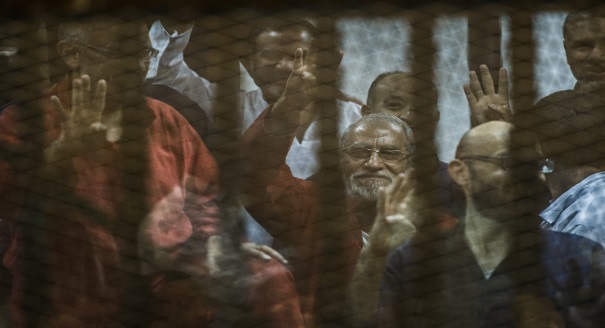
In recent months, the Muslim Brotherhood (MB) has been rethinking its organizational approach and considering the use of violence as a response to state oppression. The violent discourse that MB members used in the first days of the July 2013 coup was spontaneous and went far beyond the ideology that the group has adopted for decades. But the Rabaa massacre that killed at least 817 people, according to Human Rights Watch, along with increasing regime repression, has brought the question of using violence against the state to the fore.
The debate is yielding nuanced—and at times contradictory—arguments about the use of violence. At the same time that some Brotherhood members say it is a tactical response to day-to-day police violence, the MB’s old guard seems unable or unwilling to find a political alternative to what young members are proposing: “smart violence.” These MB activists1 support a specific kind of violence that targets certain elements of the regime—not the indiscriminate sort employed by radical organizations. While this narrow and tactical approach reflects how far violence is from the core of Brotherhood doctrine, it also happens to be garnering more support among the group’s ranks.
For its part, the MB leadership appears wary of losing ground to its youth wing by outright opposing the use of violence. But gradually, party elites have shifted from issuing a number of statements affirming the pacifist nature of MB political action to offering justifications for its limited use. However, such rhetoric is not yet as prevalent in recent MB discourse as to represent a major strategic overhaul.
For example, Yahya Hamed, a 36-year-old MB leader and former investment minister during the Morsi period, used vague words to describe the party members’ “right to self-defense.” Hamed’s remarks are not part of a long-term strategy to ensure the group’s existence, but rather more of an angry response to regime repression that has become commonplace. On July 1, for example, security forces killed thirteen MB leaders shortly after being detained, searched, and fingerprinted. These Brotherhood members were reportedly meeting to discuss supporting the families of jailed MB members when police stormed the building. Responding to the incident, the Brotherhood criticized Sisi for moving Egypt toward a new and dangerous phase where “no one can control the rage of the oppressed people.”
Nonetheless, the MB’s official statements are still contradictory and reflect its lack of consensus about the use of violence. Prominent leader and former minister of international cooperation, Amr Darrag, is one of many questioning the pacifist approach: “the main lesson I learned is that gradual change will no longer work.” Moreover, in late January, the movement released an online statement that many perceived as a sharp turn from non-violence: “We are at the beginning of a new phase where we summon our strength and evoke the meaning of jihad.” It continued, “[We] prepare ourselves, our wives, our sons and daughters, and whoever follows our path for relentless jihad where we ask for martyrdom.” Several commentators have argued that this was not an official statement, and they point out that the MB was quick to condemn the June 29 assassination of Egypt’s prosecutor general, stating: “the brotherhood is affirming its refusal to all killings.” Yet these conflicting statements, beyond reflecting the mixed views on the issue, still indicate that senior officials are increasingly willing to consider the merits of formally adopting violence as a tactic to confront the Egyptian state.
Recent changes to the Brotherhood’s internal structure reflect this shift. In April, the official spokesman of the party announced the election of a new seven-member executive bureau outside Egypt. Convening in Istanbul, these members commenced meetings with political activists and academics to discuss their views of the group’s predicament and about how to improve the movement’s political vision and discourse. The group’s leaders are trying to end the party’s isolation by engaging in more open discussions with political analysts and activists from diverse backgrounds, including some foreign officials. These discussions include heated debates over the question of violence as a tactic and revolutionary strategy.
On MB social media platforms, the increasing shift toward violence is more clear. Members and supporters are calling military personnel and regime officials mortaddin (or “apostates”), reflecting the rise of Salafi-jihadist discourse among Brotherhood members. Furthermore, the “effective violence” adopted by groups such as the Islamic State of State of Iraq and al-Sham and its Egyptian branch (Wilayat Sinai, previously known as Ansar Bayt Al-Maqdis), along with the state’s inability to crush these groups, is an inspiration to many within the MB. The state media’s insistence on linking the Brotherhood to the Salafi-jihadist camp is further alienating many rank-and-file MB members, most of whom are middle-class professionals. Stigmatizing these individuals as jihadis is pushing many to turn to violence.
One female member of the Muslim Brotherhood in Cairo, who spoke on condition of anonymity2, described growing dissent within the MB over its “pacifism.” She noted that members are beginning to organize themselves to prepare for attacks against security and military interests in Egypt. It’s not clear whether these attacks will be directed at facilities such as headquarters and vehicles or against personnel, but it’s still an important turning point that needs to be monitored. The trials against the former president Mohamed Morsi and the group’s leaders, in addition to the lack of legal recourse, are enhancing the appeal of violence as a tactic. In the meantime, Brotherhood leaders continue to refuse reconciliation with the regime and as such are unlikely to be part of the political scene or achieve change through existing channels.
Although the tide is turning in favor of violent tactics, it is clear that the matter has yet to be settled. Given the Brotherhood’s long history of non-violence, many members don’t find it easy to accept it now even in response to the Sisi regime’s clampdown. But the fear of losing ground is occupying the minds of Brotherhood leaders. The way many Brotherhood leaders are framing this is that if there is a war between society and the state, and if the society has taken a stance, the Muslim Brotherhood should not hinder society’s fight for freedom. “We should not stand silent in this battle,” said an Istanbul-based consultant for the newly-elected executive bureau. “The vacuum should be filled by a powerful organization, and we will not repeat the mistakes of the Syrian Muslim Brotherhood (SMB),” he added. The consultant was referring to the fact that the SMB lost their support in Syria because they distanced themselves from the chaos during the early stages of the revolution.
Abdelrahman Ayyash is an MA student in the school of social sciences at Bahçeşehir University in Istanbul. His research focuses on the Egypt’s Islamists. Follow him on Twitter @3yyash.
1. Interviewed by the author.
2. Interviewed by the author, April 1, 2015.