The Armenian Orthodox Cathedral still flies the Egyptian and Armenian flags side-by-side over its Ramses Street entrance. Armenian Churches follow a similar architectural pattern that makes them easily recognizable. Photo by Angela Boskovitch
Sunday mass at the Armenian Orthodox Cathedral in central Cairo. Armenia was the first country to officially adopt Christianity in the year 301. In Egypt, the Orthodox Patriarchate is the guardian of community assets and endowments. Photo by Angela Boskovitch
The flags (left to right) of the Vatican, Egypt, and Armenia hang above the offices of the Armenian Catholic Cathedral in downtown Cairo. Whether followers are Orthodox or Catholic, churches play a unifying and organizational role in Egypt’s Armenian community. Photo by Angela Boskovitch
An Armenian cross-stone (khachkar) at the Armenian Catholic Cathedral in downtown Cairo, constructed by Garo Balian, well known for his art deco Yacobian building. The text below recalls the 1915 Armenian Genocide. Photo by Angela Boskovitch
Saint Theresa Armenian Catholic Church in Cairo’s Heliopolis district, also built by Garo Balian, is lit for Sunday evening mass. Many Armenians have moved from Cairo to outlying districts like Heliopolis. Photo by Angela Boskovitch
The garden at the Armenian Orthodox Cathedral in central Cairo. Egyptian-Armenian architect Nairy Hampikian restored the 1924 church and re-landscaped the gardens. Photo by Angela Boskovitch
A small street in Moski, a quarter near the heart of Cairo that was once home to hundreds of Armenian families. Starting in the mid-1950s, many moved to outlying districts like Heliopolis, while others left Egypt for life in Europe or the United States. Photo by Angela Boskovitch
An Armenian church, no longer in use, in Cairo’s Moski quarter. As Armenians secured a foothold in the Egyptian economy, they left for newly built upscale districts where they could purchase homes and apartments. Photo by Angela Boskovitch
The Centro Francescano Studi Orientali Cristiani, a public library in Cairo’s Moski quarter. Armenian Catholic Priest Father Mansur has spent decades collecting literature on Armenian history and the Armenian diaspora for the library, which is now managed mostly by Egyptian Coptic Christians. Photo by Angela Boskovitch
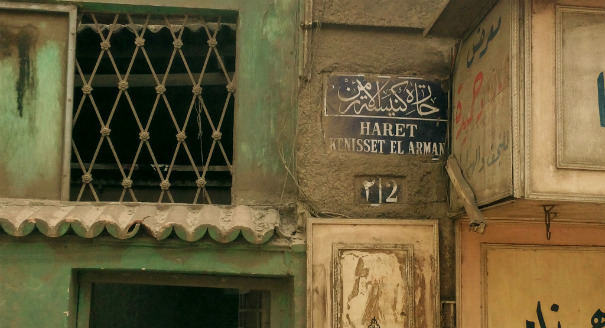
A street sign reading “Haret Kenisset El Arman” signifies an alleyway in Moski, which was home to hundreds of Armenian families. “Armenians have moved with the city of Cairo,” explained Egyptian-Armenian architect Nairy Hampikian. Photo by Angela Boskovitch
A small alleyway in Cairo’s Moski quarter. As Armenians secured a foothold in the Egyptian economy, they left their original neighborhoods, first for what was upscale downtown and later Heliopolis, the new heart of Armenian schools, organizations, and clubs today. Photo by Angela Boskovitch
Anahid Aroyan of the prominent Yervant jewelers, whose father survived the Armenian Genocide. Egyptian-Armenian jewelers have earned a distinguished reputation among Egyptians in the sector. “It’s still something special to buy jewelry from Armenians and Egyptians respect us for our honesty and professionalism,” said Aroyan. Photo by Angela Boskovitch
A gravestone at the Armenian Orthodox Cemetery in Cairo’s Heliopolis district bears an image of Mount Ararat. The Armenian community in Egypt received increased coverage in Egyptian media this year with the 100th anniversary of the 1915 genocide. Photo by Angela Boskovitch
A sculpture by Egyptian-Armenian artist and sculptor Vahan Telpian at Cairo’s Armenian Orthodox Cathedral. The piece was part of an April 24 event commemorating the 1915 genocide. Telpian said, “I feel very much Egyptian, but I’m also connected to my roots in a country where Egyptians themselves are a mixture.” Photo by Angela Boskovitch
Armenian youth organized a group to participate in the April 17 Cairo half-marathon, wearing black to raise awareness of the Armenian Genocide’s centennial. “This was the first event led by the Armenian youth and the community really got involved,” Paylag (center) said. Photo by Angela Boskovitch
Egypt’s Armenian community today operates as a kind of state within a state. It provides services to its members in a country where social welfare is largely limited to government subsidies and attempts to preserve its identity with a network of clubs, schools, newspapers, benevolent organizations, and churches. But the Armenian population is drastically smaller today than its peak in the 1950s. Armenian institutions in Egypt are now challenged with keeping their community together as intermarriage becomes more common and Armenian youth are increasingly tempted by opportunities abroad.
In the years during and after the 1915 genocide, thousands of Armenians came to Egypt—where the Armenian General Benevolent Union (AGBU), founded in Cairo by a group of prominent Egyptian Armenians in 1906, set up a school for refugee children and provided other relief, social, and cultural services. In its early years, the AGBU was central to providing for the new arrivals and integrating them into the larger Armenian community. “Egyptian–Armenians have a long history of organizing things and founded this institution to work worldwide,” explained Viken Djizmedjian, AGBU’s Cairo chair since 2006.
Over the years, the Armenian community’s spirit of solidarity has helped to keep it organized and united. “We have a lot of institutions and it’s very important for us to keep Armenians together so each organization tries to do its part,” explained Djizmedjian. A 24-member Community Council is elected every eight years. They in turn elect an executive body every four years to run the Armenian Patriarchate’s institutions—including its schools, churches, cemeteries, real estate, and philanthropic endowments. Today AGBU Egypt supplements the meager services offered by the Egyptian state, providing educational grants, operating homes for the elderly, and offering medical, pension, and social welfare programs.
Armenians in Egypt are Egyptian citizens, carry Egyptian ID cards, and serve in the army, but they’re rarely involved in Egyptian political affairs. “Unlike Lebanon, for example, we don’t have parliamentary representatives, so to be active in Egyptian public life is really up to the individual,” Djizmedjian explained. The community’s numbers have dwindled, however, from a peak of 45,000 in the mid-20th century to between 5,000 and 7,000 today, according to Djizmedjian. Following Gamal Abdel Nasser’s economic nationalization programs in the 1960s, many Armenians, who tended to be self-employed and have their own businesses, left for Europe or the United States—and the country’s economic problems continue to tempt youth with opportunities abroad.
Until recently, there were three schools in Cairo catering to members of the Armenian community, but in 2013 dwindling enrollment meant that downtown Cairo’s historic Armenian school was forced to close its doors and merge with a nearby school in Heliopolis. About 150 students in grades K-12 now receive tuition-free education at the Kalousdian–Nubarian Armenian School, which has a 100 percent graduation rate, and growing numbers now come from families with Egyptian and Armenian parents, as intermarriages have become more common.
Most Armenians in Egypt still speak Armenian, in Armenian-owned businesses, or among students at church functions, and the language is seen as crucial to preserving their identity. “Language is a real concern for us as Armenians in the Middle East, which is why we also offer Armenian language courses as part of our AGBU virtual college,” Djizmedjian said. But downtown Cairo, once a nexus of Armenian life, is now home to only a small number of mostly aging Armenians and a few Armenian businesses. Much of the community has relocated to districts like Heliopolis, which has become the center of Armenian organizations. “Armenians have moved together with the city of Cairo,” explained architect and conservationist Nairy Hampikian, who restored two Armenian churches in central Cairo—the Armenian Catholic Cathedral, known as the Church of the Assumption and built in 1926, serves a small, but steadfast community of Armenian Catholics downtown, and the Armenian Orthodox Cathedral, which was built in 1924, still flies the Egyptian and Armenian flags side-by-side in the historic Faggala neighborhood.
“The revolution has made us belong to this place,” Hampikian said, noting that as an architect, success depends on a team of Egyptians working with her. “A community is a privilege, but it can also be a bubble, so we should get involved in whatever Egypt is going through and not hide ourselves from the situation around us,” she emphasized.