

Paper
Mei Ying Gechlik (Veron Hung)

REQUIRED IMAGE
This study seeks to answer three questions: Are interference, intracourt and intercourt influence, and judicial corruption of a lesser magnitude in Shanghai than in other parts of China? If so, what measures has Shanghai taken to accomplish this? What lessons about judicial reform in China can be learned from Shanghai’s experiences?
Summary
The George W. Bush administration in September 2002 laid out in the "National Security Strategy of the United States" its strategy toward China: "We welcome the emergence of a strong, peaceful, and prosperous China, "During a trip to Asia in March 2005, Secretary of State Condoleezza Rice adopted a similar phrase to welcome "the rise of a confident, peaceful, and prosperous China."
Implicit in Washington’s message is its concern about the potential threat of China’s rise. To ease such concern prevailing outside China and to respond to criticisms about the Chinese Communist Party’s (CCP) governance spreading across the country, Beijing has vowed to establish a "socialist harmonious society" that features, among other characteristics, the rule of law, fairness, and justice. Unfortunately, courts in China have yet to exemplify the rule of law, fairness, and justice. Understanding that its governance cannot be sustained by a dysfunctional justice system, Beijing has taken a series of actions to reform China’s judiciary.
This study seeks to analyze whether fairness has been achieved in Shanghai and what this means to China as a whole, and it tries to accomplish this through extensive literary research as well as a survey and interviews in China, especially Shanghai. This study seeks to answer three questions: Are interference, intracourt and intercourt influence, and judicial corruption of a lesser magnitude in Shanghai than in other parts of China? If so, what measures has Shanghai taken to accomplish this? What lessons about judicial reform in China can be learned from Shanghai’s experiences?
Click on link above for the full text of this Carnegie Paper.
About the Author
Veron Mei-Ying Hung is an associate in the Carnegie Endowment’s China Program. She has in-depth experience in Chinese law, and law and politics in the Asia-Pacific region. In academia and the private sector, she has studied such areas as legal reform in China, constitutional development in Hong Kong, human rights in Cambodia, and trade with China. She is the author of "China’s WTO Commitment on Independent Judicial Review: Impact on Legal and Political Reform"(American Journal of Comparative Law) and "Getting to Democracy in Hong Kong" (Carnegie Endowment).
Also published in The Columbia Journal of Asian Law, Spring/Fall 2005 issue, Volume 19, Number 1.

Former Non-Resident Associate
Recent Work
Mei Ying Gechlik (Veron Hung)
Mei Ying Gechlik (Veron Hung)
Carnegie does not take institutional positions on public policy issues; the views represented herein are those of the author(s) and do not necessarily reflect the views of Carnegie, its staff, or its trustees.
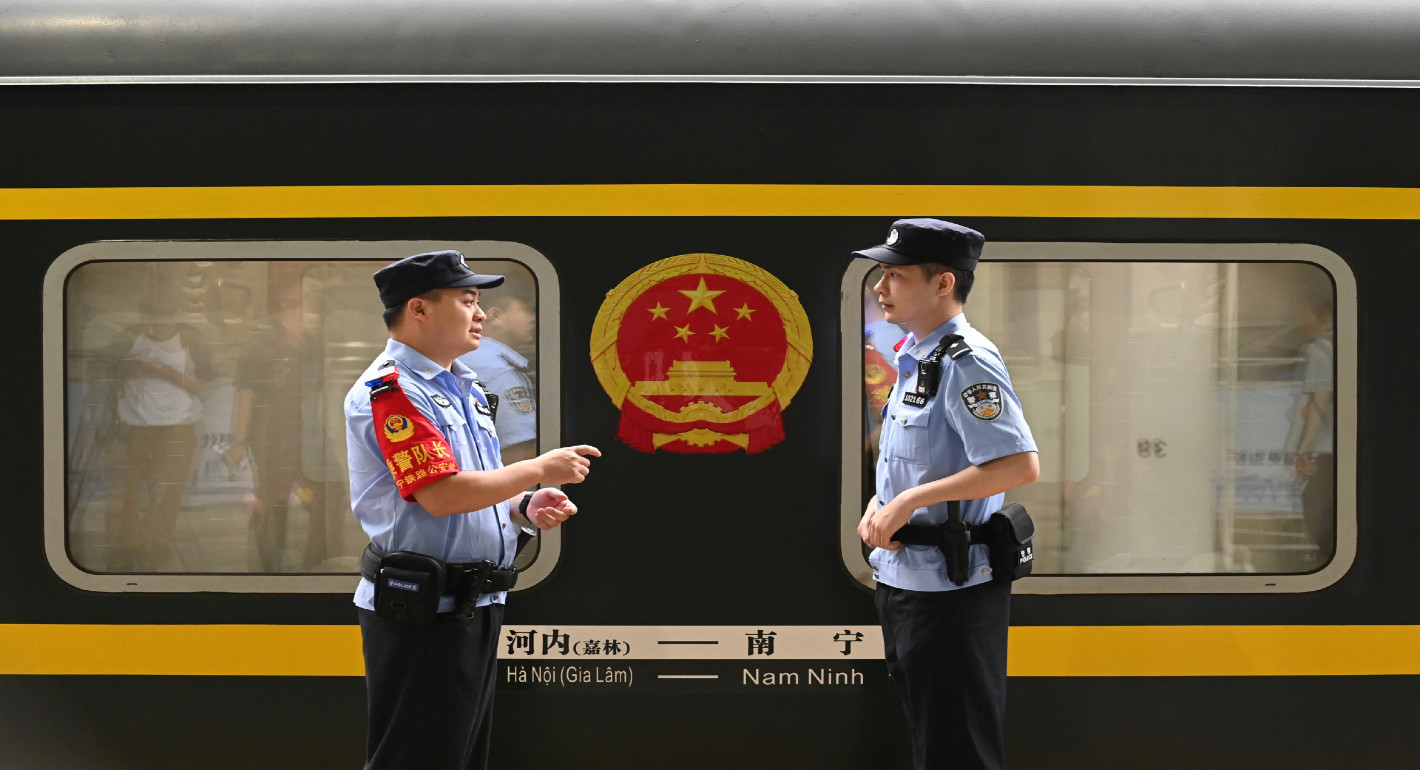
Despite long-standing differences, China and Vietnam are reinforcing common ground for collaboration, especially in public security. This internal security–centered diplomacy offers a strengthened road map for how China moves forward with Southeast Asia.
Sophie Zhuang

The return of war as the organizing factor in Middle Eastern politics has predictable consequences: governments are prioritizing regime stability and becoming averse to political and social reform.


Sarah Yerkes, Amr Hamzawy

The future looks bleak for independent media worldwide, but there is a robust infrastructure of knowledge, organizations, and people to build upon.


Daniel Sabet, Susan Abbott

Across Asia, China is better positioned to withstand energy shocks from the fallout of the Iran war. Its abundant coal capacity can ensure stability in the near term. Yet at the same time, the country’s energy transition away from coal will make it even less vulnerable during the next shock.

Damien Ma

Defenders of democracy often split over perceptions, methods, urgency levels, and priorities.


Murat Somer, Jennifer McCoy