• Research
  • Emissary
  • About
  • Experts
Carnegie Global logoCarnegie lettermark logo
DemocracyIran
  • Donate
{
  "authors": [
    "Karim Sadjadpour"
  ],
  "type": "other",
  "centerAffiliationAll": "dc",
  "centers": [
    "Carnegie Endowment for International Peace"
  ],
  "collections": [],
  "englishNewsletterAll": "menaTransitions",
  "nonEnglishNewsletterAll": "",
  "primaryCenter": "Carnegie Endowment for International Peace",
  "programAffiliation": "MEP",
  "programs": [
    "Middle East"
  ],
  "projects": [],
  "regions": [
    "North America",
    "United States",
    "Middle East",
    "Iran"
  ],
  "topics": [
    "Security",
    "Military",
    "Foreign Policy",
    "Nuclear Policy"
  ]
}
Source: Getty

Other

Iran: Is Productive Engagement Possible?

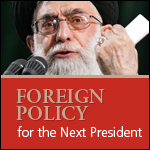
Iran continues to be a critical national security challenge for the United States, despite decades of effort to change Tehran’s behavior by isolating the country politically and economically. The relevant question is not whether to talk to Iran but how. Engagement should focus on six critical issues: Iraq, Afghanistan, nuclear proliferation, the Arab–Israeli conflict, energy, and terrorism.

Link Copied
By Karim Sadjadpour
Published on Oct 16, 2008
Program mobile hero image

Program

Middle East

The Middle East Program in Washington combines in-depth regional knowledge with incisive comparative analysis to provide deeply informed recommendations. With expertise in the Gulf, North Africa, Iran, and Israel/Palestine, we examine crosscutting themes of political, economic, and social change in both English and Arabic.

Learn More

Iran continues to be a critical national security challenge for the United States, despite decades of effort to change Tehran’s behavior by isolating the country politically and economically. A different approach is required. In a new policy brief, Karim Sadjadpour explains that the relevant question is not whether to talk to Iran but how to talk to Iran, and prioritizes U.S. engagement with Iran on six critical issues: Iraq, Afghanistan, nuclear proliferation, the Arab–Israeli conflict, energy, and terrorism.  

The next U.S. president should:
  • Focus initially on areas where the United States and Iran share common interests, such as Iraq and Afghanistan, rather than issues with little or no common interest, like the nuclear issue or the Israeli–Palestinian conflict.
     
  • Refrain from any grand overtures to Tehran which risk redeeming Iranian President Ahmadinejad’s policies and enhancing his bid for reelection in June of 2009. 
     
  • Deal with those who hold power in Iran, namely Supreme Leader Ayatollah Ali Khamenei.
     
  • Avoid rhetoric that threatens violence. This only empowers Tehran’s hard-liners and paints the United States as the aggressor.
     
  • Maintain a multilateral approach. Tehran is highly adept at exploiting rifts in the international community.
     
  • Resist attempts by spoilers within Iran to torpedo a diplomatic breakthrough. 
     
  • Pursue “secret” or “private” discussions—proven to have a greater success rate.
     
  • Support policies that facilitate, rather than impede, Iran’s modernization and reintegration in the global economy.
 Sadjadpour concludes with a note of caution:
 
“Around the same time the next U.S. president is inaugurated, the Iranian revolution will mark its thirtieth anniversary. Given three decades of compounded mistrust and ill will, the results of any process of engagement will not be quick; such antagonism will not melt away after one, two, or even many meetings. The initial pace will likely be painfully slow, as each side ascertains whether the other truly has good intentions. Furthermore, given the potentially enormous implications that a changed relationship with Washington would have for the Islamic Republic’s future, there are a variety of reasons why even a sincere, sustained American attempt at dialogue may not initially bear fruit.”

About the Author
Karim Sadjadpour
, a leading researcher on Iran, joined Carnegie as an associate after four years as the chief Iran analyst at the International Crisis Group based in Tehran and Washington, D.C. Sadjadpour has conducted dozens of interviews with senior Iranian officials, and hundreds with Iranian intellectuals, clerics, dissidents, paramilitaries, businessmen, students, activists, and youth, among others.

About the Author

Karim Sadjadpour

Senior Fellow, Middle East Program

Karim Sadjadpour is a senior fellow at the Carnegie Endowment for International Peace, where he focuses on Iran and U.S. foreign policy toward the Middle East.

    Recent Work

  • Q&A
    What’s Keeping the Iranian Regime in Power—for Now

      Aaron David Miller, Karim Sadjadpour, Robin Wright

  • Q&A
    How Washington and Tehran Are Assessing Their Next Steps

      Aaron David Miller, David Petraeus, Karim Sadjadpour

Karim Sadjadpour
Senior Fellow, Middle East Program
Karim Sadjadpour
SecurityMilitaryForeign PolicyNuclear PolicyNorth AmericaUnited StatesMiddle EastIran

Carnegie does not take institutional positions on public policy issues; the views represented herein are those of the author(s) and do not necessarily reflect the views of Carnegie, its staff, or its trustees.

More Work from Carnegie Endowment for International Peace

  •  A machine gun of a Houthi soldier mounted on a police vehicle next to a billboard depicting the U.S. president Donald Trump and Mohammed Bin Salman, the Crown Prince and Prime Minister of Saudi Arabia, during a protest staged to show support to Iran against the U.S.-Israel war on March 27, 2026 in Sana'a, Yemen.
    Collection
    The Iran War’s Global Reach

    As the war between the United States, Israel, and Iran continues, Carnegie scholars contribute cutting-edge analysis on the events of the war and their wide-reaching implications. From the impact on Iran and its immediate neighbors to the responses from Gulf states to fuel and fertilizer shortages caused by the effective shutdown of the Strait of Hormuz, the war is reshaping Middle East alliances and creating shockwaves around the world. Carnegie experts analyze it all.

  •  A machine gun of a Houthi soldier mounted on a police vehicle next to a billboard depicting the U.S. president Donald Trump and Mohammed Bin Salman, the Crown Prince and Prime Minister of Saudi Arabia, during a protest staged to show support to Iran against the U.S.-Israel war on March 27, 2026 in Sana'a, Yemen.
    Article
    Amid Iran War, Gulf Countries Slow the Pace of Reforms

    The return of war as the organizing factor in Middle Eastern politics has predictable consequences: governments are prioritizing regime stability and becoming averse to political and social reform.

      • Sarah Yerkes

      Sarah Yerkes, Amr Hamzawy

  • Commentary
    Carnegie Politika
    Power, Pathways, and Policy: Grounding Central Asia’s Digital Ambitions

    Central Asia’s digital ambitions are achievable, but only if policy is aligned with the region’s physical constraints.

      Aruzhan Meirkhanova

  • Commentary
    Strategic Europe
    Taking the Pulse: Can NATO Survive the Iran War?

    Donald Trump has repeatedly bashed NATO and European allies, threatening to annex Canada and Greenland and deploring their lack of enthusiasm for his war of choice in Iran. Is this latest round of abuse the final straw?

      • Rym Momtaz

      Rym Momtaz, ed.

  • A person faces away from the camera wearing a yellow jacket with "PRESS" printed across the back
    Paper
    The Impact of Ending U.S. International Media Assistance

    The future looks bleak for independent media worldwide, but there is a robust infrastructure of knowledge, organizations, and people to build upon.

      Daniel Sabet, Susan Abbott

Get more news and analysis from
Carnegie Endowment for International Peace
Carnegie global logo, stacked
1779 Massachusetts Avenue NWWashington, DC, 20036-2103Phone: 202 483 7600Fax: 202 483 1840
  • Research
  • Emissary
  • About
  • Experts
  • Donate
  • Programs
  • Events
  • Blogs
  • Podcasts
  • Contact
  • Annual Reports
  • Careers
  • Privacy
  • For Media
  • Government Resources
Get more news and analysis from
Carnegie Endowment for International Peace
© 2026 Carnegie Endowment for International Peace. All rights reserved.