

{
  "authors": [
    "Paul Salem",
    "Marina Ottaway",
    "Amr Hamzawy",
    "Nathan J. Brown"
  ],
  "type": "event",
  "centerAffiliationAll": "dc",
  "centers": [
    "Carnegie Endowment for International Peace"
  ],
  "collections": [],
  "englishNewsletterAll": "menaTransitions",
  "nonEnglishNewsletterAll": "",
  "primaryCenter": "Carnegie Endowment for International Peace",
  "programAffiliation": "MEP",
  "programs": [
    "Middle East"
  ],
  "projects": [],
  "regions": [
    "Middle East",
    "Israel",
    "Palestine"
  ],
  "topics": [
    "Security",
    "Foreign Policy"
  ]
}
Crisis in Gaza
Wed, December 31st, 2008
Washington, D.C.
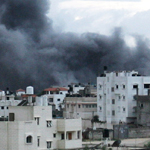
IMGXYZ1092IMGZYX The continuing violence in Gaza between Israel and Hamas is reverberating across the entire region, generating increased scrutiny on the Egyptian government’s role in the crisis, and opening new opportunities for mediation by moderate states like Turkey. Carnegie experts in the Middle East and DC explain the various regional perspectives on the conflict, its current impact on neighboring nations, and its possible outcome.
Key Points:
- Hamas has not rejected a newly brokered, mediated ceasefire and would likely accept one. Unlike the 2006 war between Israel and Hizbollah, which left Hizbollah with greater political power, Hamas is unlikely to strengthen its influence as a result of the violence.
- The Egyptian government, along with some others in the region, sees Hamas control of Gaza as a national security problem. By closing its border crossings with Gaza, it is weathering a campaign of Arab media and public outrage and accusations that it is complicit in Israeli actions.
- By talking with Israel and sending its prime minister to Syria for negotiations with Hamas, Turkey will have more influence when the time comes to mediate and ultimately shape the outcome of the conflict.
- The Israelis have not set Hamas’ destruction as an immediate objective of military action, which makes it easier for them to declare victory, even if—as is likely—Hamas retains power in Gaza.
- Hizbollah has not threatened any action; it appears Lebanon will remain out of the conflict.
Carnegie does not take institutional positions on public policy issues; the views represented herein are those of the author(s) and do not necessarily reflect the views of Carnegie, its staff, or its trustees.
Event Speakers
Paul Salem
Senior Fellow at the Middle East Institute
Paul Salem is a senior fellow at the Middle East Institute.
Marina Ottaway
Former Senior Associate, Middle East Program
Before joining the Endowment, Ottaway carried out research in Africa and in the Middle East for many years and taught at the University of Addis Ababa, the University of Zambia, the American University in Cairo, and the University of the Witwatersrand in South Africa.
Amr Hamzawy
Director, Middle East Program

Amr Hamzawy is a senior fellow and the director of the Carnegie Middle East Program. His research and writings focus on governance in the Middle East and North Africa, social vulnerability, and the different roles of governments and civil societies in the region.
Nathan J. Brown
Nonresident Senior Fellow, Middle East Program

Nathan J. Brown, a professor of political science and international affairs at George Washington University, is a distinguished scholar and author of nine books on Arab politics and governance, as well as editor of five books.