Q&A
Aaron David Miller, Karim Sadjadpour, Robin Wright
Source: Getty
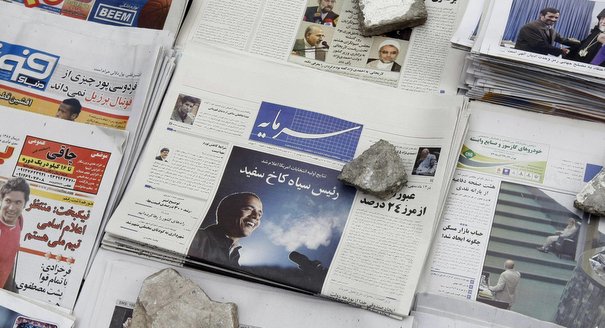
President Obama reached out to the Iranian people and leadership on Friday in a recorded video message on the New Year holiday of Nowruz. Karim Sadjadpour discusses President Obama's Nowruz overture to Iranians, its likely reception, and next steps for U.S. policy makers.
President Obama reached out to the Iranian people and leadership on Friday in a recorded video message on the New Year holiday of Nowruz. In a new Q&A written from Dubai, Carnegie’s Karim Sadjadpour discusses the president’s overture, its likely reception among Iranians, and next steps for U.S. policy makers.
Why did President Obama choose this occasion for his video message to Iran?
It’s very thoughtful timing. In acknowledging Nowruz, President Obama showed the Iranian people that he has an appreciation for their culture and history. In Dubai, the reaction among the huge Iranian expat community has been overwhelmingly and universally positive.
Was there anything about the tone and language of Obama’s remarks that struck you as particularly significant or deliberate?
Obama made it clear to Tehran’s leadership that his administration is committed to diplomacy, and is genuinely interested in overcoming the tremendous mistrust that has developed over the last three decades. He mentioned the word “respect” several times, which is what Iran’s leaders always claim U.S. policy has lacked.
How would you rate Obama’s foreign policy toward Iran thus far?
It’s only been a couple months, but thus far I think the Obama administration’s approach to Iran has been more informed and nuanced than that of any U.S. administration in the last 30 years. Obama has been respectful without projecting weakness, which is always a difficult feat to achieve.
What can we expect Obama’s effort to accomplish?
Ultimately it takes two to tango, and at the moment, hardliners in Tehran who are not interested in having an amicable relationship with the United States have an inordinate amount of influence.
Rather than strengthen these hardliners, Obama’s overtures will put pressure on them to justify their often gratuitous enmity toward the United States. Most Iranians recognize that, in 2009, the “death to America” culture of 1979 is obsolete—it only prevents the country from fulfilling its enormous potential.
Whereas the Bush administration united Iran’s disparate political actors against a common external threat, the Obama administration, I believe, is going to deepen the divisions and incongruities among Iran’s political elites.
How should the Obama administration focus its efforts in Iran?
The administration should attempt to discern which Iranian policies are driven by immutable revolutionary ideology, and which are merely a reaction to punitive U.S. measures.
The United States should continue to focus on Supreme Leader Ayatollah Khamenei, whose authority is far greater than that of President Mahmoud Ahmadinejad. All of the most influential institutions in Iran—the Revolutionary Guards, the Guardian Council, the presidency, and the parliament—are led by individuals who were either appointed by Khamenei or remain unfailingly loyal to him.
Is the nuclear issue the biggest cause of tensions between the United States and Iran?
The nuclear issue is the trickiest of all, but it is only a symptom of greater mistrust between the United States and Iran, not the underlying cause of it. The United States must sustain an airtight multilateral approach on the issue, maintaining clear redlines and ensuring that the international community will respond if Iran crosses them.
Is there a consensus in Iran about re-establishing relations with the United States?
U.S. policy makers must recognize that certain Iranian elites, and others among the country’s allies in the region do not want to see a rapprochement between Iran and the United States, because that would diminish their influence and open them up to new kinds of competition. A small group of spoilers will likely attempt to subvert serious dialogues, perhaps by jailing Iranian-Americans on trumped-up charges, or sending new, large and conspicuous weapons shipments to Hamas or Hizbollah. But if the United States ends its confidence-building efforts in retaliation, it will strengthen the influence of hardliners seeking to derail an eventual reconciliation.
How should the Obama administration craft its rhetorical approach to Iran?
Hostile American rhetoric allows the Iranian leadership to portray the United States as an aggressor, and Obama’s remarks were very carefully crafted to play down that perception. But Obama should also be mindful of who he talks to, and when.
Notwithstanding private, introductory discussions, as well as ambassadorial-level meetings in Kabul and Baghdad, the United States should refrain from making any grand overtures to Tehran that could redeem Mahmoud Ahmadinejad’s leadership style and increase his popularity ahead of the country’s June 2009 presidential elections. Since assuming office in August 2005, Ahmadinejad has used his influence to amplify objectionable Iranian foreign practices while curtailing domestic political and social freedoms and flagrantly disregarding human rights. His continued presence could serve as an insurmountable obstacle to confidence building with the United States.
Even if confidence building doesn’t succeed, the Obama administration’s diplomatic approach can help the Iranian people recognize that their own leadership is the impediment to improved relations, not the United States.
How will the Iranian regime respond internally to Obama’s overture?
With Obama having clearly expressed his support for reconciliation with Iran, this becomes an internal Iranian battle, and unfortunately, it won’t be resolved anytime soon. But Obama shows in this video that instead of tipping the scales in favor of the radicals, as the Bush administration did, he will pursue diplomacy to undermine their narrative that a hostile U.S. government is bent on oppressing Iran.

Senior Fellow, Middle East Program
Karim Sadjadpour is a senior fellow at the Carnegie Endowment for International Peace, where he focuses on Iran and U.S. foreign policy toward the Middle East.
Recent Work


Aaron David Miller, Karim Sadjadpour, Robin Wright
Aaron David Miller, David Petraeus, Karim Sadjadpour
Carnegie does not take institutional positions on public policy issues; the views represented herein are those of the author(s) and do not necessarily reflect the views of Carnegie, its staff, or its trustees.
As the war between the United States, Israel, and Iran continues, Carnegie scholars contribute cutting-edge analysis on the events of the war and their wide-reaching implications. From the impact on Iran and its immediate neighbors to the responses from Gulf states to fuel and fertilizer shortages caused by the effective shutdown of the Strait of Hormuz, the war is reshaping Middle East alliances and creating shockwaves around the world. Carnegie experts analyze it all.
The return of war as the organizing factor in Middle Eastern politics has predictable consequences: governments are prioritizing regime stability and becoming averse to political and social reform.


Sarah Yerkes, Amr Hamzawy
Central Asia’s digital ambitions are achievable, but only if policy is aligned with the region’s physical constraints.

Aruzhan Meirkhanova
Donald Trump has repeatedly bashed NATO and European allies, threatening to annex Canada and Greenland and deploring their lack of enthusiasm for his war of choice in Iran. Is this latest round of abuse the final straw?

Rym Momtaz, ed.
The future looks bleak for independent media worldwide, but there is a robust infrastructure of knowledge, organizations, and people to build upon.


Daniel Sabet, Susan Abbott