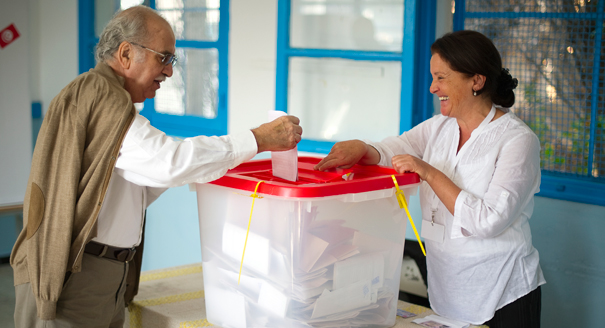
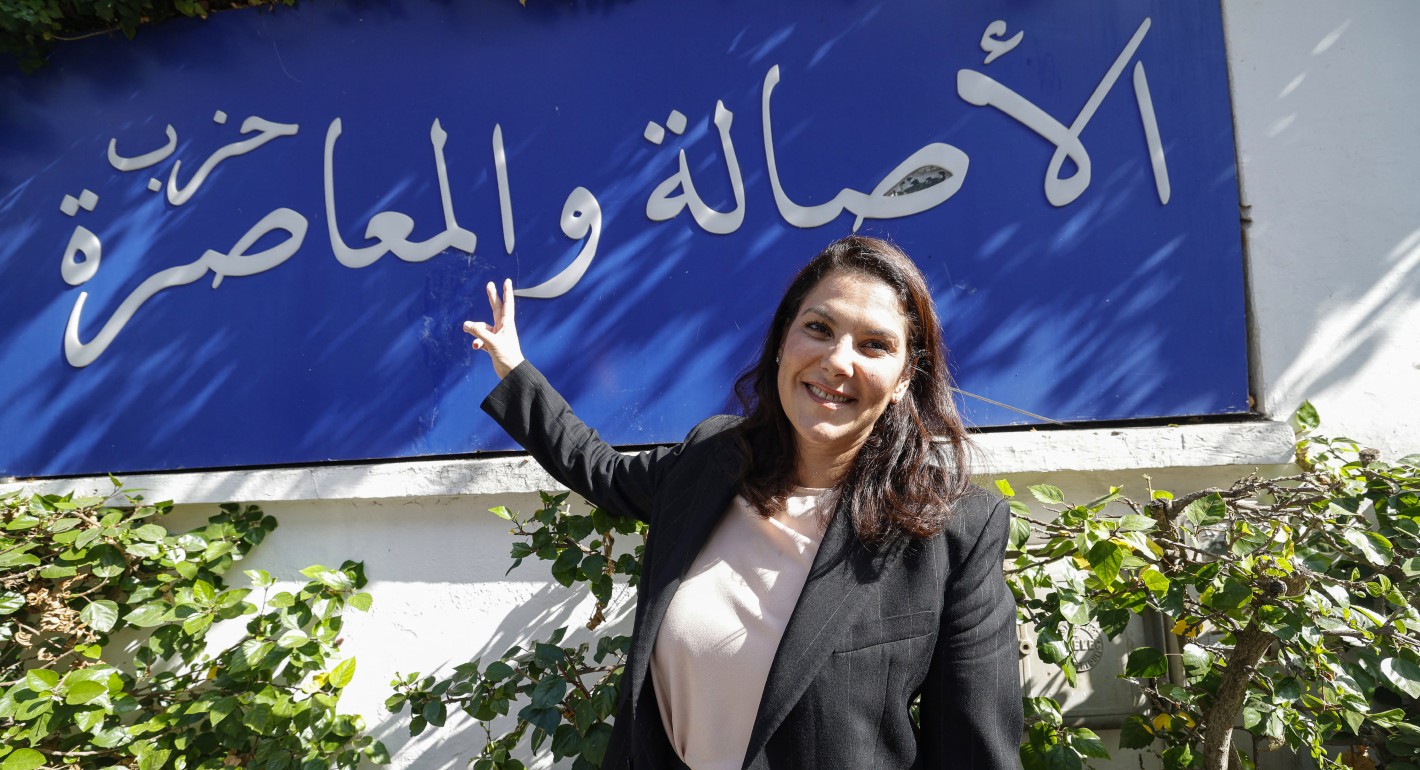
Tunisia democracy Arab SpringOne year after the start of the uprising that brought down President Zine al-Abidine Ben Ali along with his family and close associates, Tunisia is in the middle of a more promising process of transition than any other country so far. There is evidence that the outcome may be democracy: a combination of a military that kept firmly out of politics, good management of the potentially explosive period between the overthrow of Ben Ali and the installation of an elected government, and good political judgment on the part of major political parties. Ennahda, the Islamist party that gained 37 percent of the vote in the October 23 elections, is demonstrating an impressive level of political acumen, somewhat surprising for a long-banned party whose leaders spent years in detention or exile.
To be sure, it is still early days in Tunisia in the development and consolidation of a democratic political system. A lot could still go wrong, and although the initial situation did not look promising, a lot has been going right so far.
Tunisia has already overcome many obstacles: an old regime that initially tried to perpetuate its hold on power even after the ouster of President Ben Ali; later, the attempt by a small liberal elite, which had not been aligned with Ben Ali or at the forefront of the fight against him, to dominate the transition process and the constitution writing; and the parallel attempt by an equally unrepresentative self-proclaimed committee to safeguard the revolution to impose its views in the name of revolutionary legitimacy. The solution engineered with the support of the interim prime minister was the merger of experts and revolutionaries in a much broader High Council for the Realization of the Goals of the Revolution, Political Reforms, and Democratic Transition, which included major political parties and civil-society organizations. Inevitably, the commission experienced hiccups and recriminations, threatened resignations and mutual accusations; nevertheless, it did what was needed to get to the elections, even surviving the controversial decision to postpone elections from July to October when it became logistically impossible to meet the earlier date. It was not all love and harmony, but the council struggled through.
The success of the October 23 elections was reinforced by one-year term limits for the constituent assembly, with parliamentary elections to be held once the new constitution is promulgated. The choice of a short-lived assembly was the answer to the chicken-and-egg dilemma that confronts all countries in transition—should a constitution be written before new elections take place, or should elections come first, with the constitution written by an elected body? Tunisia chose a compromise solution: election first, but for a constituent assembly with a one year-mandate. This has relieved to some extent the fear of a tyranny of the majority if an elected body writes the constitution. The majority parties will face voters again before long, and an attempt to impose a constitution with no broad consensus could bring swift retribution by the voters.
Tunisia also faced anxiety from secular forces about Ennahda. The previously banned Islamic party immediately emerged as a strong, well-organized contender, with a parallel fear by Ennahda about the “Left,” the secular parties that were trying to demonize and isolate the Islamists. With anxiety on both sides high because nobody knew what to expect in a free election, the situation could easily have degenerated into open conflict. Tensions remain high today, but real incidents have been few and limited, although rumors abound.
The election results, with 37 percent of the vote going to Ennahda, caused consternation in the ranks of secular parties, because support for the Islamists was greater than expected. By and large, however, the secular parties proved to be good losers—the most extreme anti-Islamist statements came not from political parties but from secular women’s organizations that accused Ennahda of intending to abrogate Tunisia’s liberal personal-status laws, although no evidence suggested that this was the case. Secular parties had little choice but to be good losers, in fact. With the military out of politics, secularists had to learn to live with the Islamists; by contrast in Egypt, secular parties are faced with an even larger election victory by the Islamists, but they still hope that the military will intervene to limit the power of the elected parliament and enhance that of nonelected secular organizations.
Ennahda’s policy also helped. Not only did the party send reassuring messages that it would not seek to dominate the country and that it wanted to share power with secular parties, it also acted accordingly. It brought the two most successful secular parties, the Congress for the Republic (CPR) and Ettakatol, into an alliance that controlled 138 out of the 217 seats in the Constituent Assembly. It gave Ettakatol, the CPR and independents control over almost half the ministerial positions, although the CPR only brought twenty-nine constituent assembly seats to the coalition and Ettakatol twenty, while Ennahda brought eighty-nine.
In another attempt to reassure Tunisians that it did not intend to rule single-handedly, Ennhada left the Central Bank in the hands of a World Bank technocrat appointed shortly after the overthrow of Ben Ali. In the distribution of ministries, Ennahda kept control of some major ones such as Interior, Justice and Foreign Affairs but not of Finance or Defense. And in a clear attempt to assuage fears that it intended to limit the rights of women, it chose not to control the Ministry of Women and Family Affairs, which went to the CPR instead.
There are important lessons in the positive trajectory of the Tunisian transition, which seems to be moving toward pluralism and power sharing under conditions that are far from ideal. The first is that conditions do not determine the outcome. We should take it as axiomatic that political transitions always take place under unfavorable conditions, particularly following an upheaval. There are always winners and losers in a transition and exaggerated hopes and fears on all sides—because nobody knows what to expect. In an abstract sense, it may be that if a transition leads to democracy everybody is a winner; but in the short run, a transition is not going to feel like a victory to the members of the old regime or be celebrated by those who discovered that in a free election they have no support.
Economic conditions are also difficult in the aftermath of an upheaval, and social cleavages are always deep. The difference between transitions that remain mired in long-term strife and instability and those that progress toward a new order is the management of inevitable problems—in other words, good politics. Tunisia has so far been successful through a political process that entails give-and-take and compromises. It is not riding toward a bright dawn of democratic bliss. But, thanks to the political acumen demonstrated by major players, so far it muddles through.
Before joining the Endowment, Ottaway carried out research in Africa and in the Middle East for many years and taught at the University of Addis Ababa, the University of Zambia, the American University in Cairo, and the University of the Witwatersrand in South Africa.
Carnegie does not take institutional positions on public policy issues; the views represented herein are those of the author(s) and do not necessarily reflect the views of Carnegie, its staff, or its trustees.
More Work from Carnegie Endowment for International Peace
Putin’s conservative staffing policies and search for ever greater control have cemented parliament’s transformation into a bureaucratic appendage of the executive branch.
Ex-president Gurbanguly Berdimuhamedov remains interested in politics, but his son Serdar, Turkmenistan’s current president, is becoming increasingly independent and willing to break with his father’s legacy. If their covert rivalry goes too far, both risk losing power.
A notable degree of participative democracy has firmly arrived in Europe. But to have more far-reaching impact, democratic deliberation needs to move into a radically new phase.
Sergei Kiriyenko used Russia’s parliamentary vote to further hone his strategy of corporate mobilization that is designed to maximize votes for United Russia.