

Paper
Douglas H. Paal
Source: Getty
The Obama administration now faces awkward choices about how to respond to North Korea's flouting of the United Nations resolution and the negotiating record of the February 29 agreement.
When I wrote last time praising the policy firmness that led to the February 29 announcement of resumed U.S. nutritional aid to North Korea (in exchange for the return of international inspectors to the Yongbyon nuclear facilities and the North’s reaffirmation of the September 17, 2005 declaration on denuclearization, among other assurances), I did not know there was evidence that Pyongyang was planning a satellite launch in violation of UN Security Council Resolution 1874. The U.S. government did have such indications, and its negotiators explicitly warned the North’s counterparts that a launch would jeopardize the food aid and the agreement. The U.S. participants swear the North’s negotiators agreed orally.
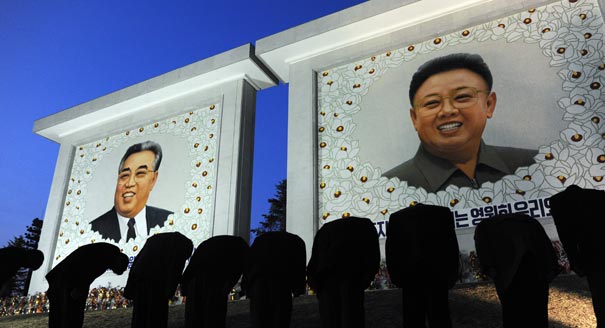
This week the North is celebrating the one hundredth anniversary of the birth of the founder of the Democratic People’s Republic of Korea, Kim Il Sung. There will be many activities and meetings, and more ominously, a satellite launch that certainly masks an effort to develop long-range ballistic missiles to support the North’s growing nuclear weapons program. The launch presumably also will help to burnish the image at home of the young successor now presiding over the North, Kim Jung Un, and divert attention from the shortages and failings of the regime to deliver a livelihood to the North Korean people. Warnings from the United States and China have been to no avail and Pyongyang has invited a horde of international visitors and media to observe the launch.
Borrowing from a very familiar playbook, Pyongyang has reacted to the voices calling for cancellation of the launch and warning of dire consequences by threatening dire consequences of its own through various outlets portending a third nuclear test. Some experts suspect the North’s nuclear specialists will be eager to test a new weapon built with highly enriched uranium, unlike the previous two tests of plutonium fuelled weapons. Pyongyang publicly revealed its long suspected highly enriched uranium program to visiting scientists a year and a half ago, in what this and other observers believed to be a move to open a new bargaining ploy for outside assistance.Nuclear and missile tests have a way, moreover, of adding value to the North’s deterrence capabilities while advertising its wares to potential proliferators with cash.
The Obama administration now faces awkward choices about how to respond to the North’s flouting of the UN resolution and the negotiating record of the February 29 agreement. On one hand, it can choose from a variety of means to ratchet up pressure on the North. It seems there is unanimity in the international community, including the North’s best friend, China, that there should at least be a reaction in the form of a statement from the president of the Security Council after the launch. Such statements are feckless at further isolating an already isolated regime, but diplomats are reluctant to proceed to new sanctions because they fear, frustratingly enough, that they have to reserve any sanctions option to respond to the anticipated nuclear test. Moreover, the scope for new sanctions is narrow, and enforcement of past sanctions has been undermined by Chinese aid and investments in the North.
Early on, the Obama administration indicated its preference that China be the principal party to extract cooperation from North Korea. Chinese diplomats and media did increase their signs of worry about the North’s intentions, at least to reduce the public relations costs of association with Pyongyang. But there is no sign yet that China will exercise its considerable leverage, for example, in halting shipments of certain categories of goods the North needs to get compliance. The widespread suspicion is that China has a bigger stake in keeping the North’s regime stable through a sensitive transition period to a new leader than in pressing for specific policy outcomes.
U.S. and South Korean leaders can also select from alternatives of a military nature, including more numerous, more sensitive, and larger joint exercises and forward deployment of air and naval capabilities from the United States. China will not like this, either. Moreover, this is risky in a year of presidential elections in both South Korea and the United States, especially if escalation ensues.
It is riskier, still, because of strong opinion among some of the advisors of President Lee Myung-bak that the South should respond directly and militarily to a third nuclear test, after the serious provocations of 2010, when a South Korean corvette was sunk and an island population shelled by the North. Obama officials will not relish having simultaneously to appear tough to the North and to restrain allies in the South.
On the other hand, some argue that beyond making pro forma statements condemning the “satellite launch” or a nuclear test, the United States and the other parties to the six party talks (South Korea, Japan, Russia, and China) should swallow hard and take what they can get from the North in the form of a return of International Atomic Energy Agency inspectors to the Yongbyon facilities. Some argue that any achievable limits on the North’s capabilities are better than leaving it to its own devices.
A few long-time observers go farther and argue for a kind of Marshall Plan for North Korea, embracing the regime with openness and assistance in order to undermine it from within. Needless to say, after two previous failed agreements offering aid in exchange for nuclear capabilities, together with the failure of the South’s ten years of so-called “Sunshine Policy,” this will be a hard sell.
When President Obama gave his nod to the February 29 announcement of a new agreement, he probably did not anticipate he would end up with these lousy options in a year when he would presumably prefer to focus on re-election. One can imagine him wondering why his negotiators failed either to get a written version of what their counterparts promised orally in terms of no missile launches, or to postpone concluding the agreement to see whether the missile would be launched. This seems to have been a strategic error that has left the administration with an unpalatable choice of denouncing or only partially enforcing an agreement it recently hailed.
This kind of policy dilemma could easily be foreseen in the record of past agreements with the North. The senior diplomats and leaders there are masters of interpreting or breaking agreements to their advantage with decades of experience doing so. The Americans were newcomers to North Korea, although they were back stopped by experts on the subject.
Much analytical attention is focused on why the North behaved in such a contradictory fashion. Some speculate that leader Kim Jung Un and his closest advisors deliberately gave conflicting instructions to their diplomats and military so as to have Kim’s cake and eat it, too. This is consistent with the regime’s top-down authoritarian nature and underdeveloped inter-agency and bottom-up feedback systems. This could be compounded by Kim’s immaturity and lack of experience. Certainly, the young leader shows every intention to bask at home in the glow of a successful launch (and maybe a nuclear test) even as he wishes he could get food aid to make his people a little happier on the anniversary.
Another rationalization is that military and diplomatic counsels to the young leader were divided. Kim Jung Un has recently promoted officers almost exclusively from the nuclear and missile programs, according to a recent survey, and he may see them as key to his authority. Diplomats don’t seem to count so much. An unusual statement by a spokesman for the nation’s military commission showed a gap with the foreign affairs establishment on this subject, feeding the speculation.
Whether these alternative lines of analysis or another is ultimately shown to be correct, it appears all the more necessary to consider carefully what a government agrees to with North Korea. More importantly, it is necessary to nail down the meaning in clear and unambiguous terms. While still secretary of defense Robert Gates said some wise things, one of which was about “not buying a dead horse for the third time.” Moreover, while it is impossible to deal with North Korea without factoring in China, it is unwise to depend on Beijing for material results.

Distinguished Fellow, Asia Program
Paal previously served as vice chairman of JPMorgan Chase International and as unofficial U.S. representative to Taiwan as director of the American Institute in Taiwan.
Recent Work
Douglas H. Paal


Douglas H. Paal, Tong Zhao, Chen Qi, …
Carnegie does not take institutional positions on public policy issues; the views represented herein are those of the author(s) and do not necessarily reflect the views of Carnegie, its staff, or its trustees.

Chinese biotech companies have been on the receiving end of U.S. economic coercion. Yet their responses have differed significantly because firm and state interests are not uniformly aligned. For Washington, treating all Chinese tech firms the same, irrespective of their actual interests, risks pushing them farther into Beijing’s corner.

Xue Gong

But their "principal to principal" model will only be as effective as the political strength of each leader back home.

Damien Ma

U.S. unpredictability has allowed China to capitalize on its positioning as the “responsible great power”. Paradoxically, the more China wins the perception game, the more likely expectations will rise for Beijing to deliver not just words but to demonstrate with its deeds.

Chong Ja Ian

Hanoi and Beijing have long treated each other as distant cousins rather than comrades in arms. That might be changing as both sides draw closer to hedge against uncertainty and America’s erratic behavior.

Nguyễn Khắc Giang

Across Asia, China is better positioned to withstand energy shocks from the fallout of the Iran war. Its abundant coal capacity can ensure stability in the near term. Yet at the same time, the country’s energy transition away from coal will make it even less vulnerable during the next shock.
Damien Ma