

Paper
Christopher S. Chivvis, Rohan Mukherjee, Milan Vaishnav
Source: Getty
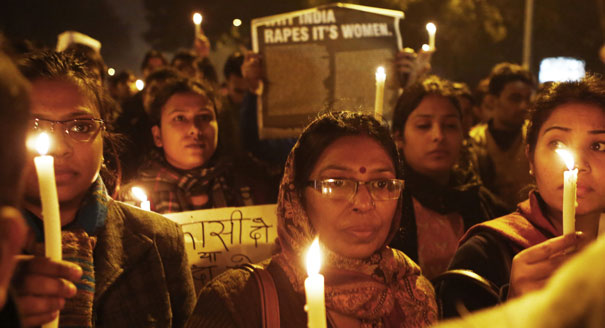
The Indian government’s response to the recent much-publicized gang rape case will be measured by its ability to deliver justice for millions of Indian women not in the headlines.
The death of a young female student, after she suffered a vicious gang rape on a public bus in Delhi, ushered in an unceremonious end to India’s 2012. The New Year in the world’s largest democracy will be marked not with a bang but with a whimper.
This heart-wrenching incident in the nation’s capital has shocked the conscience of Indians and non-Indians alike, and it comes at the tail end of what could charitably be described as a trying year—one that has rendered even the most loquacious of India-boosters at a loss for words. In 2012, India saw revelations of staggering grand corruption, a confidence-decimating blackout that left hundreds of millions without power, and the disappointing reality of a hobbled economy that appears to have lost the dynamism it displayed during the heady 2000s.
The cruel gang rape of “India’s daughter”—and the many other instances of violence against women, some that are reported and many sadly that are not—are blemishes on Indian society.When it comes to the reasons for the injustices women face in India, there is plenty of blame to go around. Many have rightly pointed to a host of cultural factors that underlie the lamentable status of India’s women. They range from a skewed male-to-female ratio thanks to sex-selective abortion and female infanticide to patriarchal norms that result in women's low status in society to the social stigmas attached to victims of rape or abuse—just to name a few.
Not to be ignored, though, are the deep-seated institutional shortcomings of the Indian state.
Over the past two decades, India has witnessed three great transformations in economics, politics, and foreign policy. These have, in many ways, been good news for the country’s women.
Economically, India has shed some of its socialist tendencies and opened its markets. The benefits from education have increased, changing the incentives of families to enroll young girls in school.
Politically, an era of one-party dominance and centralized power has given way to an age of coalition politics and more decentralized governance. The emergence of local institutions of self-governance, and the reservation of elected positions for women, have increased women’s role in the country’s political life.
In its relations with the outside world, India has shunned autarky and embraced globalization. Today, there are unprecedented opportunities for young Indian women to join the labor force in cutting-edge sectors of the economy.
But despite these strides, India’s institutions have not undergone an equivalent transformation. For instance, the courts are hopelessly overburdened and pocked with vacancies while the criminal justice system appears badly broken. A young Punjabi woman committed suicide after police refused to register her complaint of being gang-raped and instead opted to broker a “compromise” between the accused and the victim’s family.
India’s institutional shortcomings are a problem for all of India’s citizens, not just its women. But, due to the unique confluence of institutional weakness and cultural bias, women are particularly disadvantaged.
As the year ends, Indians from Ajmer to Zahirabad are wondering whether there is any prospect for change on the horizon. There are perhaps reasons to be optimistic. For the second time in as many years, on the heels of injustice, thousands of protesters occupied the streets of Delhi, demanding a more accountable, responsive government.
In 2011, Indians took to the streets—in the wake of a series of high-profile corruption scandals—to support the antigraft fighter and Gandhian social activist Anna Hazare in his push to win parliamentary support to create a Lokpal, or anticorruption ombudsman. This week, protesters were out in force demanding that the government take steps to make India safer for its women—both in its private and public spaces.
Ultimately, “Team Anna’s” maneuver failed, but the protesters gathering at Jantar Mantar in Delhi could learn a few lessons from Anna’s failure.
First, the anticorruption protesters of 2011 obsessively focused on the creation of a Lokpal—treating it almost as if it were a panacea for India’s corruption travails. Today’s protesters seeking a better future for India’s women need not shy away from specifics, but they need to adopt a broad-based assault on India’s institutions. There is no single institutional fix that could have addressed all the ills the Delhi gang rape exposed.
Second, Hazare’s anticorruption movement struggled to connect with the rural grassroots; it instead thrived on a largely urban, middle-class base of supporters who have traditionally been politically diffident. It appears that the vanguard of the most recent outpouring also hail from India’s urban middle class. But if a shift in culture is what is needed to help improve the lot of women, at least in part, then reformers will have to take their campaign on the road—educating citizens in rural as well as urban India about today’s realities and sensitizing them to those truths.
Finally, the modus operandi of last year’s anticorruption protests was to demonize politics and politicians. But producing institutional change is an inherently political process. Pressure from the outside is valuable, but the protesters on the streets today—if they are serious about change—need to be visiting legislators tomorrow. What made last summer’s obsession with a Lokpal so unhelpful was activists’ lack of attention to the many other legislative reforms that could help reduce corruption, like the judicial accountability bill or a proposed law that would protect whistleblowers from retribution.
“She died, but she woke us up,” a young protester told the Washington Post when asked about the impact of the young rape victim’s tragic death. As a new year begins, the extent of India’s “awakening” will be determined not simply by the government’s ability to deliver justice to a family that has experienced unimaginable loss but by the government’s willingness to deliver justice for millions of Indian women not in the headlines.

Director and Senior Fellow, South Asia Program
Milan Vaishnav is a senior fellow and director of the South Asia Program and the host of the Grand Tamasha podcast at the Carnegie Endowment for International Peace. His primary research focus is the political economy of India, and he examines issues such as corruption and governance, state capacity, federalism, and electoral behavior. He also conducts research on the Indian diaspora.
Recent Work


Christopher S. Chivvis, Rohan Mukherjee, Milan Vaishnav



Sophia Besch, Eric Ciaramella, Steve Feldstein, …
Carnegie does not take institutional positions on public policy issues; the views represented herein are those of the author(s) and do not necessarily reflect the views of Carnegie, its staff, or its trustees.

If the Russian-speaking community in Latvia cannot articulate their interests without being seen as disloyal, they could end up embracing a pro-Kremlin agenda.

Sergejs Potapkins

Russia’s ruling party would have benefited from Putin appearing as its distant patron, but as an active frontman imposing his views on the public, he has done nothing but harm both the party’s election campaign and the ruling system overall.

Andrey Pertsev

Despite myriad challenges and occasional stumbles, the new Hungarian government is moving ahead with energy and conviction to uproot years of illiberalism and corruption and rebuild Hungarian democracy.

Thomas Carothers

Radical-right parties are expected to do well in upcoming elections in four of the EU's biggest member states. If successful, they could prevent the union from addressing key challenges ahead.

Stefan Lehne

By abandoning past U.S. pro-democracy policies and adopting several lines of pro-autocratic action, the Trump administration has fundamentally repositioned the United States vis-à-vis democracy in the world.
Thomas Carothers