

Paper
A new Carnegie survey of Indian Americans examines shifting vote preferences, growing political ambivalence, and rising concerns about discrimination amid U.S. policy changes and geopolitical uncertainty.
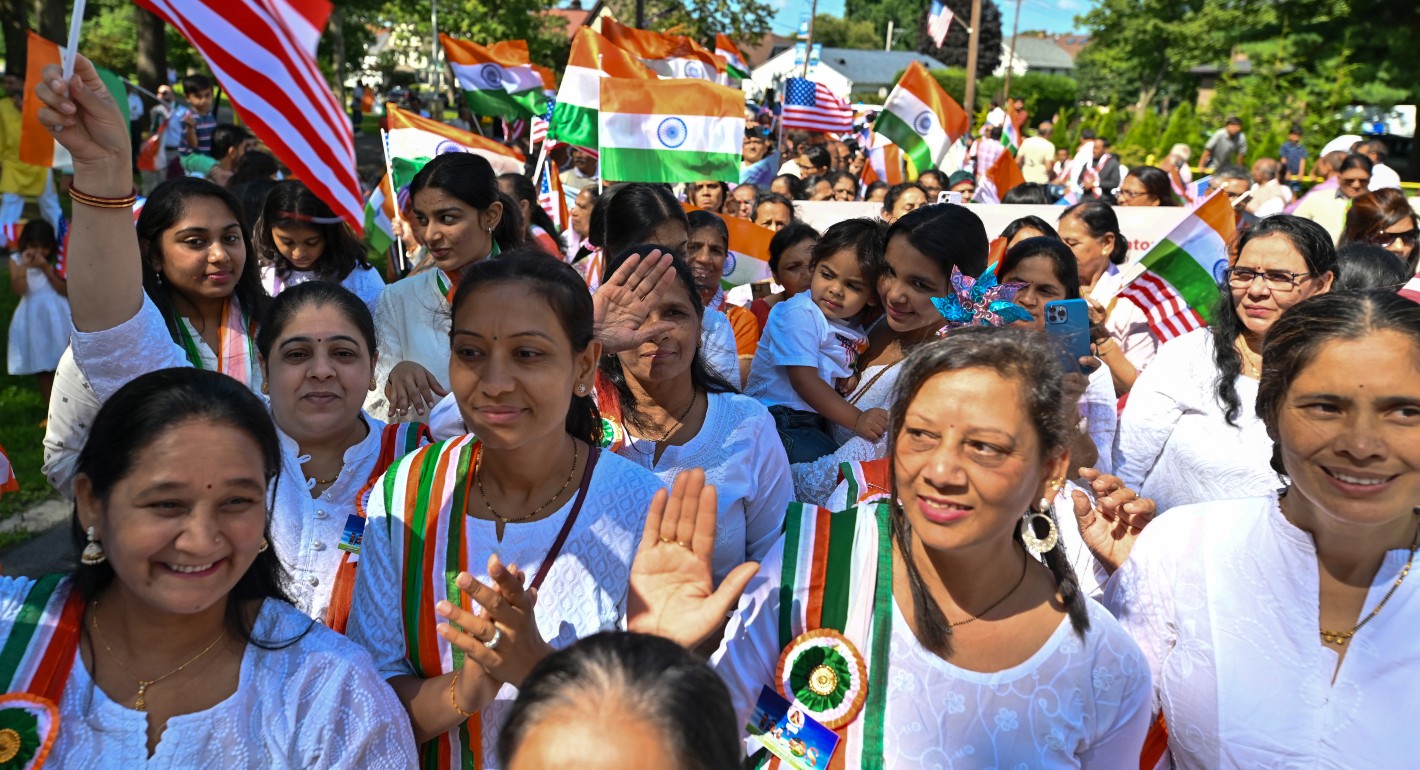
Indian Independence Day is celebrated in Scranton with a parade of revelers waving American and Indian flags. (Photo by Aimee Dilger/SOPA Images/LightRocket via Getty Images)
The 2024 Republican gains among this important constituency have not held.
Questions about Indian Americans’ place in American society have become an unexpected flash point ahead of the U.S. midterm elections. Indian Americans, who number fewer than 6 million and account for roughly 1.5 percent of the U.S. population, were thrust into the limelight when a Republican candidate for Texas state office posted a photo of University of Texas (UT) students visibly of South Asian origin celebrating the school’s football team. “I heard UT graduation this year looked like this. I didn’t believe it,” the candidate, Bo French, wrote.
That post ignited a debate about national identity and belonging that has arrived at a crucial political moment for Indian Americans. Since at least the mid-2000s, surveys have shown Indian Americans to be among the Democratic Party’s most reliable voters. Yet that partisan advantage has narrowed in recent years. In 2020, 68 percent of Indian American citizens planned to vote for Joe Biden, while 22 percent supported Donald Trump. In 2024, 62 percent intended to vote for Kamala Harris while 30 percent backed Trump.
Then came Trump’s second term in office. By early 2026, large majorities of Indian Americans disapproved of the president’s handling of immigration, the domestic economy, international economic policy, and even U.S.-India relations, once a relative strength. But Democrats gained remarkably little from that disillusionment.
Results from a new survey conducted ahead of the midterm elections reveal a backlash against Trump and the Republican Party accompanied by a rebound in support for the Democratic Party.
The Indian American Attitudes Survey (IAAS) was conducted by Carnegie in partnership with the research firm YouGov. The October 2026 IAAS is a nationally representative online survey of 1,000 Indian American adults, fielded between October 7, 2026, and October 27, 2026, with an overall margin of error of ±3.87 percent. The survey builds on earlier IAAS waves conducted in 2020, 2024, and early 2026, and it provides a detailed portrait of Indian Americans’ partisan identities, vote preferences, policy priorities, evaluations of political leaders, and experiences with racism and discrimination.
This article focuses on Indian Americans’ political attitudes ahead of the 2026 midterm elections. Subsequent work will examine questions of race, belonging, identity, and discrimination. Given the focus on voting, many analyses here are restricted to the IAAS subsample of U.S. citizens (n=861).
A new Carnegie survey of Indian Americans examines shifting vote preferences, growing political ambivalence, and rising concerns about discrimination amid U.S. policy changes and geopolitical uncertainty.
According to the October 2026 IAAS, 62 percent of Indian American citizens intend to vote for the Democratic candidate in their congressional district, compared to just 19 percent who favor the Republican candidate (see figure 1). Another 12 percent remain undecided, while 5 percent say they do not intend to vote and 2 percent support another candidate. Democratic candidates enjoy a similarly commanding advantage in Senate races: 63 percent of respondents in states holding Senate elections support the Democratic candidate, compared to 21 percent who favor the Republican.
In 2024, 62 percent of Indian Americans supported Harris while 30 percent favored Trump (see figure 2). By January 2026, Democratic support had slipped to 57 percent, with 25 percent expressing support for Trump. The latest figures suggest that the Republican Party’s electoral gains among Indian Americans have not translated into durable support for Republican congressional candidates.
To be clear, caution is necessary when comparing across IAAS surveys because previous waves measured voters’ preferences in presidential elections, whereas the October 2026 survey measures congressional voting intentions.1 Nevertheless, the trend is notable. Democratic support has returned to its 2024 presidential level while Republican support has fallen considerably. Indeed, the resulting 43-percentage-point Democratic advantage ahead of the November 2026 midterms is substantially larger than the 32-point advantage Harris enjoyed over Trump in 2024.
How do Indian American voting intentions look compared with the larger U.S. population? To answer this, one can assess the IAAS top-line findings against those from a separate YouGov survey fielded around the same time (see table 1).
Among Indian Americans, support for the Democratic Party remains high, in relative terms. Only Black Americans are more supportive of the party, with 76 percent of respondents indicating they will vote for the Democratic congressional candidate in their district while just 12 percent say they will vote for the Republican on the ballot. Among Hispanics, Democrats enjoy only an 11-percentage-point advantage. Forty-seven percent of White voters plan to support the Republican candidate, compared to 40 percent for the Democratic one.
The turn against Republicans is most pronounced among older Indian American men, a group that had previously shown growing openness to Republican candidates.
Among men aged forty and older, support for the Republican candidate now stands at just 16 percent, compared to 32 percent who supported Trump in January 2026 (see figure 3). Over the same period, support for Democratic Party candidates increased from 53 percent to 68 percent among this age/gender group. Older Indian American men, who appeared increasingly receptive to Trump earlier in the decade, now register some of the strongest Democratic voting intentions of any demographic subgroup of Indian American citizens.
A different pattern emerges among younger men aged eighteen to thirty-nine. In 2024, 40 percent supported Trump and 53 percent favored Harris. By January 2026, Republican support had fallen to 24 percent, while Democratic support had recovered to 60 percent. Now, 64 percent of younger men favor Democratic congressional candidates, compared to 23 percent supporting Republican candidates. This suggests that the substantial Republican gains among younger Indian American men in 2024 had largely receded by January 2026.
Among women, the picture is more mixed.2 Younger women aged eighteen to thirty-nine remain strongly Democratic, with 58 percent supporting Democratic congressional candidates and 21 percent favoring Republicans. However, Democratic support is 10 percentage points lower than it was in January 2026, when 68 percent supported the Democratic presidential candidate. Among women aged forty and older, Democratic support has recovered from 50 percent in January to 58 percent in October, while Republican support has fallen from 28 to 16 percent.
Among respondents who intend to support the Democratic candidate for Congress, 65 percent report that they are motivated primarily by support for the Democratic candidate or party, while 35 percent say their vote is primarily motivated by opposition to the Republican candidate or party (see figure 4).
Among Republican supporters, the corresponding figures are considerably more lopsided: 83 percent say they are voting primarily to support the Republican candidate or party, while just 17 percent are motivated by opposition to Democrats.
This 18-percentage point asymmetry suggests that among Indian Americans, negative partisanship—the idea that citizens are more repelled by the opposing party than attached to their own party—plays a more prominent role in Democratic voting intentions than in Republican voting intentions. This finding is particularly striking in light of recent research challenging the conventional wisdom that American partisanship is predominantly negative. However, other polls also suggest that in the 2026 midterm elections, many Democratic voters are motivated against Republican candidates rather than by their own party.
Perhaps the most revealing finding of the October 2026 IAAS is that these changes in electoral preferences have occurred without any corresponding shift in partisan identification. Ahead of the 2026 midterms, 46 percent of Indian Americans identify as Democrats, 19 percent as Republicans, and 26 percent as independents (see figure 5). These figures are virtually unchanged from January 2026.
In 2020, 56 percent of respondents identified as Democrats and just 15 percent as Republicans. By 2024, Democratic identification had fallen to 47 percent, while Republican identification had risen to 21 percent. Since then, partisan attachments have seemingly stabilized.3
The contrast between stable partisan identities and changing electoral preferences is striking. While 46 percent of respondents identify as Democrats, 62 percent intend to vote for Democratic congressional candidates. Conversely, the share identifying as Republican is identical to the share intending to vote Republican, at 19 percent. This suggests that the Democratic Party’s electoral advantage among Indian Americans extends beyond its core partisan base, attracting support from respondents who do not necessarily identify with the party.
How does party identification vary based on respondents’ demographic characteristics, and how has the picture changed since 2024? Table 2 provides a breakdown based on age, education, household income, gender, religion, place of birth, year of arrival/birth in the United States, duration of stay, and U.S. region. A few findings stand out.
First, the share of respondents earning less than $50,000 per year who identify as Republicans has dropped from 18 to 14 percent in the past two years. Among “middle earners,” or those making between $50,000 and $99,000, the reverse is true: The share identifying as Republicans has modestly increased, from 19 to 23 percent. And 45 percent identify as Democrats, compared to 54 percent in 2024. Some of these differences are small and not likely to be statistically significant.
Second, women’s identification with the Democratic Party has dipped slightly from 50 to 46 percent in the last two years, while men’s partisan attachments have stayed roughly the same.
Third, there are no major changes among religious subgroups between 2024 and 2026, with one exception. In 2024, 17 percent of Indian American Muslims identified with the Republican Party. Today, that share stands at 10 percent.
Fourth, the share of foreign-born respondents and those who are more recent arrivals (defined as having spent less than twenty years in the United States) who identify as Democrats has declined since 2024. Today, forty percent of foreign-born Indian Americans identify as Democrats, compared to 45 percent in 2024. Similarly, 31 percent of recent arrivals identify as Democrats, a 6-percentage-point decline from 2024 levels.
Finally, there are some modest changes in partisan identification based on regional demographics. Democrats continue to receive the strongest support from Indian Americans based in the Northeastern and the Western states. While Democratic identification is unchanged in the Midwest, it has dropped from 43 to 39 percent in the South. On the other side, the share of Indian Americans who reside in the Midwest and identify as Republicans has dropped from 25 to 16 percent.
To explore respondents’ views on the two major national parties in a slightly different manner, the survey collected responses to a feeling thermometer, whereby respondents were asked to rate political parties or individual leaders on a scale of 0 to 100—a technique popularized by the American National Election Studies.
Ratings between 0 and 49 mean that respondents do not feel favorable (that is, they feel “cold”) toward the person or entity, a rating of 50 means that respondents are indifferent toward them, and ratings between 51 and 100 degrees mean that respondents feel favorable (or “warm”) toward them.
As of October 2026, the Democratic Party has received a rating of 58, which is higher than its January 2026 rating of 53 but slightly lower than the rating of 60 it received in 2024 (see figure 6). Notably, the rebound in the Democratic Party’s rating is largely due to Republican respondents; among this group, the Democratic Party’s rating jumped from 30 to 40 between January and October 2026.
The aggregate rating for the Republican Party is 35, roughly the same level as in January 2026. However, this is down from a 41 rating in 2024. Democrats now give the Republican Party a 22 rating, lower than 2024 levels (when it received a 28). Today, Republicans rate their own party lower (66) than they did in January 2026 (72) (see figure 6).
The results of the October 2026 IAAS suggest a few conclusions.
First, the Democratic Party has recovered ground among Indian Americans, but only partially, likely due to the pull of negative partisanship. More than one-third of Indian Americans who plan to vote for Democrats in November 2026 do so largely out of opposition to the Republican candidate. Furthermore, the degree of partisan identification among Democrats has remained largely unchanged since 2024.
Second, the Republican Party has found it difficult to sustain the gains it has made among Indian Americans in recent years. In the 2024 election, the Democratic Party’s advantage—while still sizeable—narrowed considerably as the Republican Party made new inroads in this community. The data from voting intentions in the 2026 midterm elections suggest those gains have largely been reversed.
Third, recent shifts in the voting preferences of Indian Americans suggest that, even within a community that has long backed the Democratic Party, there exists a pool of persuadable voters. While Democrats will be buoyed by the fact that support for the party has rebounded somewhat, this recovery has not led to stronger partisan attachment. The Republican Party, in turn, should consider why its recent inroads have not translated into sustained gains at the ballot box.
We are grateful to Alexander Marsolais, Clara Cullen, Alexis Essa, and their colleagues at YouGov for their help with the design and execution of the survey. This project has been reviewed and approved by the American University Institutional Review Board (Protocol #IRB-2025-32). At Carnegie, we owe special thanks to Alana Brase, Haley Clasen, and Jocelyn Soly for their editorial and design assistance on a very tight timeline. While we are grateful to all our collaborators, any errors found in this study are entirely the authors’.

Sumitra Badrinathan
Assistant Professor of Political Science, American University
Sumitra Badrinathan is an assistant professor of political science at American University’s School of International Service.

Devesh Kapur
Starr Foundation Professor, Johns Hopkins (SAIS)
Devesh Kapur is the Starr Foundation Professor of South Asian studies at the Johns Hopkins School of Advanced International Studies (SAIS). He is the author of three books on migration, including The Other One Percent: Indians in America (with Sanjoy Chakravorty and Nirvikar Singh).

Annabel Miller
James C. Gaither Junior Fellow, South Asia Program
Annabel Miller is a James C. Gaither Junior Fellow in the Carnegie South Asia Program.

Andy Robaina
Research Assistant, South Asia Program
Andy Robaina is a research assistant in the Carnegie South Asia Program.
Director and Senior Fellow, South Asia Program
Milan Vaishnav is a senior fellow and director of the South Asia Program and the host of the Grand Tamasha podcast at the Carnegie Endowment for International Peace. His primary research focus is the political economy of India, and he examines issues such as corruption and governance, state capacity, federalism, and electoral behavior. He also conducts research on the Indian diaspora.
Carnegie does not take institutional positions on public policy issues; the views represented herein are those of the author(s) and do not necessarily reflect the views of Carnegie, its staff, or its trustees.
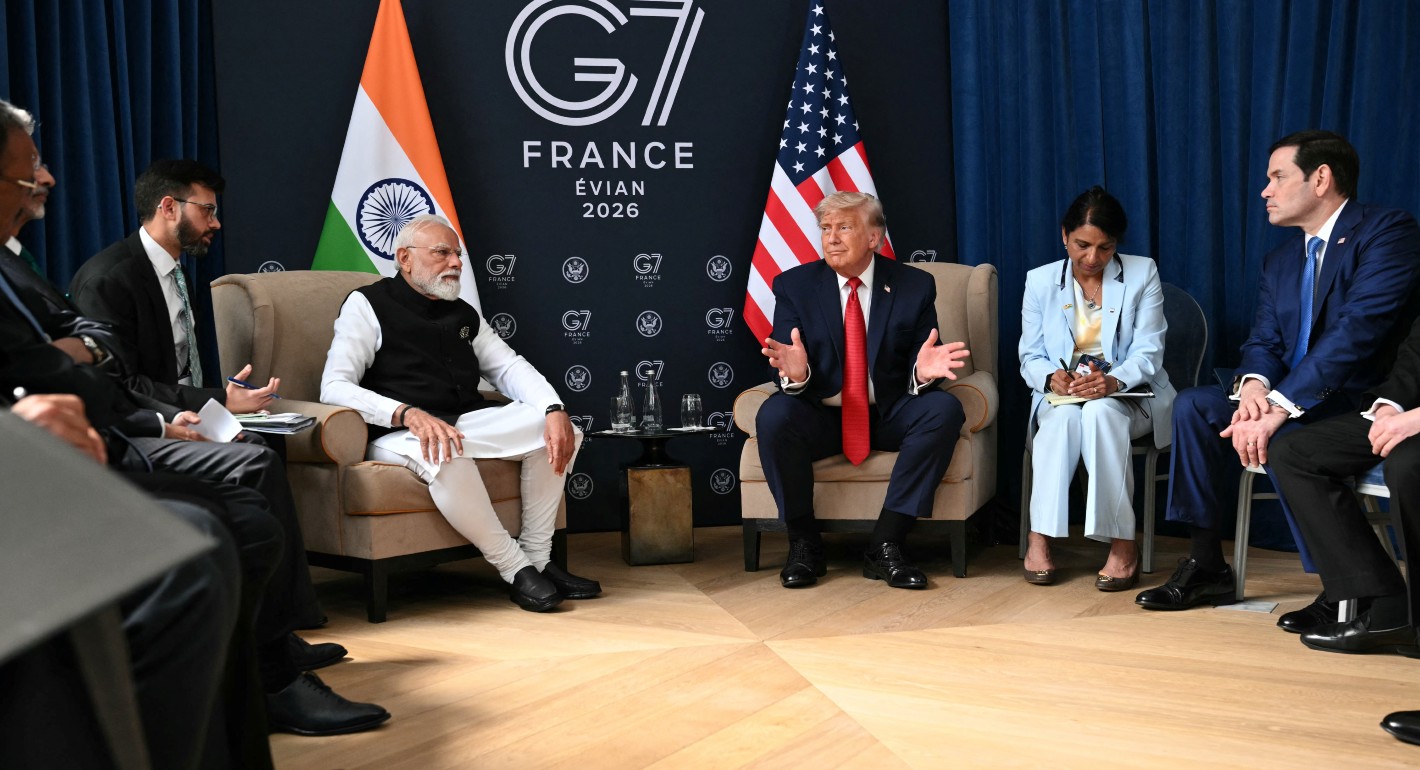
Despite public disputes over trade and immigration, the strategic partnership’s foundations remain sturdy.
Sameer Lalwani
Economic recovery has brought Sri Lanka a modicum of stability, but domestic strains and great-power rivalry could test how long it lasts.

Avinash Paliwal
There is a transnational far-right populist movement that links middle powers in a global movement that extends well beyond Trump.

Christopher S. Chivvis, Rohan Mukherjee, Milan Vaishnav
As India undergoes a demographic transition, its cities will be its economic powerhouse—but only if it accurately captures city growth and empowers cities to support their citizens.

Apoorva Jadhav
Unresolved tensions within the AfD may ultimately constrain the its potential as a leader among European and global populist forces.
Jeremy Cliffe