

Research
- +10
Rosa Balfour, Frances Z. Brown, Yasmine Farouk, …
{
  "authors": [
    "Moisés Naím"
  ],
  "type": "legacyinthemedia",
  "centerAffiliationAll": "",
  "centers": [
    "Carnegie Endowment for International Peace"
  ],
  "collections": [],
  "englishNewsletterAll": "",
  "nonEnglishNewsletterAll": "",
  "primaryCenter": "Carnegie Endowment for International Peace",
  "programAffiliation": "",
  "programs": [],
  "projects": [],
  "regions": [
    "North America"
  ],
  "topics": [
    "Political Reform",
    "Global Governance",
    "Religion"
  ]
}
Source: Getty
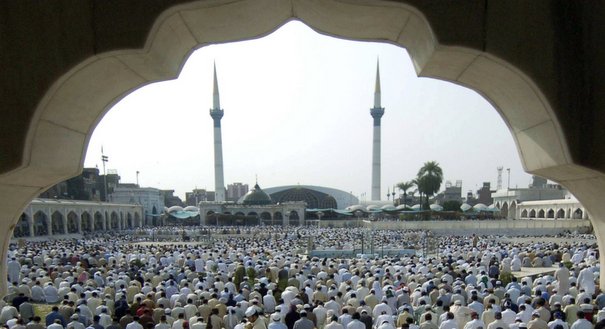
There are a number of obstacles facing major established religious institutions in today’s globalized world, where the number of smaller religious affiliations has proliferated.
Source: VOA Press Conference
Speaking to Voice of America, Carnegie's Moises Naím discussed the fascinating trends overcoming religions in today's global society. Established religious institutions, which once had strong followings in countries across the world, are losing their market share, Naím explained. For instance, the 1970 census in Brazil showed 90 percent of the population identifying as Catholic. In 2010, this figure dropped to 65 percent. The same trend is occurring in Guatemala, the Philippines, and Nigeria. On the reverse end, Naím added, some religious sectors are growing. The Pentecostal church has seen a surge, as it has been competing effectively in attracting people that come from families with traditional roots in one of the more common institutionalized religions.
Islam, like Christianity, is also seeing a revolution; it is observing hyper-fragmentation, Naím argued.. Unlike the centralized hierarchy in Catholicism, there is no central power or order that established a homogenous doctrine and rules for the religious following, Naím concluded.

Distinguished Fellow
Moisés Naím is a distinguished fellow at the Carnegie Endowment for International Peace, a best-selling author, and an internationally syndicated columnist.
Recent Work



Rosa Balfour, Frances Z. Brown, Yasmine Farouk, …
Moisés Naím
Carnegie does not take institutional positions on public policy issues; the views represented herein are those of the author(s) and do not necessarily reflect the views of Carnegie, its staff, or its trustees.

Despite long-standing differences, China and Vietnam are reinforcing common ground for collaboration, especially in public security. This internal security–centered diplomacy offers a strengthened road map for how China moves forward with Southeast Asia.
Sophie Zhuang

Climate mobility interventions can vary, but they all present opportunities to unlock transformative results that mitigate costs associated with inaction.

Alejandro Martin Rodriguez

Despite having the resources and expertise, the Russian space industry missed the opportunity to offer the United States or China a mutually rewarding partnership in the lunar race.

Georgy Trishkin

The return of war as the organizing factor in Middle Eastern politics has predictable consequences: governments are prioritizing regime stability and becoming averse to political and social reform.


Sarah Yerkes, Amr Hamzawy
Not only does the fighting jeopardize regional security, it undermines Russian attempts to promote alternatives to the Western-dominated world order.

Ruslan Suleymanov