

Paper
Renée DiResta, Rachel Kleinfeld, Margot Treadwell
{
  "authors": [
    "Rachel Kleinfeld"
  ],
  "type": "legacyinthemedia",
  "centerAffiliationAll": "dc",
  "centers": [
    "Carnegie Endowment for International Peace",
    "Carnegie Russia Eurasia Center"
  ],
  "collections": [],
  "englishNewsletterAll": "democracy",
  "nonEnglishNewsletterAll": "",
  "primaryCenter": "Carnegie Endowment for International Peace",
  "programAffiliation": "DCG",
  "programs": [
    "Democracy, Conflict, and Governance"
  ],
  "projects": [
    "Eurasia in Transition"
  ],
  "regions": [],
  "topics": [
    "Political Reform",
    "Democracy",
    "Foreign Policy"
  ]
}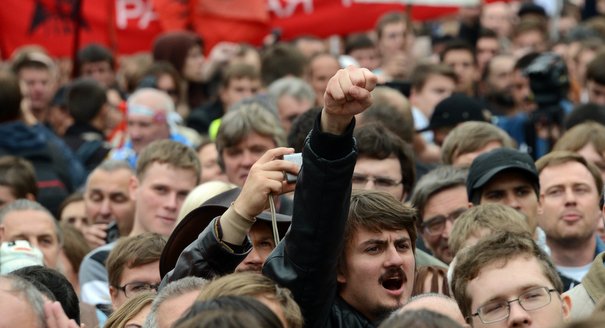
Source: Getty
It is time to recognize the security threat that corruption overseas poses to U.S. interests and begin taking it seriously at the level of high politics.
Source: Hill
What do the conviction of an activist in Russia, bribed building inspectors in Bangladesh, the Arab revolutions, and the unraveling of Afghanistan have in common? Corruption – a failure that crosses state boundaries and wreaks havoc on economic growth, human opportunity, and security. Sadly, while American politicians give lip service to the scourge of corruption, it has been consigned to the arena of low politics, for program officers and procurement officials, not top leaders.
It’s time to recognize the security threat corruption overseas poses to U.S. interests. That means taking it seriously at the level of high politics, changing bureaucratic policies to improve the ability to fight it, and ending practices in which the U.S. fuels it.Last week, Alexei Navalny, a Russian anti-corruption crusader, was convicted of (ironically) trumped-up political charges of corruption. Vladimir Putin, like many dictators, has been using corruption charges to quiet critics and bolster his power, leaving the U.S. to handle an increasingly autocratic Russia.
Last month, hundreds died in a building collapse in Bangladesh. Had building inspectors been allowed to do their jobs, the deaths could have been prevented. But Bangladeshi government corruption and collusion between garment manufacturers and politicians have allowed thousands of death-trap factories to continue to operate. Meanwhile, the U.S. human rights apparatus, based on Cold War naming and shaming to free political prisoners, is not well-suited to address corruption-based violations.
In Egypt and throughout the Middle East, America is facing the aftermath of collapsed revolutions catalyzed by anger at corruption, sparked when a Tunisian street vendor who couldn’t get a real job without connections lit himself on fire. Youth throughout the Arab world whose economic hopes were stymied by sclerotic, corrupt economies fueled those flames. The upheaval caught nearly every Middle East analyst by surprise, leaving America flat-footed in dealing with the aftermath of the biggest change to Middle East stability in a generation, one that imperils Israel, long-term security alliances, and the U.S. force posture and rebalance towards Asia.
Revolution is not the only way corruption destabilizes security strategy. General John Allen has called corruption the number one security threat in Afghanistan. By undermining citizens’ faith in their government, corruption allowed the Taliban to regain a foothold by establishing themselves as a parallel regime that could provide clean government and justice. Citizens disgusted by government corruption would not support the central government – on whose behalf the U.S. had premised its war effort. Without those “hearts and minds” supporting the government, U.S. military strategy could not work – one reason why a “zero option” for troops is now under discussion.
But guess what – a significant amount of Afghan corruption was fueled by U.S. procurement practices, in which U.S. government agencies pumped billions of dollars into Afghanistan’s economy with little oversight, while the CIA provided slush funds that enriched warlords and Karzai’s political protégés. Washington has asked its military to fight an insurgency that others in the U.S. have been fueling.
America’s security apparatus has mixed views on corruption. While program officers at USAID and the State Department Bureau of Narcotics and Law Enforcement sponsor programs abroad to fight corruption, Cabinet officials and parts of the Pentagon and intelligence community often turn a blind eye, supporting “their” corrupt politicians, or funding programs in such a way that the procurement process itself leads to corruption.
Meanwhile, America’s anti-corruption programs face bureaucratic challenges that undermine their impact. Congressional budgeting rules make U.S. programs overly technocratic and therefore unable to respond to the highly political nature of corruption. Contracting procedures force bureaucrats in Washington to guess at program needs and program them with a rigidity and specificity that is absurd and ineffective. Congress’ willingness to throw money at places like Afghanistan, matched with an unwillingness to spend funds on government officials who could track funds and make programs meaningful, mean that contractors watch contractors who watch contractors – with little accountability for programs worth billions of dollars.
The U.S. needs to get serious about how much corruption harms American interests. Congress should support aid and grant reforms that could enable our governance programs to be effective. Cabinet-level officials must stop undermining the rule of law in other countries in pursuit of shorter-term security gains.
The U.S. does not buy real security when it supports corrupt, non-democratic governments – even when it develops a close working relationship with them. Instead, it keeps one hand on the lid of a pot that is boiling over, while turning up the flame. Eventually, it will blow.

Senior Fellow, Democracy, Conflict, and Governance Program
Rachel Kleinfeld is a senior fellow in Carnegie’s Democracy, Conflict, and Governance Program, where she focuses on issues of rule of law, security, and governance in democracies experiencing polarization, violence, and other governance problems.
Recent Work
Renée DiResta, Rachel Kleinfeld, Margot Treadwell
Political Violence Researchers, Rachel Kleinfeld, ed., Dalya Berkowitz, ed.
Carnegie does not take institutional positions on public policy issues; the views represented herein are those of the author(s) and do not necessarily reflect the views of Carnegie, its staff, or its trustees.

European Commission President Ursula von der Leyen is about to give her annual address on the state of the EU. Here’s what she won’t—but should—say.

Rym Momtaz

Radical-right parties are expected to do well in upcoming elections in four of the EU's biggest member states. If successful, they could prevent the union from addressing key challenges ahead.

Stefan Lehne

The books, podcasts, and films that explain the world it made.

Andrew Leber

U.S. trading partners in Asia are closely watching the dispute for signs of how it may affect their own interests.

Barbara Weisel

The aftermath of the Ceuta crisis shows Europe has drawn the wrong lessons. Rather than doubling down on failed migration policies, the EU needs to address the underlying roots of such episodes.

Richard Youngs