

Paper
James M. Acton, Ankit Panda
{
  "authors": [
    "James M. Acton"
  ],
  "type": "legacyinthemedia",
  "centerAffiliationAll": "dc",
  "centers": [
    "Carnegie Endowment for International Peace"
  ],
  "collections": [
    "U.S. Nuclear Policy"
  ],
  "englishNewsletterAll": "ctw",
  "nonEnglishNewsletterAll": "",
  "primaryCenter": "Carnegie Endowment for International Peace",
  "programAffiliation": "NPP",
  "programs": [
    "Nuclear Policy"
  ],
  "projects": [],
  "regions": [
    "North America",
    "United States",
    "East Asia",
    "China"
  ],
  "topics": [
    "Nuclear Policy"
  ]
}
Source: Getty
It’s hard to dispute the notion that before spending billions of dollars on a new weapon, the Pentagon ought to be able to explain what it’s for. So it’s surprising how often this rule isn’t followed. Take the Advanced Hypersonic Weapon.
Source: Defense One
It’s hard to dispute the notion that before spending billions of dollars on a new weapon, the Pentagon ought to be able to explain what it’s for. So it’s surprising how often this rule isn’t followed.
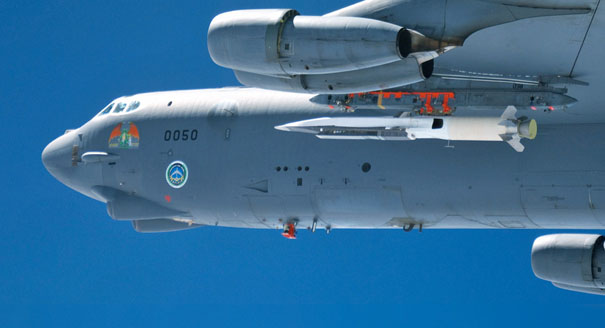
Take the Advanced Hypersonic Weapon. Just tested last month, it’s the latest candidate technology being developed for the Defense Department’s Conventional Prompt Global Strike program, an effort to develop long-range, ultra-fast, non-nuclear weapons. Following a successful test in 2011, hopes were running high ,but the booster rocket went out of control and was deliberately destroyed shortly after its launch from Alaska. If the test had gone to plan, the rocket would have released a glider that would then have flown—without power—for about 4,000 miles across the Pacific at many times the speed of sound.
Members of Congress will undoubtedly want to know about the causes of this failure and whether a do-over is warranted (which it may well be since the glider itself never got the chance to perform). But they should also be asking tough questions about how this weapon fits into broader U.S. defense strategy.
Jessica T. Mathews Chair, Co-director, Nuclear Policy Program
Acton holds the Jessica T. Mathews Chair and is co-director of the Nuclear Policy Program at the Carnegie Endowment for International Peace.
Recent Work

James M. Acton, Ankit Panda
James M. Acton
Carnegie does not take institutional positions on public policy issues; the views represented herein are those of the author(s) and do not necessarily reflect the views of Carnegie, its staff, or its trustees.

Despite its flop at the box office, the film raises important questions for the climate community to answer.

Leonardo Martinez-Diaz

In an interview, Rozina Ali discusses her new book on the rise and manifestations of Islamophobia in the United States.

Michael Young

While the EU and European governments are embracing the much-lauded middle-power moment, this entails three difficult conundrums.

Richard Youngs

Europe is facing rising populism internally as well as external pressures from Russia, China, Turkey, and the United States.

Dimitar Bechev

The acknowledgment has sparked fears of a new arms race with China and Russia.

Chris O’Meara