

Paper
James M. Acton, Ankit Panda
{
  "authors": [
    "James M. Acton"
  ],
  "type": "other",
  "centerAffiliationAll": "dc",
  "centers": [
    "Carnegie Endowment for International Peace"
  ],
  "collections": [
    "Hypersonic Weapons"
  ],
  "englishNewsletterAll": "ctw",
  "nonEnglishNewsletterAll": "",
  "primaryCenter": "Carnegie Endowment for International Peace",
  "programAffiliation": "NPP",
  "programs": [
    "Nuclear Policy"
  ],
  "projects": [],
  "regions": [
    "Russia"
  ],
  "topics": [
    "Security",
    "Military"
  ]
}
Source: Getty
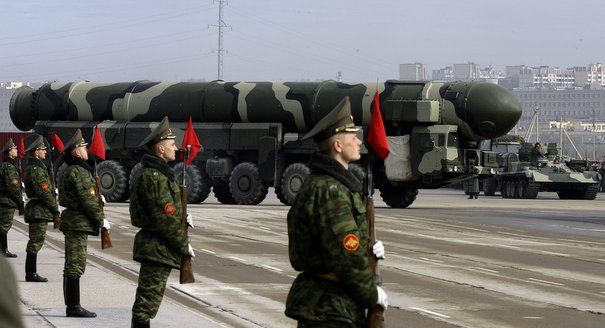
Russian political leaders and military strategists are growing increasingly concerned about strategic conventional weapons, particularly long-range, hypersonic weapons. Some fear that strategic conventional weapons could prove decisive in a major conflict and that Russia is lagging behind in their development.
Source: Nonproliferation Review
Russian President Vladimir Putin must have a special place in his heart for the US Conventional Prompt Global Strike (CPGS) program. Since they were first unveiled in 2006, he has publicly decried US plans to develop hypersonic, long-range, non-nuclear munitions on at least five occasions—including at such high-profile occasions as his State of the Nation address in December 2013. In that speech, he criticized the CPGS program by name and stated that, in combination with US ballistic missile defense, it “could negate all previous agreements on the limitation and reduction of strategic nuclear weapons, and disrupt the strategic balance of power.” ...
This article was originally published in Nonproliferation Review.

Jessica T. Mathews Chair, Co-director, Nuclear Policy Program
Acton holds the Jessica T. Mathews Chair and is co-director of the Nuclear Policy Program at the Carnegie Endowment for International Peace.
Recent Work

James M. Acton, Ankit Panda
James M. Acton
In the fog of modern war, generative AI offers every side a simple transaction: Trade documented reality for permanent doubt.

Mahsa Alimardani, Afsaneh Rigot

As we close out another season of Strategic Europe, it is worth taking stock of the deep shifts underway.

Rym Momtaz
Reading the purported correspondence of celebrity Ksenia Sobchak sheds light on her role within the system, and how journalism and politics function in Putin’s Russia.

Vladislav Gorin

The hybrid warfare landscape is evolving rapidly, leaving policymakers without clear strategies. To better inform their work in addressing emerging challenges, governments must dig deeper into the underlying dynamics at play.


Raluca Csernatoni, Alicia Wanless
Acknowledging these harms strengthens the case for ethical limits on the weaponization of critical infrastructure.

Alia Sajjadian, Andrew Leber