

Commentary
Closer EU-UK ties could help address urgent European concerns. But is the EU ready for rapprochement with the United Kingdom?
Rym Momtaz, ed.
{
  "authors": [
    "Richard Sokolsky",
    "Joel S. Wit"
  ],
  "type": "legacyinthemedia",
  "centerAffiliationAll": "",
  "centers": [
    "Carnegie Endowment for International Peace",
    "Carnegie Russia Eurasia Center"
  ],
  "collections": [],
  "englishNewsletterAll": "",
  "nonEnglishNewsletterAll": "",
  "primaryCenter": "Carnegie Endowment for International Peace",
  "programAffiliation": "",
  "programs": [],
  "projects": [],
  "regions": [
    "North America",
    "United States",
    "East Asia",
    "North Korea"
  ],
  "topics": [
    "Foreign Policy",
    "Nuclear Policy"
  ]
}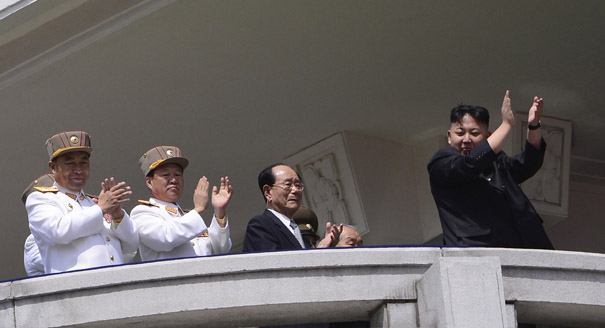
Source: Getty
If President Trump decides he wants business as usual with North Korea, he will be playing a losing hand. More progress is likely to be made if he plays the role of peacemaker rather than disrupter.
Source: Atlantic
North Korea’s launch of a ballistic missile this past weekend likely signals the beginning of the end of a four-month respite from its testing of ballistic missiles and nuclear weapons. It’s nothing to lose our heads about, not yet at least. Assertions that this test poses the first big foreign-policy challenge for the Trump administration have a breathless quality: The missile flew roughly 300 miles before falling in the sea, well short of Japan’s territorial waters. It is uncertain what type of missile was tested, but the United States Strategic Command issued a statement that the system that “did not pose a threat to North America.” Pyongyang already has hundreds of short- and medium-range missiles in its inventory, as well as the capability to hit U.S. military targets throughout the Pacific theater and perhaps as far away as Guam. Thus, the test did not indicate a dramatic improvement in North Korean military capabilities.
But the clock may be running out on the administration’s ability to prevent significant advances in the North’s development of more-capable missiles and nuclear weapons. Last week’s test could herald the beginning of a strategy in which Pyongyang gradually escalates provocations during the Trump administration. The real tipping point for the Trump administration is likely to come within the next few months, when the United States and South Korea conduct combined annual military exercises called “Key Resolve.” In November, at an unofficial meeting with former U.S. government officials in Geneva, North Korean officials made it clear that, while Pyongyang was going to take a “wait and see” attitude toward the newly elected President Trump, its patience would not last forever and might not last past the joint exercise.
For the past few years, the U.S.-South Korean military exercises have simulated military operations for invading North Korea and managing the aftermath of a collapse of its regime. If that were not enough to rattle the North Koreans, recently the exercises have involved the deployment of American nuclear-capable bombers and drills to practice the “decapitation” of the North Korean leadership, that is, killing senior officials before the nuclear button could be pushed. It is not surprising that North Korean officials both publicly and privately have harped on getting the exercises canceled to create the right atmosphere for renewed diplomatic dialogue. But they are also realistic and know that isn’t going to happen. So, in November 2016, in private discussions with American experts, including one of the authors, North Korean officials hinted they might be willing to exercise restraint in the testing of ballistic missiles and nuclear weapons if the United States and South Korea adjusted the exercises to make them less threatening. That message was reaffirmed by the Korean Central News Agency, Pyongyang’s official mouthpiece, which stated on February 6 that “the Trump Administration should propose the DPRK to adjust military drills in 2017.”
The exercises certainly both have operational value and provide reassurance of the U.S. defense commitment to South Korean security, which is particularly important at a time when the North Korean WMD threat is mounting. On the other hand, it doesn’t take a rocket scientist to understand that the North will not give up nuclear weapons as long as Pyongyang believes that the United States and South Korea pose an existential threat to its security. Every time Washington and Seoul do something to fan these fears—and the joint exercises are part of that mix—the North doubles down on developing its missile and nuclear capabilities. How the administration decides to carry out these exercises—and how it moves forward in dealing with North Korea from this week on—could mean the difference between maintaining a brittle peace on the Korean peninsula or precipitating a renewed period of tit-for-tat U.S. and North Korean escalatory actions, which could endanger stability and increase the risk of a military conflict involving the United States, North Korea, South Korea, and possibly Japan. The stakes, in other words, could not be higher.
Reading North Korean intentions is, of course, always a tricky business. However, the White House, already consumed with putting out daily fires and faced with a bunch of bad options for constraining North Korea, has little to lose in exploring them. Moreover, the U.S. will be no worse off than it is now if testing the North proves that it is not serious about abandoning the escalatory path it has been on for the past eight years. In fact, it will arguably be in a stronger position to seek greater Chinese pressure on the North if it has, as Beijing has urged, pursued diplomacy.
Speed is of the essence to get past a potentially escalating crisis and that will require balancing a complicated set of initiatives. The Trump administration has already taken two important steps: moving forward with United Nations deliberations on Pyongyang’s ballistic-missile test, since it violates existing sanctions; and signaling to the North that Washington will defend its allies. But it also makes sense to test North Korea’s intentions by signaling a new openness to serious diplomacy without preconditions.
Such contacts would be facilitated by reactivating the only channel of communication between the two countries through Pyongyang’s Mission to the UN, which has been shut down since last July. And given the tightly controlled and centralized North Korean political system, it would also make sense to create a parallel and private high-level dialogue between Trump and Kim Jong Un, starting with direct communications between the two leaders. Suspending the exercises, as the North Koreans have demanded, is neither politically nor strategically prudent. But continuing to speak publicly about decapitating the North Korean leadership and making overt nuclear gestures, such as over-flights of long-range nuclear-capable bombers, would send precisely the wrong signal unless Pyongyang conducts another nuclear test.
If the United States can get past what could become the first foreign-policy crisis of the Trump administration, it can then move on to solidifying a longer-term strategy. During the campaign and the transition, Trump’s tweets and statements on North Korea were all over the map—at various times offering to cut a deal with the North over a hamburger with Kim Jong Un, to get China to make the North’s leader “disappear,” and to wipe out a North Korean ICBM test site in a preemptive military strike. If the president decides that he wants to continue business as usual with North Korea—or to intensify the Obama policy with more sanctions, threats, and pressure aimed at both Pyongyang and Beijing—he will be playing a losing hand. Instead, more progress is likely to be made if the deal-maker-in-chief follows his instincts to play the role of peacemaker rather than disrupter.
As much as hawks both in and outside of the government are loath to admit it, there is no better alternative right now than diplomacy and negotiations to make a deal with North Korea that would bring some semblance of stability to the Korean peninsula. Expecting a near-term collapse of the North Korean is wishful thinking; the significance of recent defections from the North has been greatly overplayed by South Korea, and there is not one shred of reliable evidence that Kim Jong Un is facing a serious internal threat to his rule.
Focusing solely on ratcheting up sanctions on the North is a mug’s game: Pyongyang, with and without China’s connivance, is extremely skilled at skirting UN sanctions. And trying to pressure Beijing into turning the screws on Pyongyang by applying secondary sanctions on Chinese entities that do business with the North will not work either. More likely than not, the Chinese will only dig their heels in deeper, and pressuring Beijing will only complicate the administration’s efforts to deal successfully with its other differences with the Chinese.
Another option frequently mentioned is launching preemptive U.S. military strikes against North Korean ICBM test sites as Pyongyang moves into the final phase of developing its missile. That approach is also highly problematic; it will almost certainly be opposed by South Korea and Japan (not to mention China) since it poses a serious risk of igniting a potentially devastating conflict on the peninsula and in the region. Skepticism is also warranted about shooting down a North Korean missile test—the U.S. Navy and Air Force do not currently have the capability to make a successful intercept with the missile-defense systems they have deployed in the region.
All of this may prove to be moot unless the Trump administration deftly handles the crisis that is just over the horizon. A policy that emphasizes confrontation over dialogue will almost certainly provoke bigger and better North Korean missile and nuclear tests—including a North Korean ICBM and further work to develop a hydrogen bomb. On the other hand, resorting to the failed policies of the past—a sole focus on sanctions and other steps to mount pressure on Pyongyang and Beijing—will mean going down the same dead-end road as the Obama administration, a path that promises a serious and ongoing crisis for a White House that has enough problems already.

Nonresident Senior Fellow, Russia and Eurasia Program
Richard Sokolsky is a nonresident senior fellow in Carnegie’s Russia and Eurasia Program. His work focuses on U.S. policy toward Russia in the wake of the Ukraine crisis.
Joel S. Wit
Carnegie does not take institutional positions on public policy issues; the views represented herein are those of the author(s) and do not necessarily reflect the views of Carnegie, its staff, or its trustees.

Closer EU-UK ties could help address urgent European concerns. But is the EU ready for rapprochement with the United Kingdom?

Rym Momtaz, ed.
In an interview, Jim Lamson discusses the ongoing regional conflict and sees an unclear picture when it comes to winners and losers.

Michael Young

Our new report offers a path forward for local officials and future policymakers.



Joe McCannon, Jenny Keroack, Lauren Jensen, …

Present and future policymakers seeking to address climate-related health challenges can draw lessons from the successes and failures of the Biden administration.
Joe McCannon, Jenny Keroack, Lauren Jensen, …

In the Philippines, Duterte-era discourse emphasizing sovereignty, anti-Western skepticism, and strongman diplomacy mirrors tenets of populist foreign policy around the world.

Aries A. Arugay