

Paper
Christopher S. Chivvis, Rohan Mukherjee, Milan Vaishnav
{
  "authors": [
    "Milan Vaishnav"
  ],
  "type": "commentary",
  "centerAffiliationAll": "dc",
  "centers": [
    "Carnegie Endowment for International Peace"
  ],
  "collections": [],
  "englishNewsletterAll": "ctw",
  "nonEnglishNewsletterAll": "",
  "primaryCenter": "Carnegie Endowment for International Peace",
  "programAffiliation": "SAP",
  "programs": [
    "South Asia"
  ],
  "projects": [],
  "regions": [
    "South Asia",
    "India",
    "East Asia",
    "China"
  ],
  "topics": [
    "Economy",
    "Security",
    "Foreign Policy"
  ]
}
Source: Getty
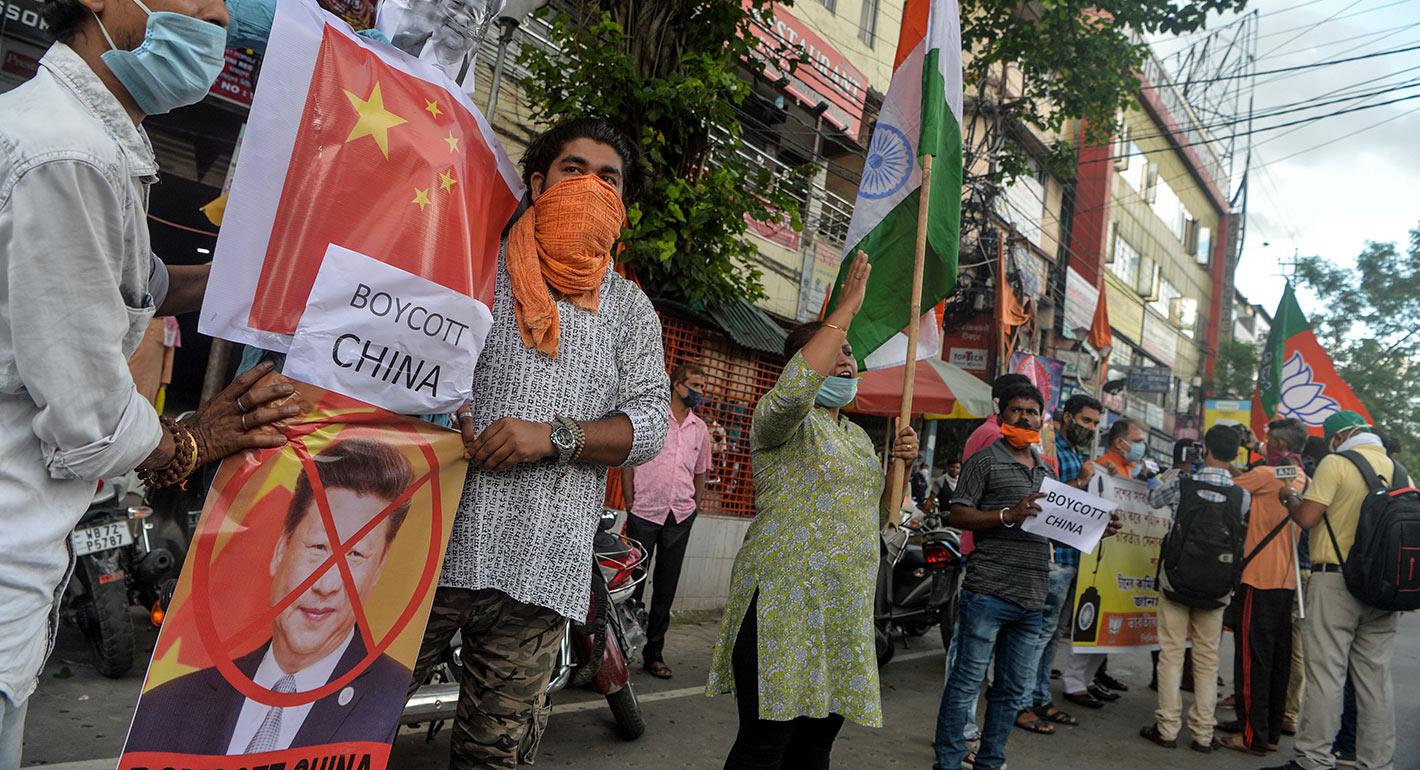
India has been embroiled in a foreign policy crisis with China, after violent clashes along their mountainous border. But if Delhi really wants to get tough with Beijing, it must first ensure its economy is in fighting shape.
While last week’s border skirmishes between India and China sent commentators rushing to Google Maps to locate obscure mountainous locales, the jousting in the Himalayas may prove to be a geopolitical inflection point. On strategic affairs, New Delhi and Beijing have long been at loggerheads, but the former has attempted a tightrope walk of cozying up to the West without alienating the communist regime. That may be about to change. In the wake of the brutal killing of at least twenty Indian soldiers by Chinese forces wielding a medieval mix of stones, clubs, and nail-studded rods, India might be forced to rethink its longstanding policy of strategic hedging.
Yet the foreign policy impact of last week’s high-altitude encounter will turn less on India’s diplomatic and defense maneuvers than on simple economics at home. India’s ability to project power abroad, protect its homeland, and assemble and sustain meaningful partnerships depends on the capacity of India’s political leaders to quickly and competently get its economy back on track. The foreign policy crisis consuming the government of Indian Prime Minister Narendra Modi in the wake of the border clash—as real and raw as it might be—cannot be resolved unless India first fixes its economic emergency.
The stringent coronavirus lockdown Modi imposed in late March imposed severe economic costs on India’s 1.3 billion citizens. HSBC India projects that India’s gross domestic product will shrink by 7.2 percent this fiscal year. But perhaps more worrying is the bank’s assertion that trend growth in India, as high as 7 percent just three years ago, has slumped to a ho-hum 5 percent.
In other words, even if India were to emerge quickly from the shadow of the coronavirus (this is a big if, given that its caseload is unlikely to peak until August), the economy’s pre-existing conditions will impede forward momentum. Even before the pandemic, India was in the midst of a protracted economic slowdown, with growth sagging to an eleven-year low of just 3.1 percent in the quarter ending March 2020. And even this meager figure is itself likely overstated, India’s former chief economic advisor Arvind Subramanian has argued that India’s GDP growth rate could be exaggerated by as much as 2.5 percentage points.
For the better part of a decade, India has been struggling to resolve a knotty twin balance-sheet crisis. Infrastructure and natural resource companies (such as those involved in construction and mining) were saddled with a noxious debt hangover, while the books of the country’s public sector banks were riddled with a troubling share of non-performing assets (NPAs). With access to credit choked, the shadow banking sector rushed in to fill the void, only to find itself beset with the same charges of dodgy lending.
The economy hobbled along, driven by government expenditure and private consumption. These twin engines are now running on fumes. India’s combined fiscal deficit is on the order of 10 percent of GDP. Government revenues have collapsed, thanks to the patchy rollout and convoluted design of the Goods and Services Tax (GST) and a risky corporate income tax cut. Consumption too has gone for a toss; in 2019, leaked government data showed consumer spending falling for the first time in over four decades—leading the government to junk the survey in an effort to bury bad economic news. Exports, booming during India’s heady years of the 2000s, have sunk as global trade headwinds have intensified.
How can New Delhi get the economy back on track? First, India must ensure that the economic slowdown does not careen further into a humanitarian crisis by expanding access to the food security net, increasing health spending, and addressing the dire situation faced by tens of millions of internal migrants fleeing big cities.
Second, India should act decisively to clean up the residue of toxic assets encumbering private investment activity. In 2017, the government’s flagship Economic Survey recommended the creation of a bad bank to ease the NPA burden on banks; three years later, this idea is finally under consideration. An asset quality review of largely unregulated nonbanking financial companies must follow.
Third, the Modi government must rediscover the promise on which it first sailed to power in 2014: maximum governance, minimum government. The last six years have seen scarce progress on administrative reforms; in a weak state like India, the objective is not to shrink government per se, but to shrink government paperwork. The recent decision by some state governments to reform archaic labor laws signals positive intent, but they must not confuse the removal of stifling hiring and firing practices with the elimination of workers’ basic protections.
India’s citizens are repelled by China’s recent aggression, which represents the culmination of a series of expansionist measures that have silenced even New Delhi’s most reliable China backers. While India’s foreign policy mandarins debate a reorientation of the country’s strategic posture, it is the economy that demands priority attention. After all, as a common refrain in India goes, the best foreign policy is 8 percent growth.

Director and Senior Fellow, South Asia Program
Milan Vaishnav is a senior fellow and director of the South Asia Program and the host of the Grand Tamasha podcast at the Carnegie Endowment for International Peace. His primary research focus is the political economy of India, and he examines issues such as corruption and governance, state capacity, federalism, and electoral behavior. He also conducts research on the Indian diaspora.
Recent Work


Christopher S. Chivvis, Rohan Mukherjee, Milan Vaishnav



Sophia Besch, Eric Ciaramella, Steve Feldstein, …
Carnegie does not take institutional positions on public policy issues; the views represented herein are those of the author(s) and do not necessarily reflect the views of Carnegie, its staff, or its trustees.
A leak of Russian gas price data helps establish that China is paying Russia far less than Central Asian countries and Gazprom’s former European customers.

Sergey Vakulenko

China’s political future will be shaped between now and next October. As the Communist Party enters its intense “campaign season” to prepare for a major political transition in 2027, reading Beijing's actions and responses may become more difficult as domestic politics weigh on its behavior more than usual.

Damien Ma

The EU can impose sanctions but struggles to enforce them without the United States. With Washington increasingly disinterested in backing European interests, the bloc must now fend for itself.


Nicu Popescu, Tiago Antunes
Global and rising powers will need to engage with Africa’s priorities and agency in order to secure the continent’s increasingly attractive partnerships.

Fonteh Akum

Rubio’s recent visit brought welcome attention, but more capital requires governance changes that may be a hard sell for regional governments.

Jennifer B. Murtazashvili