

Article
Thomas Carothers
{
  "authors": [
    "Thomas Carothers"
  ],
  "type": "commentary",
  "blog": "Emissary",
  "centerAffiliationAll": "",
  "centers": [
    "Carnegie Endowment for International Peace"
  ],
  "collections": [
    "Global Democracy"
  ],
  "englishNewsletterAll": "",
  "nonEnglishNewsletterAll": "",
  "primaryCenter": "Carnegie Endowment for International Peace",
  "programAffiliation": "",
  "programs": [],
  "projects": [],
  "regions": [],
  "topics": [
    "Democracy",
    "Economy",
    "Foreign Policy"
  ]
}
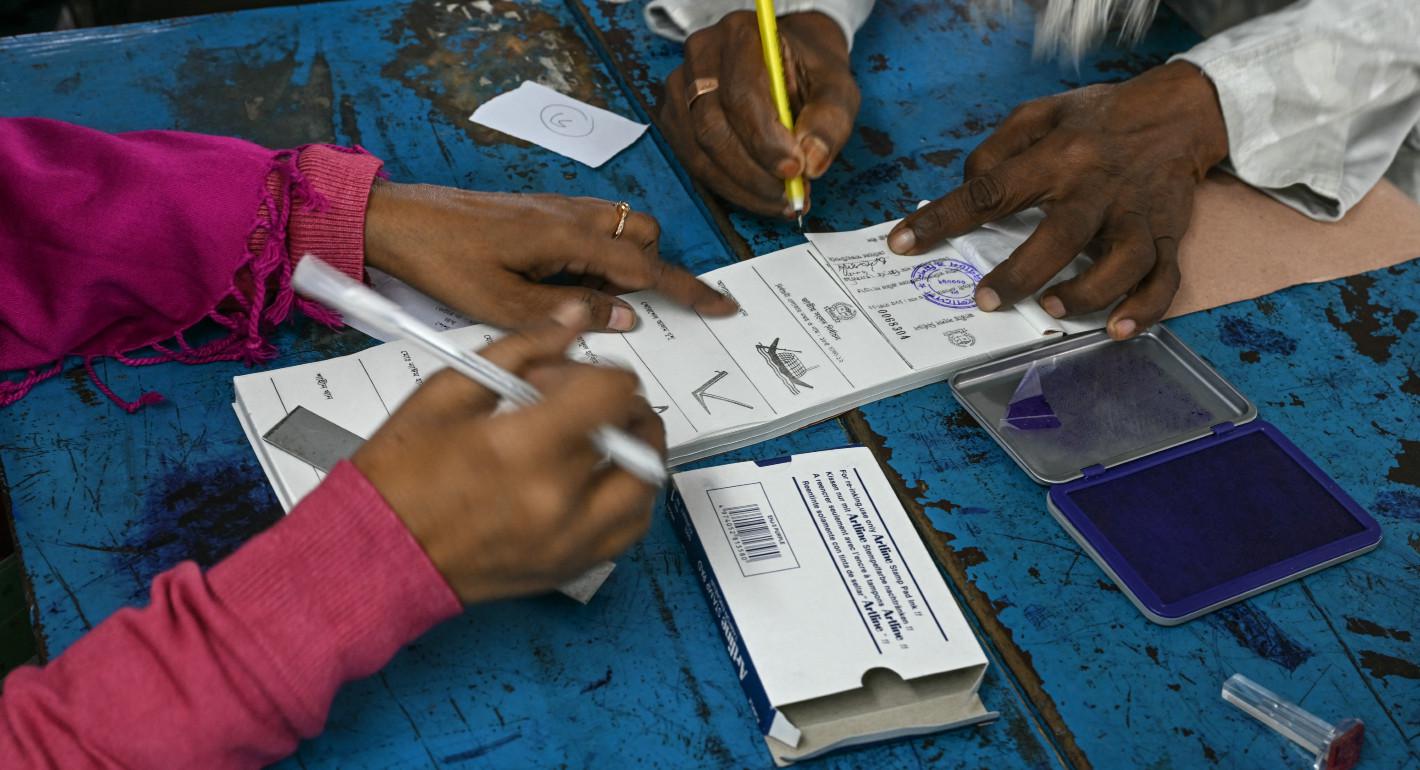
Source: Getty
This year’s global elections present a panoply of political contexts and issues at stake.
This year, a dizzyingly diverse array of countries—from the most populous (India), to one of the least (Palau)—will hold national elections. Some will be fully in the global limelight, such as those in Russia, the United Kingdom, and the United States. Many others will attract relatively little international attention, even though they will be of great importance to their citizens and neighbors. In some, the outcomes are already predictable; for others, uncertainty prevails.
This notable run of elections will take place in a global context defined by an ongoing democratic recession and ever-intensifying geopolitical tensions among major powers. Many of the elections will have significant consequences for one or the other—or both—of these defining trends.
However, 2024’s elections do not revolve around a single overarching issue or vector, such as the rise of right-wing illiberalism or the spread of toxic political polarization. Instead, they fall along a more differentiated spectrum, defined by at least five major categories.
Some elections, whether presidential or legislative or both together, will take place in countries where autocracy has already taken root. These include Belarus, Iran, Rwanda, Russia, and Venezuela—all of which are rated as not free in Freedom House’s Freedom in the World 2023 report. Rubber-stamping will likely occur in most, but not necessarily all, of these cases. In Venezuela, for example, the opposition maintains at least some capacity, despite the strenuous efforts by the regime to limit its space and reach. And even where incumbents fully dominate the process, how they position themselves in their campaigns and how well they succeed in mobilizing turnout can be informative about their political strengths and weaknesses.
Other elections will be in countries that have been experiencing significant democratic backsliding but are not yet fully autocratic, such as El Salvador, Georgia, India, Mozambique, and Pakistan. At issue will be whether the elections’ outcomes reinforce and deepen their undemocratic slide or breathe new political oxygen into constricted systems.
Uncertainty will be much more widespread in the sizable set of elections taking place where democracy has been facing serious tremors from surging illiberal political currents, punishing economic crises, debilitating governance shortcomings, or other woes. These include the elections in Ghana, Indonesia, Mexico, Senegal, South Africa, Sri Lanka, the United Kingdom, and the United States, and for the European Parliament. In these cases, whether the elections will end up fueling greater democratic shakiness or putting the countries on a firmer democratic footing is an overriding question.
Another sizable set of elections will take place in political contexts of relative democratic normality. These include the elections to be held in Austria, Belgium, Croatia, Finland, Palau, Panama, Portugal, Romania, and Uruguay. These contests will present voters with important choices between contending sides, but not ones where democracy itself seems to be fundamentally at risk. However, potential gains by far-right parties in some of these countries—including Austria, Belgium, and Portugal—worry some observers.
Finally, in some countries that have experienced coups or other types of serious internal conflict, rulers have promised elections in 2024, but whether they will be reasonably free and fair—if they happen at all—is unclear.* This is the case in Chad, Mali, and South Sudan. If the votes are carried out in an orderly and genuinely competitive fashion, they could represent democratic openings, albeit very tentative ones.
On the geopolitical front, some elections will present voters with choices between sharply varying foreign policy orientations. The outcomes of these elections may therefore have significant regional or global implications relating to international peace and security. The United States is a major case in this regard, given the differences in foreign policy outlook between President Joe Biden and his most likely opponent, Donald Trump. If the European Parliament elections see a sharp rightward turn, the implications for EU foreign policy would likely be considerable, whether relating to migration, China, or Russia.
Elections in some smaller places may also have weighty international implications. Taiwan is perhaps the most important example, where the direction of the island’s relations with China depends in some part on which party wins the January balloting. Divisions over policy toward China will be less intense but still salient in South Korea’s legislative elections later in the year. In somewhat parallel fashion, the outcome of Georgia’s elections will be consequential for the country’s relationship with Russia, and by extension, regional security in the Caucasus. And if Venezuela does manage to hold genuinely competitive elections, one important element will be the potential continuation or reversal of the country’s long-standing hard-left foreign policy orientation, with major consequences for larger regional dynamics.
In short, the outcomes of many of this year’s elections will be critical to understanding the advance or retreat of democracy in the world and the intensification or easing of security tensions in multiple regions. For this reason, the Carnegie Endowment for International Peace is launching its Global Elections 2024 series. Once or twice each month, Carnegie will offer incisive videos and commentaries by leading country experts about key elections on the horizon, focusing on what’s at stake in the elections, both for the country in question and for the regional and global dynamics at play.
*Correction, January 12, 2024: This sentence has been updated to more accurately reflect South Sudan’s political situation.

Harvey V. Fineberg Chair for Democracy Studies; Senior Fellow, Democracy, Conflict, and Governance Program
Thomas Carothers, a senior fellow in the Carnegie Endowment for International Peace’s Democracy, Conflict, and Governance Program, is a leading expert on comparative democratization and international support for democracy.
Recent Work
Thomas Carothers
Thomas Carothers
Carnegie does not take institutional positions on public policy issues; the views represented herein are those of the author(s) and do not necessarily reflect the views of Carnegie, its staff, or its trustees.
Fatima El Mansouri is the country’s first female prime minister. She’s also a privileged insider in a largely ceremonial position.

Sarah Yerkes

The acknowledgment has sparked fears of a new arms race with China and Russia.

Chris O’Meara

The summit may be remembered as a fatal blunder, when Washington, Beijing, and the AI industry collectively chose ceremony over action.

Jeffrey Prescott

The real test may come after the leaders leave the room.



Sheena Chestnut Greitens, Oriana Skylar Mastro, Yukon Huang, …

The Horn of Africa countries are among those facing a new security calculus.


Andrew Leber, Lesley Anne Warner