

Commentary
Katie Tobin
{
  "authors": [
    "Katie Tobin"
  ],
  "type": "commentary",
  "blog": "Emissary",
  "centerAffiliationAll": "dc",
  "centers": [
    "Carnegie Endowment for International Peace"
  ],
  "collections": [
    "Climate Mobility"
  ],
  "englishNewsletterAll": "americanStatecraft",
  "nonEnglishNewsletterAll": "",
  "primaryCenter": "Carnegie Endowment for International Peace",
  "programAffiliation": "ASP",
  "programs": [
    "American Statecraft"
  ],
  "projects": [],
  "regions": [
    "United States",
    "Europe"
  ],
  "topics": [
    "Migration",
    "Foreign Policy"
  ]
}
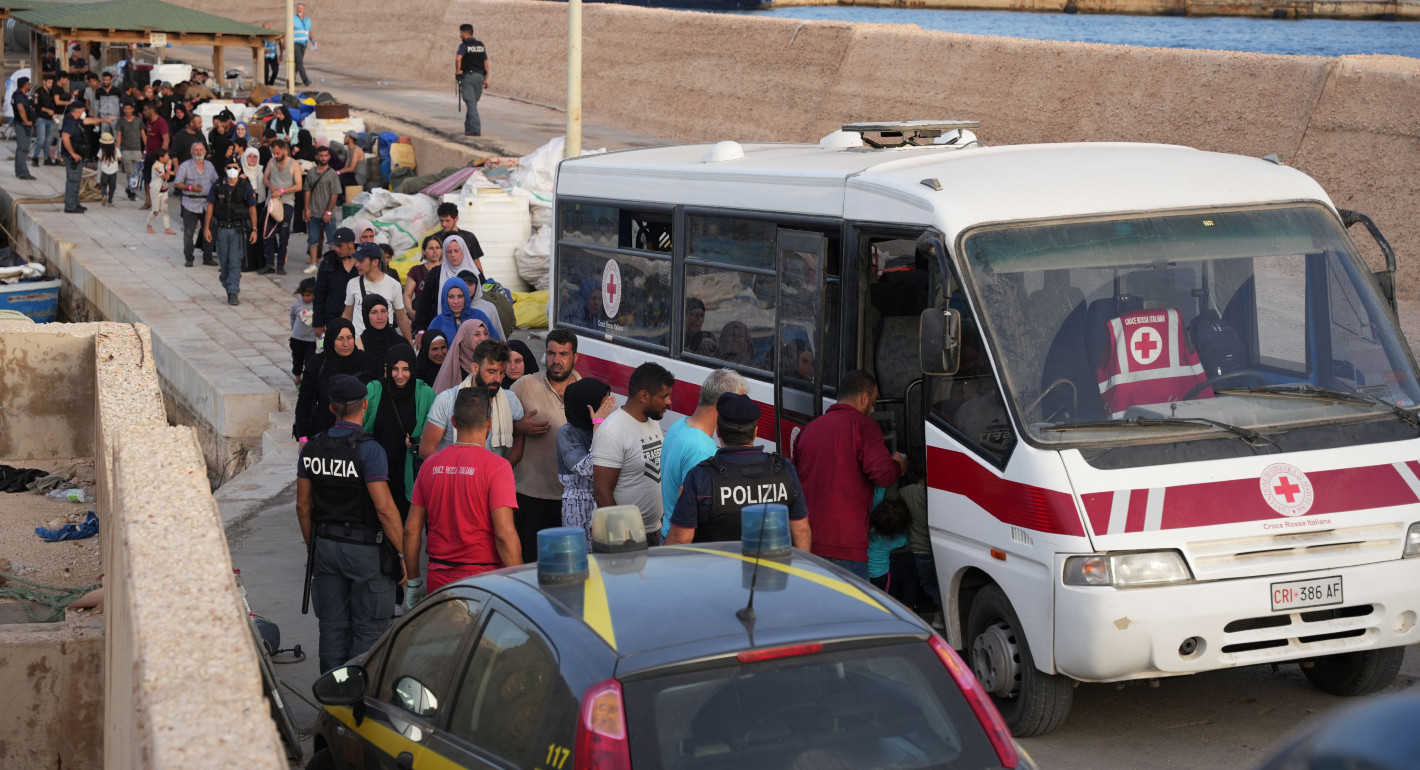
Migrants board a Red Cross bus after arriving on the Italian island of Lampedusa in September. (Photo by Zakaria Abdelkafi/AFP via Getty Images)
The three-pronged approach developed by Western Hemisphere leaders should be a road map for how the world’s major economies can tackle the challenge together.
At this week’s G7 Summit in Italy, migration will be on the agenda for the first time in the group’s history. With more than 110 million people displaced globally—the highest number since World War II—migration has become a vexing challenge and political lightening rod for nearly every government. It has been a particular headache for the G7’s host, Italian Prime Minister Giorgia Meloni, whose country confronted a 50 percent increase in irregular migration from North Africa last year. Migration was also a hot topic in the EU parliamentary elections this month, and it is currently polling as a top issue for U.S. voters in November. As the G7 leaders consider how to deal with this challenge together, there is already a road map for them to follow.
Two years ago, U.S. President Joe Biden and twenty other leaders in the Western Hemisphere enshrined a first-of-its-kind regional approach to the issue, in what is known as the Los Angeles Declaration on Migration and Protection. Under the LA Declaration, countries joined forces to tackle the challenge with a three-pronged approach:
This approach, which I personally spearheaded in 2022 as a member of Biden’s national security team, contrasts with the more transactional deals such as ones some European leaders have pursued recently with North African countries. The deals European leaders struck with Tunisia, Egypt, and Rwanda in the past year have each been mired in controversy and allegations of human rights abuses—and likely will not have a sustained impact on reducing migration.
Having worked with refugees and migrants for the past twenty years, I’ve witnessed time and time again that when people are fleeing violence and starvation, they are rarely deterred by enforcement measures alone. Yet, when offered a safe place to stay, legal status, and a chance to work, they can be persuaded to settle where they are or wait their turn for an official immigration pathway. This is what inspired the three-pronged approach of the LA Declaration. It is a framework that takes into consideration human motivations and promotes collaboration, not coercion, among countries.
Understand the world with the latest from our scholars around the world.
The LA Declaration is by no means a panacea. In 2024, migration remains a challenge across the Western Hemisphere and at the U.S. southern border. Nevertheless, the declaration warrants consideration among the G7 members because in just two years, it is already sparking more “coordinated, consistent, and effective” policy.
Since June 2022, Belize, Costa Rica, Ecuador, Panama, and Peru have each launched new legalization policies to give migrants in their countries legal status. They joined Colombia and Brazil, which have been leaders on this issue, in response to Venezuela’s migration crisis. More than 2 million Venezuelans have obtained legal status under Colombia’s ten-year Temporary Protection Status policy, and Brazil has welcomed approximately 500,000 Venezuelans, matching many of them with job opportunities throughout the country. These countries’ collective actions under the LA Declaration are anchoring migrants where they are, giving them access to work and education, and helping to create more order at borders—a practice that could be adopted elsewhere.
In turn, new targeted investments by the Inter-American Development Bank, World Bank, and donor countries such as the United States and Canada are making it possible for countries on the front lines of migration crises to maintain their welcoming policies. For example, in 2022 and 2023, the World Bank approved loans for Ecuador and Costa Rica, two middle-income countries that traditionally would be ineligible for this kind of lending. The new funds go toward roads, schools, and climate resiliency projects that will benefit not only the refugee and migrant populations but also the communities hosting them. That is key. The United States, South Korea, Canada, and Spain are also working together to make $89 million available, through the Inter-American Development Bank’s Migration Grant Facility, to support countries most impacted by migration. Italy and other European countries could benefit from promoting migrant integration in North Africa instead of simply paying these countries to try to enforce their maritime borders.
In addition to the wave of new integration policies in the Americas, countries party to the LA Declaration are partnering to advance a historic expansion of legal pathways. Specifically, six countries and the United Nations joined forces last year to launch the Safe Mobility Offices Initiative. Under this initiative, migrants in Costa Rica, Colombia, Ecuador, and Guatemala have the option to register on a virtual platform and be screened for a wide range of immigration pathways to the United States, Canada, and Spain within a few weeks. Since it launched in 2023, the platform has registered more than 200,000 migrants, 10 percent of whom have been approved to travel to the United States by plane with a work permit. This initiative and many other legal pathway programs are transforming how migration is managed. This presents clear benefits to various G7 countries that want to reduce irregular migration at their borders but also would benefit from migration to address challenges like aging populations and labor shortages.
In addition, new cross-border partnerships have formed to increase border security. In a historic move, Panama and Colombia came together in April 2023, with the support of the United States, to jointly tackle the increase in migration in the Darien Gap. Under the campaign, governments surged their military and law enforcement personnel to disrupt the criminal groups facilitating the new migration route for enormous profit. While the Darien remains a challenge, the joint campaign is a prime example of how the LA Declaration is creating space for countries to table their differences and work together to tackle the migration challenge.
As the LA Declaration marks its two-year anniversary, it continues to gain momentum as a framework to collectively address the migration problem. Just last month, Guatemala hosted foreign ministers from the LA Declaration countries, including U.S. Secretary of State Antony Blinken. New initiatives, such as a job program for Haitian migrants in Mexico and the expansion of legalization plans in Ecuador and Costa Rica, show how ongoing collaboration is a key component of its success. This week, the G7 is slated to adopt the LA Declaration principles as a deliverable from the summit.
Nevertheless, the EU parliamentary elections were a sobering reminder that foreign policy approaches that promote coalition-building face major competition with more nationalistic agendas. This likely will be true in the November U.S. election, with the two candidates presenting starkly different approaches to foreign policy, as well as upcoming votes in the UK and France. But at a time when more people are fleeing their homes than ever before, the G7 leaders have an opportunity to rise above domestic politics and send a strong message on the global stage to come together to address the migration crisis. The LA Declaration as a road map is a good place to start.

Nonresident Scholar, American Statecraft Program
Katie Tobin is a nonresident scholar at the Carnegie Endowment for International Peace.
Recent Work
Katie Tobin
Carnegie does not take institutional positions on public policy issues; the views represented herein are those of the author(s) and do not necessarily reflect the views of Carnegie, its staff, or its trustees.

Why Pakistan, Saudi Arabia, and Turkey are joining forces on regional security.


Alper Coşkun, Amr Hamzawy

Despite public disputes over trade and immigration, the strategic partnership’s foundations remain sturdy.

Sameer Lalwani

It signals a new era of tech diffusion and warfare.

Steve Feldstein

Despite its flop at the box office, the film raises important questions for the climate community to answer.

Leonardo Martinez-Diaz

The acknowledgment has sparked fears of a new arms race with China and Russia.

Chris O’Meara