

Commentary
Carnegie’s Middle East Program scholars reflect on the impasse and its potential impacts on the Middle East.
- +9
Nathan J. Brown, Alper Coşkun, Amr Hamzawy, …
{
  "authors": [
    "Jennifer Hendrixson White"
  ],
  "type": "commentary",
  "blog": "Emissary",
  "centerAffiliationAll": "dc",
  "centers": [
    "Carnegie Endowment for International Peace"
  ],
  "englishNewsletterAll": "americanStatecraft",
  "nonEnglishNewsletterAll": "",
  "programAffiliation": "ASP",
  "programs": [
    "American Statecraft"
  ],
  "regions": [
    "United States"
  ],
  "topics": [
    "Democracy",
    "Domestic Politics",
    "Foreign Policy"
  ]
}
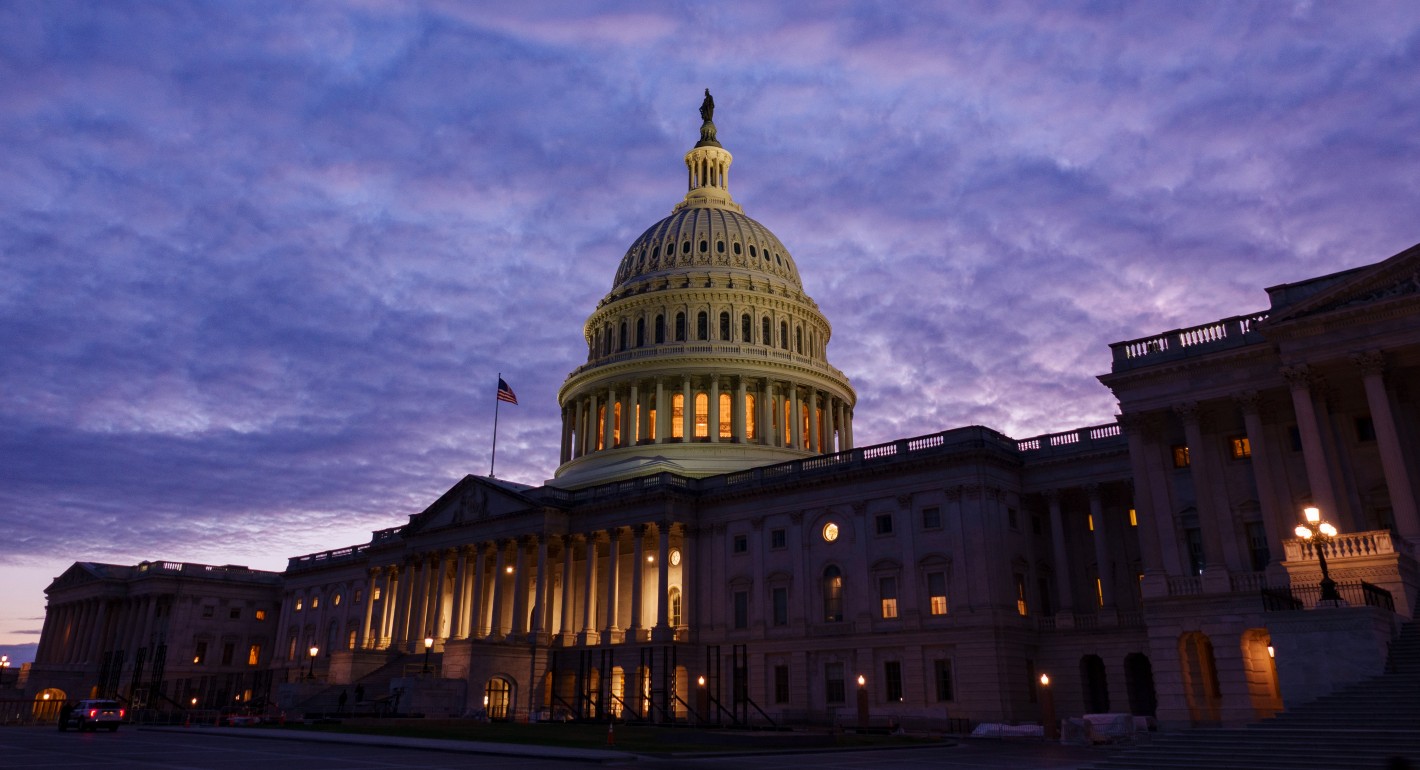
The U.S. Capitol building at dusk on November 2, 2026. (Photo by Kevin Carter/Getty Images)
How Capitol Hill might reassert checks on the executive branch.
In a historic midterm election on Tuesday, voters gave Democrats decisive control over Congress, with majorities in both the House and the Senate. Sentiments shifted among many demographic categories in an election that appears to have been centered around concerns over the Iran war, the economy, and corruption.
Given these results, the expectation may be that the new Congress places meaningful checks on President Donald Trump’s foreign policy. History suggests, however, that a Congress in opposition to a sitting president faces limited options. The tools that it is most eager to use, such as speeches, nonbinding resolutions, and investigations, can apply political pressure on the White House but do not easily force its hand. And the more weighty legal and financial tools, such as binding resolutions on the use of force or withholding federal funds, require veto-proof majorities that will need votes from Republicans as well.
As an incoming majority staff member on the House Foreign Affairs Committee following the 2018 midterms, I had a front-row seat to an election with similar atmospherics and foreign policy debates. I saw again and again how hard it was for members to move beyond simple signals of disapproval and how few options they had to legally or financially constrain presidential action.
In 2018, Trump was halfway into his first term with Republican majorities in both the House and Senate when Democrats took control of the House with a gain of forty-one seats—leaving Congress divided.
Expectations ran high that Democrats in the new Congress would be able to rein in what they perceived as Trump’s foreign policy excesses, such as his continued support for Saudi-led war in Yemen, the abrupt withdrawal from Syria, and the suspension of military exercises with South Korea. But by late 2019, these lofty expectations had been dashed.
The new Congress produced a flurry of measures that were rich in political signaling but produced no meaningful constraints on the administration. Some of these were binding resolutions, such as bills requiring the president to end U.S. support for the war in Yemen and halt hostilities with Iran, that passed both chambers but were vetoed by the president. On Europe, the House passed the NATO Support Act, which prohibited the use of federal funds to withdraw from the alliance, but the bill stalled in the Senate when Majority Leader Mitch McConnell decided not to bring it to the floor, perhaps to save the president from a direct rebuke. In the 120th Congress, Republicans will no longer be able to protect the president by setting the legislative agenda, but they will still be able to use the filibuster to prevent legislation from coming to the Senate floor. If that fails, any legislation that passes will still face the possibility of a presidential veto.
In a few cases, foreign policy legislation did become law. Some of these reflected bipartisan areas of agreement, such as the Hong Kong Human Rights and Democracy Act and the Uyghur Human Rights Policy Act. Others represented areas of bipartisan concern about what Trump might do: One provision in the National Defense Authorization Act (NDAA) addressed fears that the president would withdraw U.S. troops from South Korea, while another prohibited funds from being used to reduce U.S. troop numbers below a certain level. Notably, these successful legislative efforts rode on “must-pass” bills that enjoyed veto-proof support or were heavily negotiated in both chambers. Failed efforts did not receive the protection of riding along with a popular bill and were more easily vetoed by the president.
There are three issues worth watching in the coming months that will reflect how—and where—Congress exercises its authorities in the foreign policy domain.
First, reports suggest that the president may attack Iran again. The Senate has already voted fourteen times on the war but only approved—along with the House—one nonbinding measure calling on the president to end the war last June. (Predictably, the White House ignored it.)
Further U.S. action against Iran could reinvigorate efforts by Democrats to meaningfully restrict military action or funding for the war. Their first major opportunity to do so may come during the so-called lame-duck session. Funding of the government depends on a continuing resolution that expires on December 11, and Senate Democrats may use this deadline as leverage to extract concessions on Iran. The second opportunity is the ongoing negotiation over the NDAA—a bill that has reliably been passed annually for sixty-five years. Senate Democrats blocked passage of the 2026 NDAA in July, largely over concerns about Iran, and will likely continue to use their leverage in the lame-duck session. If Democrats threaten to block passage of the NDAA, they have leverage to attach riders that limit presidential authority and funding on Iran.
Second, Democratic Party leadership will select new House and Senate committee chairs and ranking members of key foreign policy and defense committees. Those picks may offer hints on policy direction—especially on Israel, which is sharply dividing the center-left and progressive-left elements of the party. New leadership on the Senate Foreign Relations Committee and changes in committee composition for both the House and the Senate foreign relations committees could signal a tougher line on Israel policy to include conditions on arms sales.
Finally, and perhaps most importantly, it is worth watching how and where the new Congress chooses to convert its investigative energies into real policy constraints on the executive branch. Congressional investigations into the Iran war or defense contracts with Trump-linked firms could pressure or embarrass the president, but it is less clear whether a Democratic-controlled House or Senate would be able to convert those investigations into meaningful actions that defend Congress’s Article I prerogatives constraining presidential action. Of these, the most important and most contested is Congress’s power of the purse. The Trump administration has avoided spending funds for the specific purposes assigned by Congress (impoundment); cancelled or repealed certain appropriations (rescissions); and implemented revenue-raising techniques that bypass congressional purview, including through tariffs.
Even though Democrats have taken control of Congress, they lack a veto-proof majority in either chamber and cannot count on advancing stand-alone legislation that legally restricts presidential action. But the way they choose to use their investigations could create a path to more substantive measures designed to limit the executive branch’s budgetary workarounds and claw back congressional power of the purse. For example, to get things through the Senate, Congress might consider tools that have fast-track treatment (as some war powers resolutions and arms sales disapprovals do), because they can come to the floor under simple majority in the Senate. Incoming committee chairs will have subpoenas, hearings, and nominations as means to build cases for binding legislation. And “must-pass” legislation provides leverage by virtue of a deadline.
The 116th Congress showed that, even in divided government, there are areas of bipartisan foreign policy convergence. In recent years, these have often centered around advancing the United States’ economic, technological, and military standing relative to China, while reassuring U.S. allies in Europe and Asia.
Nevertheless, the tools and strategies the new Congress employs—most notably, its ability to translate investigative efforts into binding legislation that enjoys broad enough support to overcome a presidential veto—will determine whether and how the legislative branch is able to assert its constitutional prerogatives on the growing number of foreign policy issues that impact the daily lives of Americans.

Visiting Scholar, American Statecraft Program
Jennifer Hendrixson White is a visiting scholar in the American Statecraft Program at the Carnegie Endowment for International Peace. Her research focuses on Congress’s role in U.S. foreign policy and national security.
Carnegie does not take institutional positions on public policy issues; the views represented herein are those of the author(s) and do not necessarily reflect the views of Carnegie, its staff, or its trustees.
Carnegie’s Middle East Program scholars reflect on the impasse and its potential impacts on the Middle East.



Nathan J. Brown, Alper Coşkun, Amr Hamzawy, …

The illusion of reproducing the ideology would come at the cost of the continent’s prosperity.

Giovanna De Maio

It would provide a golden opportunity to reconsider what success looks like.

Michael Mazarr

Rubio’s recent visit brought welcome attention, but more capital requires governance changes that may be a hard sell for regional governments.

Jennifer B. Murtazashvili
Despite public disputes over trade and immigration, the strategic partnership’s foundations remain sturdy.

Sameer Lalwani