

Commentary
The disparate cases and hard questions of interpretation underline the need for nuance.
{
  "authors": [
    "Thomas Carothers",
    "Judy Lee"
  ],
  "type": "commentary",
  "blog": "Emissary",
  "centerAffiliationAll": "dc",
  "centers": [
    "Carnegie Endowment for International Peace"
  ],
  "collections": [
    "Global Democracy"
  ],
  "englishNewsletterAll": "democracy",
  "nonEnglishNewsletterAll": "",
  "primaryCenter": "Carnegie Endowment for International Peace",
  "programAffiliation": "DCG",
  "programs": [
    "Democracy, Conflict, and Governance"
  ],
  "projects": [],
  "regions": [],
  "topics": [
    "Democracy",
    "Civil Society"
  ]
}
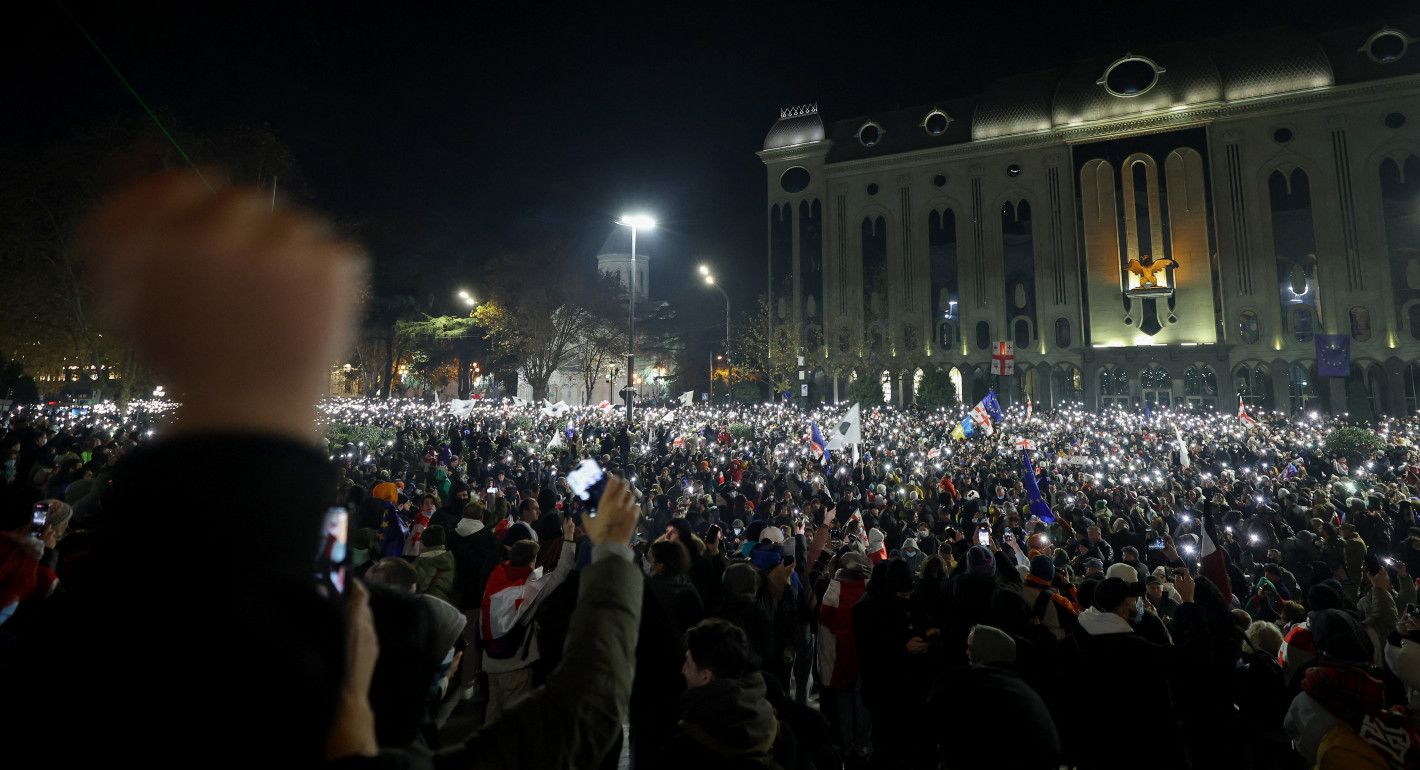
Protests in Tbilisi on November 29. (Photo by Giorgi Arjevanidze/AFP via Getty Images)
More than 160 significant anti-government protests erupted around the world this year, according to Carnegie’s Global Protest Tracker, with many driven by voting-related grievances.
Anti-government protests continued to roil numerous countries in 2024. In the Global Protest Tracker, we registered more than 160 such events in this category, spanning every region. With 2024 seeing an unusually large number of elections, citizen anger over the organization or outcome of these votes stood out as a driving factor, although other political issues such as repression and corruption also made themselves felt. Large-scale protests aimed at systemic change ousted an undemocratic government in Bangladesh. In other places, such as Georgia and Venezuela, they failed to dislodge the entrenched power holders, despite demonstrators’ white-hot anger over credible reports of major electoral fraud. Economic problems, such as high prices and poor working conditions, sparked protests in some places, as did various social issues, notably discontent regarding issues of gender and LGBTQ rights.
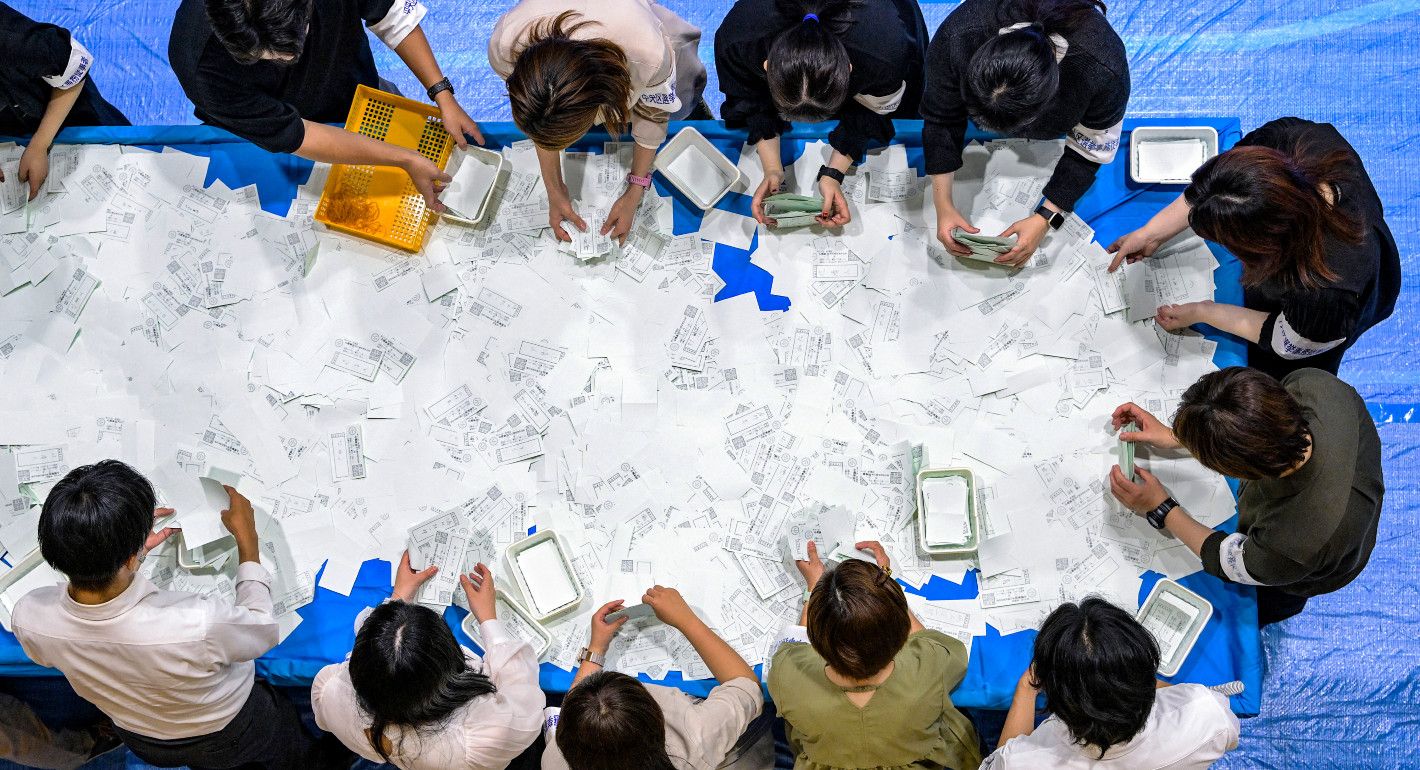
Election-related protests occurred in some countries in response to perceived problems with the organization of elections, such as in France (against changes to New Caledonia’s voter registration rules), Ghana (against alleged voter roll manipulation), Senegal (against election delays), Tanzania (against the dissolution of various administrative regions), and Tunisia (against the repression of electoral opponents). Even more frequently, protests erupted over alleged electoral fraud, as in Comoros, Georgia, Indonesia, Mauritania, Mozambique, Pakistan, Russia, and Venezuela. In Georgia, the postelection protests have been massive and are ongoing. And in some cases, protests following elections were prompted not by perceived fraud or manipulation but out of concern or anger about gains by far-right parties, as in Austria, France, Germany, Lithuania, and Romania.
The disparate cases and hard questions of interpretation underline the need for nuance.
Antidemocratic actions by governments beyond the electoral domain also triggered civic unrest in many places. Repression in the media spurred protests in Croatia, Hungary, and Indonesia. Fury over governmental corruption drove protests in Albania, Hungary, South Korea, and Uganda. Alleged abuse of power against opposition figures, in the form of criminal investigations or arrests, sparked demonstration in Albania, Bolivia, India, Pakistan, South Korea, and Taiwan. Other protests were prompted by alterations of laws or institutions perceived to be politically motivated. This category included demonstrations over a proposed amendment to executive powers in Botswana, proposed revisions to local election laws in Indonesia, judicial system reforms in Mexico, changes to criminal law in Slovakia, and the elimination of direct presidential elections in Togo.
The Israel-Hamas conflict continued to provoke numerous protests. Large pro-Palestinian demonstrations in multiple regions occurred throughout the year, spiking in October around the first anniversary of the outbreak of the fighting. In Israel, sizeable protests called on the government to reach a ceasefire with Hamas.
On the economic front, citizens in many countries demonstrated against diverse economic policies and reforms. Some of the most significant unrest was in Bangladesh, Kenya, and Nigeria, where economic protests morphed into large-scale challenges to government legitimacy. More focused economic protests took place in Afghanistan (against the elimination of the pension system), Argentina (against new austerity laws, including education budget cuts and pension reforms), Colombia (against various social and economic reforms), Finland (against changes to labor laws), India (against new labor codes), Portugal (against housing policies), and Spain (against tourism policies).
A one-stop source for following crucial trends in the most significant antigovernment protests worldwide since 2017. Last updated on July 20, 2026.
Workers’ protests around issues such as low wages, poor working conditions, and inflation were also numerous. These included a major wave of farmers’ protests throughout Europe early in the year that criticized agricultural policies relating to the war in Ukraine. Farmers in Australia and India also organized protests against different agricultural policies. Other workers’ demonstrations included ones by truckers in Colombia and Mexico, miscellaneous unions in Greece, bus drivers in Peru, police in Portugal, and doctors in South Korea.
Two additional important protest themes in 2024 were gender and LGBTQ rights. Protests relating to policies that threatened women’s rights or against gender-based violence erupted in Afghanistan, Brazil, France, Gambia, Italy, Kenya, Kyrgyzstan, Switzerland, and Türkiye. In the case of Brazil, thousands of women protested against a bill that would allow prosecutions of certain abortions as homicide. Protests against anti-LGBTQ laws took place in Bulgaria, Indonesia, and Serbia. On the other side of the policy line, South Korea saw a protest against a pro-LGBTQ court ruling.
For more information about all of the protests mentioned above, and others that took place in 2024 and before, please see Carnegie’s Global Protest Tracker.
The latest from Carnegie scholars on the world’s most pressing challenges, delivered to your inbox.

Harvey V. Fineberg Chair for Democracy Studies; Senior Fellow, Democracy, Conflict, and Governance Program
Thomas Carothers, a senior fellow in the Carnegie Endowment for International Peace’s Democracy, Conflict, and Governance Program, is a leading expert on comparative democratization and international support for democracy.
Program Coordinator, Democracy, Conflict and Governance Program
Carnegie does not take institutional positions on public policy issues; the views represented herein are those of the author(s) and do not necessarily reflect the views of Carnegie, its staff, or its trustees.
Saied’s main accomplishment has been to destroy a decade’s worth of democratic progress.

Sarah Yerkes

Despite Morocco’s hopes that its film industry would reap rewards, the blockbuster’s success will be tainted by controversy surrounding filming in occupied Western Sahara.
Sarah Yerkes

In Colombia and elsewhere in the region, the United States is trying to shape election outcomes—but at what cost?
Oliver Stuenkel, Adrian Feinberg
The impacts of the Faye-Sonko rupture could go well beyond the country’s borders.

Lesley Anne Warner
Regardless of the outcome, there’s another path to ensuring that progress doesn’t stall.

Zaur Shiriyev