

Commentary
More than 160 significant anti-government protests erupted around the world this year, according to Carnegie’s Global Protest Tracker, with many driven by voting-related grievances.
{
  "authors": [
    "Thomas Carothers"
  ],
  "type": "commentary",
  "blog": "Emissary",
  "centerAffiliationAll": "dc",
  "centers": [
    "Carnegie Endowment for International Peace"
  ],
  "collections": [
    "Global Democracy"
  ],
  "englishNewsletterAll": "democracy",
  "nonEnglishNewsletterAll": "",
  "primaryCenter": "Carnegie Endowment for International Peace",
  "programAffiliation": "DCG",
  "programs": [
    "Democracy, Conflict, and Governance"
  ],
  "projects": [],
  "regions": [],
  "topics": [
    "Democracy",
    "Domestic Politics"
  ]
}
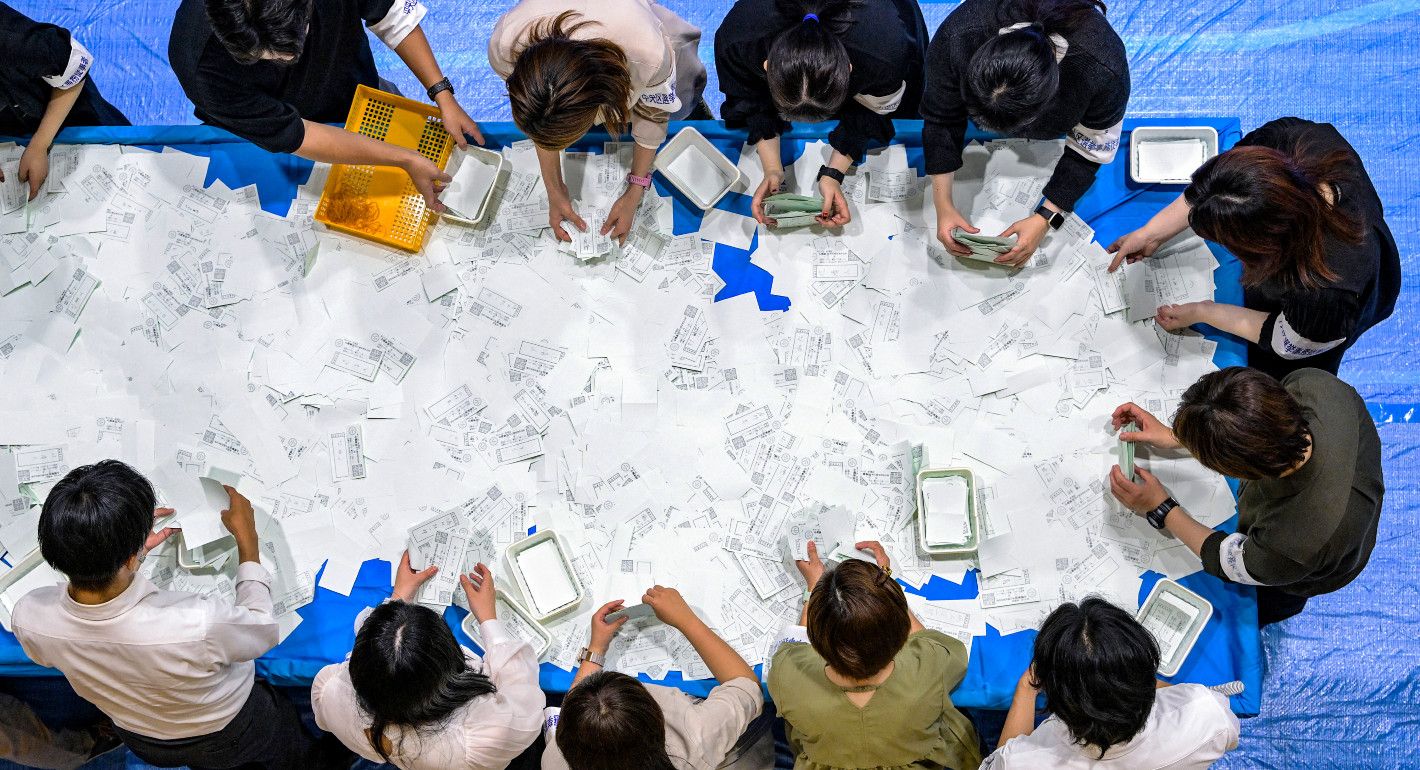
Election officials count ballots in Tokyo on October 27. (Photo by Richard A. Brooks/AFP via Getty Images)
The disparate cases and hard questions of interpretation underline the need for nuance.
Throughout this so-called year of elections, observers did not shy from quickly embracing conclusions about the implications for global democracy. The idea that 2024 was calamitous for incumbents took hold by midyear. So too did the view that the year was dominated by gains by politicians and parties on the right. A third set of views concluded that the overall pattern of electoral results was decisive for the health of democracy—with some reading the tea leaves as negative and others as positive.
With the year drawing to a close, stepping back and assessing these conclusions with a fuller empirical record is possible. Doing so underscores the precarity of such black-and-white findings and the need for analytic nuance.
The idea that 2024 has been a terrible year for incumbents—or as one commentator put it, a “bonfire of the incumbents” —gained particular currency among observers of the U.S. presidential election, as a basis for first predicting and then explaining the electoral outcome. Catchy as it was, it was not a very telling or even accurate characterization.
Certainly, various incumbent leaders or parties were defeated during the year, most prominently in the United States and the United Kingdom, though also in Botswana, Panama, and Sri Lanka. But incumbents have been doing badly in elections for quite a few years, as a result of voter dissatisfaction over issues such as ineffective governance during the pandemic and the ravages of the 2008 global financial crisis. In Latin America for example, incumbent presidents lost every election between 2018 and 2023, except one (Paraguay in 2023). Moreover, a sizeable number of incumbent leaders, parties, or candidates endorsed by the outgoing leaders were reelected this year, including in El Salvador, Finland, Indonesia, Ireland, Mexico, Moldova, Mongolia, Palau, and Taiwan. In India, Japan, and South Africa, while ruling parties were electorally dented, they did maintain power.
What about the similarly common view that 2024 marked a major rightward shift? Here too, nuance is needed. Parties on the right made electoral gains in some large countries, notably France and the United States, and in smaller ones such as Austria, Belgium, Panama, and Portugal. While some of these gains were by far-right parties (Austria and France), others were by conventional center-right parties or politicians (Panama). In the July elections for the European Parliament, gains by the far right were smaller than expected and not enough to break the hold of the mainstream parties.
Overall, the rightward shift was primarily a European and U.S. story. In other parts of the world, the picture was far more mixed. Left-of-center parties gained or held ground in various places, such as in Botswana, Mexico, Sri Lanka, Taiwan, and Uruguay. In other countries, such as India and Indonesia, the contending parties did not fall clearly on a left-right spectrum.
With regard to the implications for the overall health of democracy, the year’s results were not decisive in one direction or the other. Many of the elections did not signal noticeable change for democracy’s basic condition. This was true in the various authoritarian states where elections did little more than underscore their existing undemocratic political condition, such as in Russia and Rwanda. It was also true in numerous well-established democracies where elections were essentially democratic business as usual, including Finland, Ireland, Taiwan, and Uruguay.
There were some bright spots for democracy too. Senegal’s successful election in the face of the threat of an unconstitutional overstay in power by the outgoing president was an unquestionable gain. So too was the first-ever alternation between parties in power in Botswana’s long-standing democracy. On the other side of the ledger, for many Americans, the reelection of Donald Trump was a backward step for U.S. democracy, with potentially widespread negative ramifications for democracy globally—although many supporters of Trump felt equally strongly that they were voting to protect U.S. democracy.
In several other important votes, ambiguity prevailed with regard to the good news versus bad news question. The elections in Georgia and Venezuela can be seen as demonstrations of remarkable courage by besieged opposition forces, exposing the deep unpopularity of the autocratic regimes that resorted to fraud to stay in power. Or they can be viewed as dispiriting examples of how autocrats were able to withstand even massive popular mobilizations challenging their rule.
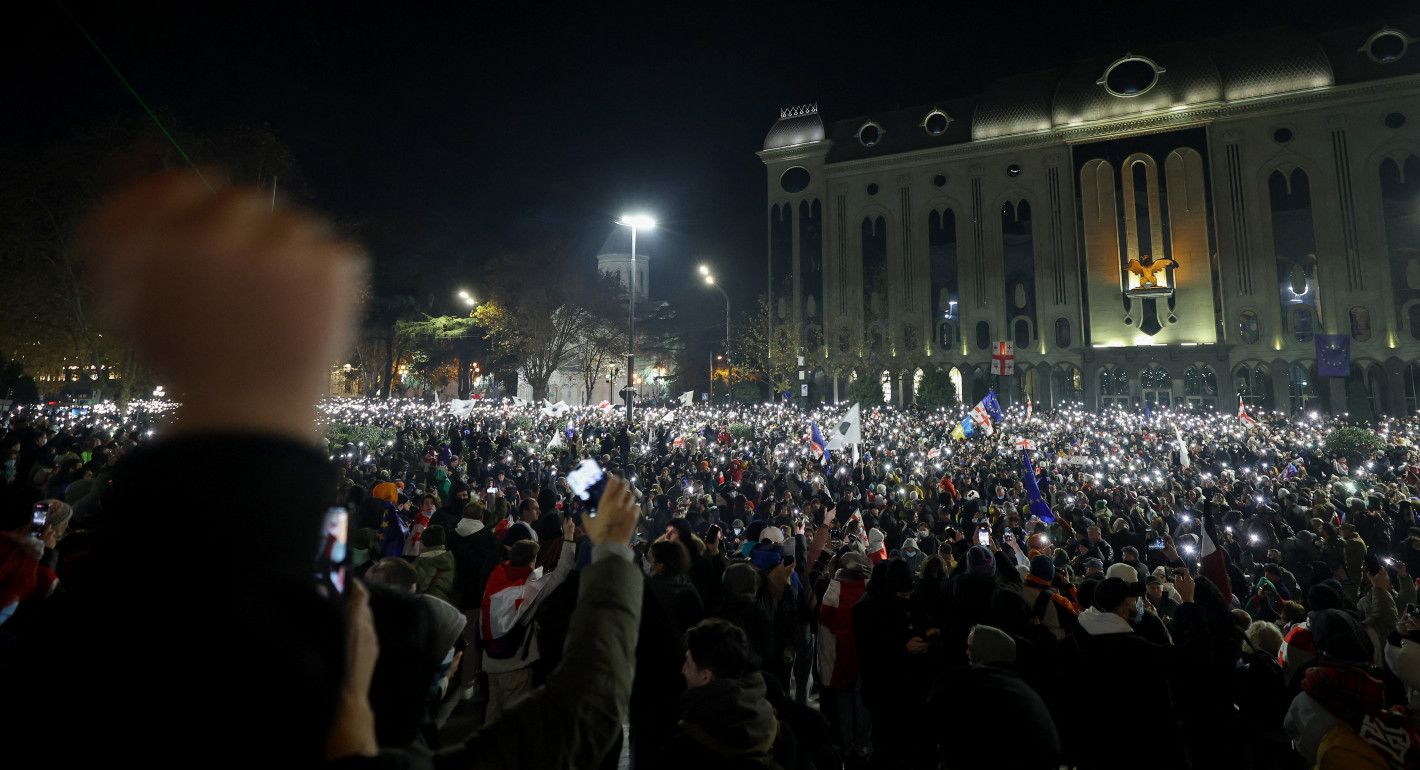
More than 160 significant anti-government protests erupted around the world this year, according to Carnegie’s Global Protest Tracker, with many driven by voting-related grievances.
The elections in India can be seen as a useful pushback against Prime Minster Narendra Modi’s overweening illiberalism. Or they can be understood as exemplifying his ability to stay in power for another term. In Mexico, critics of outgoing president Andrés Manuel López Obrador worry that his successor, Claudia Sheinbaum, will reinforce his various undemocratic impulses and projects. Others see her as bringing a more technocratic and potentially prodemocratic outlook to the Mexican presidency. The Romanian constitutional court’s startling last-minute annulment of the country’s presidential elections was viewed by some as a necessary safeguarding of an electoral process from foreign interference. Others saw it as a disturbing undermining of the popular will. These disparate cases and hard questions of interpretation underline the need for nuance in extracting conclusions about the overall message of the year of elections.
The latest from Carnegie scholars on the world’s most pressing challenges, delivered to your inbox.

Harvey V. Fineberg Chair for Democracy Studies; Senior Fellow, Democracy, Conflict, and Governance Program
Thomas Carothers, a senior fellow in the Carnegie Endowment for International Peace’s Democracy, Conflict, and Governance Program, is a leading expert on comparative democratization and international support for democracy.
Recent Work
Thomas Carothers
Thomas Carothers
Carnegie does not take institutional positions on public policy issues; the views represented herein are those of the author(s) and do not necessarily reflect the views of Carnegie, its staff, or its trustees.

Fatima El Mansouri is the country’s first female prime minister. She’s also a privileged insider in a largely ceremonial position.

Sarah Yerkes

Why governance of rapidly evolving technology will be distributed and complex.


Stewart Patrick, Scott Singer

Washington’s decision to support some UN functions while letting others wither is pulling the organization apart at the seams.
Stewart Patrick, Theodore Zaritsky

The books, podcasts, and films that explain the world it made.

Andrew Leber
U.S. trading partners in Asia are closely watching the dispute for signs of how it may affect their own interests.

Barbara Weisel