

Commentary
Saskia Brechenmacher, Shreya Joshi
{
  "authors": [
    "Saskia Brechenmacher"
  ],
  "type": "commentary",
  "blog": "Emissary",
  "centerAffiliationAll": "dc",
  "centers": [
    "Carnegie Endowment for International Peace"
  ],
  "collections": [
    "Gender"
  ],
  "englishNewsletterAll": "democracy",
  "nonEnglishNewsletterAll": "",
  "primaryCenter": "Carnegie Endowment for International Peace",
  "programAffiliation": "DCG",
  "programs": [
    "Democracy, Conflict, and Governance"
  ],
  "projects": [],
  "regions": [
    "United States"
  ],
  "topics": [
    "Civil Society",
    "Domestic Politics"
  ]
}
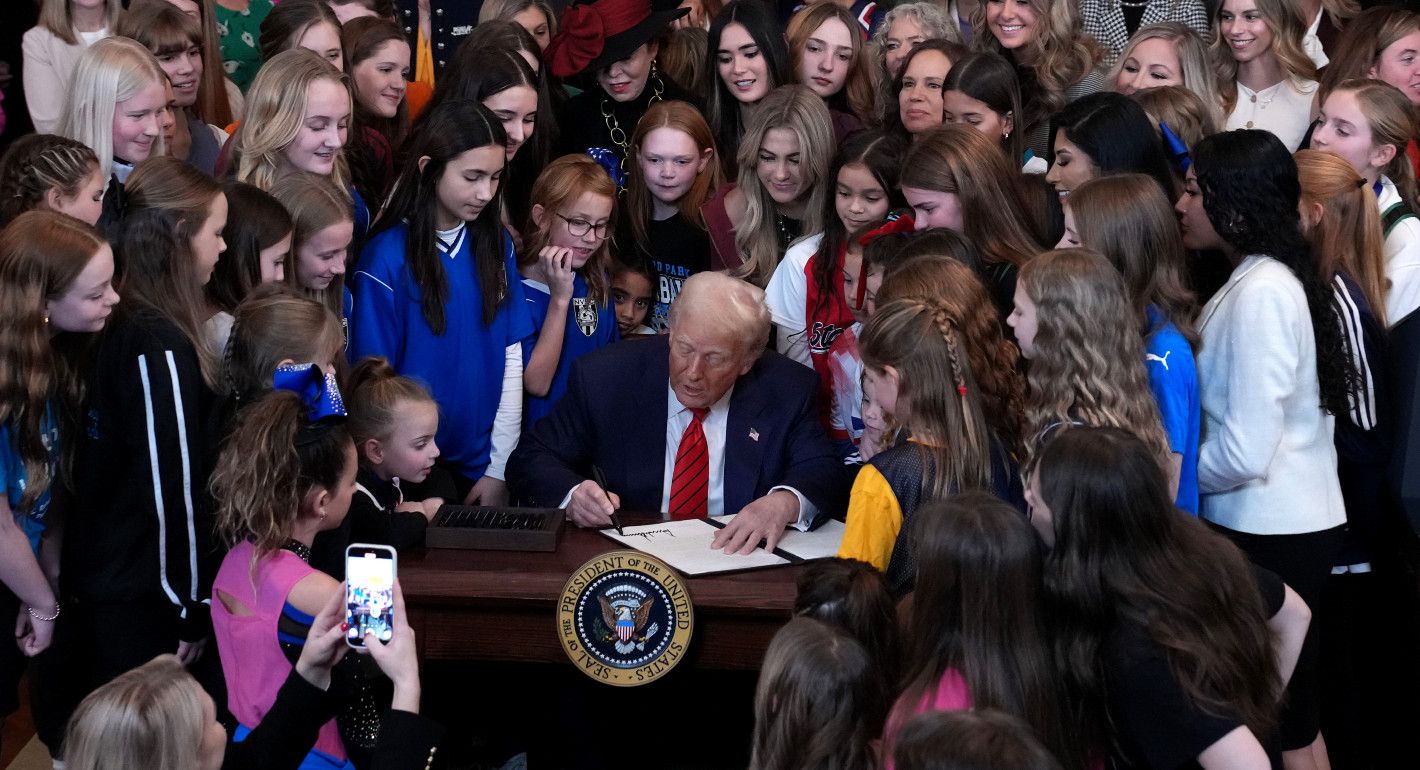
Trump signs executive order prohibiting transgender women from competing in women’s sports on February 5, 2025, at the White House. (Photo by Andrew Harnik/Getty Images)
In Europe and Latin America, the concept has been used to demand and justify far-reaching attacks on women’s rights and LGBTQ rights.
Cracking down on “gender ideology” has emerged as one of U.S. President Donald Trump’s first-order priorities. Upon assuming office, Trump immediately issued an executive order that seeks to defend women “from gender ideology extremism” and orders that “federal funds shall not be used to promote gender ideology.” The order’s primary target is transgender rights: by insisting on a biological definition of sex, it simply denies the existence of trans people as a group, with immediate and devastating consequences.
Yet by using the language of gender ideology, Trump’s administration is also allying itself with a much broader movement, not only against trans rights but against progressive gender norms. While relatively new in the United States, references to gender ideology have been a key element of far-right and religious rhetoric and mobilization in Europe and Latin America for more than a decade. Across both continents, the term has been used to demand and justify far-reaching attacks on women’s rights and LGBTQ rights, typically in the name of protecting the “natural family.” Rather than defending women, efforts to root out gender ideology from federal policies and programs represent a broader attempt to restore traditional gender norms and hierarchies.
The concept of gender ideology can be traced back to the 1990s, when the international women’s movement gained significant steam. At the 1994 Cairo International Conference on Population and Development, the term “gender” was first used in an intergovernmental document, though it was left undefined. For some advocates, the term was largely synonymous with women. For others, the concept recognized the existence of nonbinary individuals and helped draw attention to the sociocultural roles and norms imposed on men and women that in turn fuel hierarchies in resources and power.
This critique of gendered hierarchies provoked strong opposition from conservative Catholic groups. They feared that any understanding of gender as socially constructed rather than biologically determined would threaten a religiously defined gender order that rejects homosexuality and gender fluidity and views women and men as separate beings with distinct social and biological roles. In 2001, Pope John Paul II deplored that “misleading concepts concerning sexuality and the dignity and mission of the woman” are rooted in “specific ideologies on ‘gender.’” In the years that followed, the Vatican, Christian groups, and conservative Muslim-majority countries started using the term gender ideology to contest references to the socially constructed nature of gender in international negotiations, often arguing that these were code for homosexuality and a threat to the traditional family.
Over the past decade, these cultural battles have intensified, particularly in Latin America and Europe. Both regions have seen the emergence of ultraconservative and religious movements that are contesting the liberalization of women’s and LGBTQ rights by arguing that these efforts represent a radical gender ideology imposed on ordinary people by globalist elites. These campaigns are increasingly connected transnationally, through trainings, funding flows, and shared narratives. They are also gaining footholds in new regions, particularly in Africa.
Campaigns against gender ideology have sometimes focused on the legalization of same-sex marriage or other aspects of LGBTQ rights. But they have also targeted a wider set of issues. From Argentina to Poland and Serbia, civil society initiatives have used the concept to challenge sex education in schools or the inclusion of gender in textbooks. In a prominent example, opponents of the 2016 Colombian Peace Accord alleged that it imposed gender ideology by referencing “the LGBTI community” and proposing a gender commission in the final draft. The campaign contributed to Colombian voters ultimately rejecting the landmark peace deal.
In several countries, efforts to root out gender ideology and impose biological definitions have led to broader regressions in gender equality and rights protections. In Europe, for instance, right-wing populist governments and political parties have attacked the Istanbul Convention, a landmark treaty to prevent and end violence against women and domestic violence, for “promoting gender ideology” because the convention defines gender as “the socially constructed roles of men and women.” In 2021, Türkiye used this rationale to withdraw from the treaty entirely, thereby leaving Turkish women without critical protections. The Hungarian government, meanwhile, has refused to ratify the convention for the same reason. From Brazil and Paraguay to Georgia and Bulgaria, governments have also made it more difficult for schools to teach about issues related to gender norms, gender identity, and sexuality.
Ultimately, the popularity of the gender ideology concept lies in its flexibility and ambiguity. It conveys a general sense of discontent with progressive gender norms and allows opponents to frame these norms as out of sync with both science and common sense. It also makes gender a useful stand-in for perceived problems with progressive equality politics more broadly and taps into fears about rapid cultural and social change. As such, campaigns against gender ideology have increasingly brought together diverse coalitions, including religious institutions and associations, mainstream conservative politicians, far-right political parties, professional associations, and parent groups.
The most immediate and harmful impact of Trump’s executive order is on transgender people, whose identity and rights as a group will no longer be recognized by the federal government. However, insisting on biological definitions of sex will also make it more difficult to talk about and address the underlying social norms and structures that fuel inequities in politics, the labor market, and society more broadly. In fact, dismissing these factors as gender ideology limits the space to address the multiple ways in which gender norms generate negative outcomes for men and boys, from higher rates of social isolation to worse health outcomes. In addition to targeting a vulnerable minority, attacks on gender ideology open the door to a much wider offensive against equality norms and rights protections.
The latest from Carnegie scholars on the world’s most pressing challenges, delivered to your inbox.

Senior Fellow, Democracy, Conflict, and Governance Program
Saskia Brechenmacher is a senior fellow in Carnegie’s Democracy, Conflict, and Governance Program, where her research focuses on democratic erosion, gender, and civic activism in the United States and globally. She also serves on the board of the International Center for Not-for-Profit Law.
Recent Work
Saskia Brechenmacher, Shreya Joshi

Saskia Brechenmacher, Frances Z. Brown
Carnegie does not take institutional positions on public policy issues; the views represented herein are those of the author(s) and do not necessarily reflect the views of Carnegie, its staff, or its trustees.

Rubio’s recent visit brought welcome attention, but more capital requires governance changes that may be a hard sell for regional governments.

Jennifer B. Murtazashvili

Despite public disputes over trade and immigration, the strategic partnership’s foundations remain sturdy.

Sameer Lalwani

It signals a new era of tech diffusion and warfare.

Steve Feldstein
Despite its flop at the box office, the film raises important questions for the climate community to answer.

Leonardo Martinez-Diaz

Fatima El Mansouri is the country’s first female prime minister. She’s also a privileged insider in a largely ceremonial position.

Sarah Yerkes