

Commentary
It should address the shortcomings of previous crisis communication efforts and adapt to the demands of frontier AI.
Lucy Luo
{
  "authors": [
    "Zainab Usman",
    "Anthony Carroll"
  ],
  "type": "commentary",
  "blog": "Emissary",
  "centerAffiliationAll": "dc",
  "centers": [
    "Carnegie Endowment for International Peace"
  ],
  "collections": [
    "Trump’s Disruptive 100 Days",
    "Africa’s Shifting Politics and Geopolitics"
  ],
  "englishNewsletterAll": "africa",
  "nonEnglishNewsletterAll": "",
  "primaryCenter": "Carnegie Endowment for International Peace",
  "programAffiliation": "AFP",
  "programs": [
    "Africa"
  ],
  "projects": [],
  "regions": [
    "South Africa",
    "United States"
  ],
  "topics": [
    "Trade",
    "Economy",
    "Foreign Policy"
  ]
}
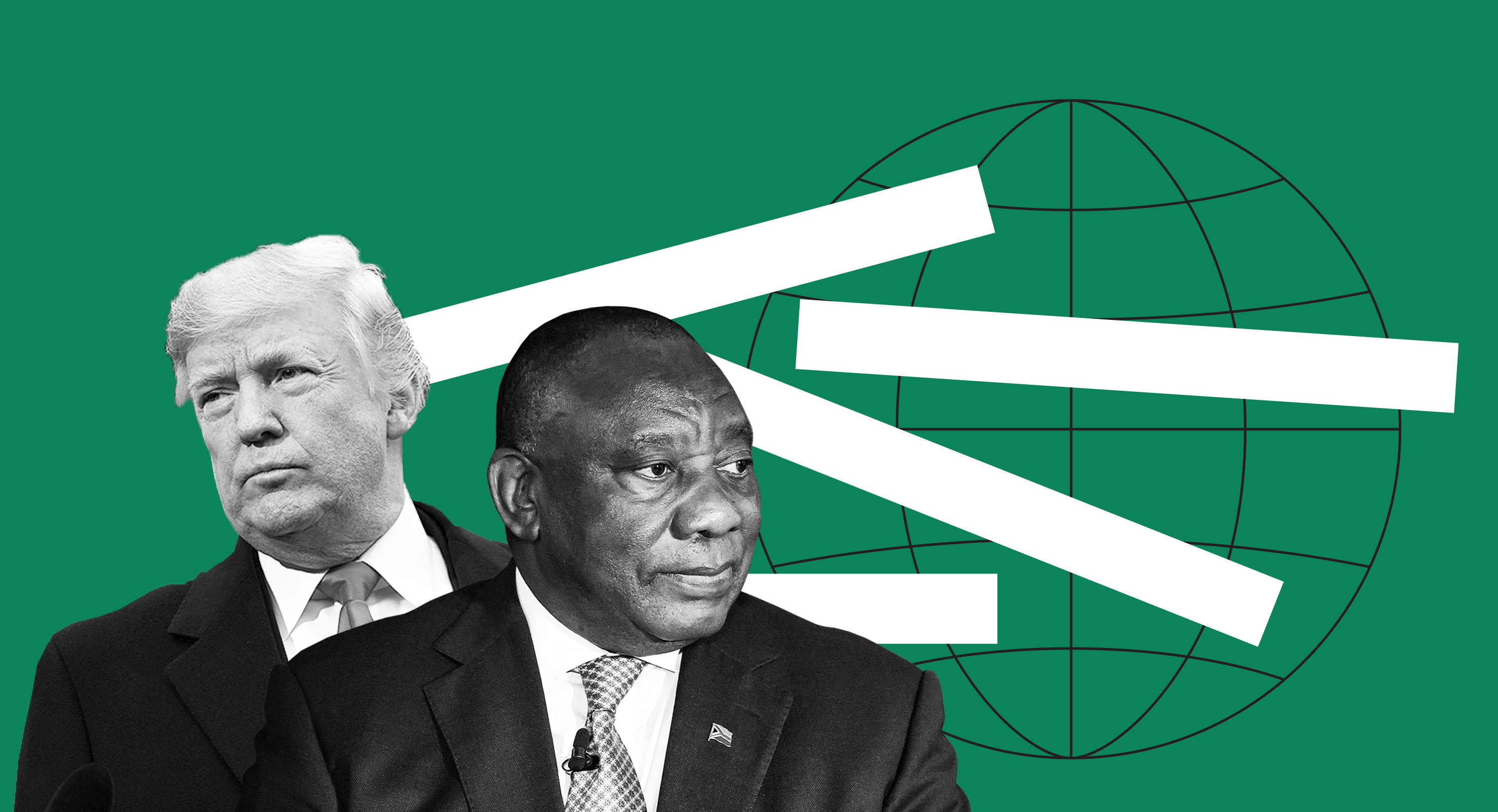
(Photos by Getty Images)
Even before Trump took office, the relationship between Washington and Pretoria was deteriorating. Now, it’s facing a complete rupture.
This piece is part of a Carnegie series examining the impacts of Trump’s first 100 days in office.
The diplomatic relationship between the United States and South Africa has entered one of its most turbulent phases since the end of apartheid. Once characterized by cooperation across sectors such as trade, health, defense, and diplomacy, the partnership is now fraying under the weight of geopolitical tensions, ideological differences, and a string of controversial policy decisions on both sides. The deterioration began during U.S. President Donald Trump’s first term and has intensified since 2022, largely due to fallout from Russia’s invasion of Ukraine, South Africa’s 2023 case against Israel at the International Court of Justice (ICJ), and South Africa’s close relationship with China.
However, tensions reached a boiling point after Trump’s return to office in January. A series of bold and, in some cases, controversial moves by the U.S. administration and a few strategic mistakes on the part of South Africa have taken the strained relationship to the brink of collapse.
Among the most incendiary was an executive order aimed at offering asylum to White South Africans—specifically Afrikaners—citing concerns over a new land reform law in South Africa. The law, part of an effort to address historical inequalities rooted in apartheid-era land dispossession, triggered alarm in some circles abroad. Trump’s order framed the situation as a human rights issue for Afrikaners, despite pushback from South Africans who saw it as a racially charged external intervention. Nearly 70,000 South Africans have since expressed interest in U.S. visas under this program, according to the South African Chamber of Commerce in the USA. Critics argue the move echoes past U.S. policies that favored the defunct apartheid regime and undermines South Africa’s ongoing efforts to redress systemic inequality. The country has the world’s highest levels of income inequalities, which, according to the International Monetary Fund, is evident in skewed income distribution, unequal access to opportunities, and regional disparities.
Another major flash point was the abrupt pause in U.S. development aid and the dismantling of USAID operations in South Africa. This particularly affected the PEPFAR program—the President’s Emergency Plan for AIDS Relief—which had been a cornerstone of the U.S.–South Africa health partnership. In 2023 alone, South Africa received roughly $460 million in PEPFAR funds, covering nearly 18 percent of the country’s total HIV/AIDS budget. The funding freeze has led to job losses in the health sector and could jeopardize efforts to combat one of the world’s most severe HIV epidemics. The South African government has begun reallocating its own resources to make up for the shortfall.
Diplomatic tensions escalated even further in March, when U.S. Secretary of State Marco Rubio declared South African Ambassador Ebrahim Rasool persona non grata after Rasool criticized the Trump administration during a private webinar. His inflammatory remarks, in which he accused the administration of mobilizing a “supremacist instinct” and “white victimhood” were considered unacceptable by Washington. Rasool, already under scrutiny for his advocacy on behalf of Palestinians and his support of South Africa’s ICJ case, was swiftly expelled. Pretoria has refrained from retaliating, instead signaling a desire to de-escalate and maintain open diplomatic channels.
Commercial diplomacy has not escaped the fallout. With a proposed 30 percent tariff rate, South Africa was among the hardest hit by Trump’s latest round of tariffs, which will disproportionately affect some African countries. Only Lesotho, Madagascar, Mauritius, Angola, Botswana, and Libya face steeper tariff hikes. Although a ninety-day pause has been granted before implementation, the looming threat of higher tariffs—particularly on automotive exports—has created deep anxiety in Pretoria.
South Africa is the largest African exporter to the United States, with at least one-quarter of these exports under the African Growth and Opportunity Act preference program. The United States is the third-largest destination for South African automotive exports, with 25,553 vehicles shipped in 2024. Should the tariffs proceed, that vital part of South Africa’s manufacturing base could lose thousands of jobs. Other exports at risk include agricultural products such as wine. Although critical minerals and natural resources remain exempt from the new tariff regime, the damage to investor confidence is already palpable.
In April, the Trump administration suspended military assistance and cooperation with the South African National Defence Force after three decades of bilateral defense collaboration. This is a symbolic yet stark marker of the unraveling relationship. Defense cooperation had long been a stabilizing force in the relationship, encompassing joint training exercises, peacekeeping coordination, and capacity-building in counterterrorism.
The U.S.-South Africa relationship today stands at a dangerous crossroads. On one side is the world’s largest economy, increasingly viewing global affairs through the lens of strategic competition and ideological alignment. On the other is Africa’s most industrialized nation, intent on carving an independent path in global diplomacy while balancing its domestic imperatives of economic justice and national development.
The consequences of a complete diplomatic rupture would be profound. For the United States, disengaging from South Africa risks further diminishing its influence in Africa at a time when it seeks to counterbalance Chinese and Russian advances across the continent. For South Africa, losing favorable access to U.S. markets, health partnerships, and development cooperation could severely undermine its socioeconomic aspirations. As the upcoming host of the G20 Summit, South Africa is positioned to emphasize Africa’s priorities on the global stage, advocating for a more inclusive and equitable international order. And the country will seek to make outreach efforts to spurned U.S. allies, especially the European Union.
Both nations have compelling reasons to pull back from the brink. Rebuilding trust will require nuanced diplomacy, mutual respect, and a willingness to engage beyond zero-sum frameworks. A durable relationship must be grounded not just in shared interests, but in an appreciation of each other’s historical contexts, domestic challenges, and foreign policy goals. The window for such reconciliation remains open—but it is rapidly closing.
Read more from this series, including:
Former Director, Africa Program
Zainab Usman was a senior fellow and the inaugural director of the Africa Program at the Carnegie Endowment for International Peace.
Former Nonresident Scholar, Africa Program
Anthony (Tony) Carroll was a nonresident scholar in the Carnegie Africa Program.
Carnegie does not take institutional positions on public policy issues; the views represented herein are those of the author(s) and do not necessarily reflect the views of Carnegie, its staff, or its trustees.
It should address the shortcomings of previous crisis communication efforts and adapt to the demands of frontier AI.

Lucy Luo
Washington’s decision to support some UN functions while letting others wither is pulling the organization apart at the seams.

Stewart Patrick, Theodore Zaritsky
AI capabilities are moving fast. Most institutions—including governments—can’t keep up.


Anton Leicht, Scott Singer

The books, podcasts, and films that explain the world it made.

Andrew Leber

U.S. trading partners in Asia are closely watching the dispute for signs of how it may affect their own interests.

Barbara Weisel