

Commentary
Venezuelans deserve to participate in collective decisionmaking and determine their own futures.
Jennifer McCoy
{
  "authors": [
    "Sheena Chestnut Greitens"
  ],
  "type": "commentary",
  "blog": "Emissary",
  "centerAffiliationAll": "",
  "centers": [
    "Carnegie Endowment for International Peace"
  ],
  "collections": [
    "Dynamic Governance Risks in Asia",
    "Korea: Emerging Player"
  ],
  "englishNewsletterAll": "",
  "nonEnglishNewsletterAll": "",
  "primaryCenter": "Carnegie Endowment for International Peace",
  "programAffiliation": "",
  "programs": [
    "Asia"
  ],
  "projects": [],
  "regions": [
    "South Korea",
    "North Korea",
    "Japan",
    "China",
    "United States"
  ],
  "topics": [
    "Democracy",
    "Foreign Policy",
    "Security",
    "Military"
  ]
}
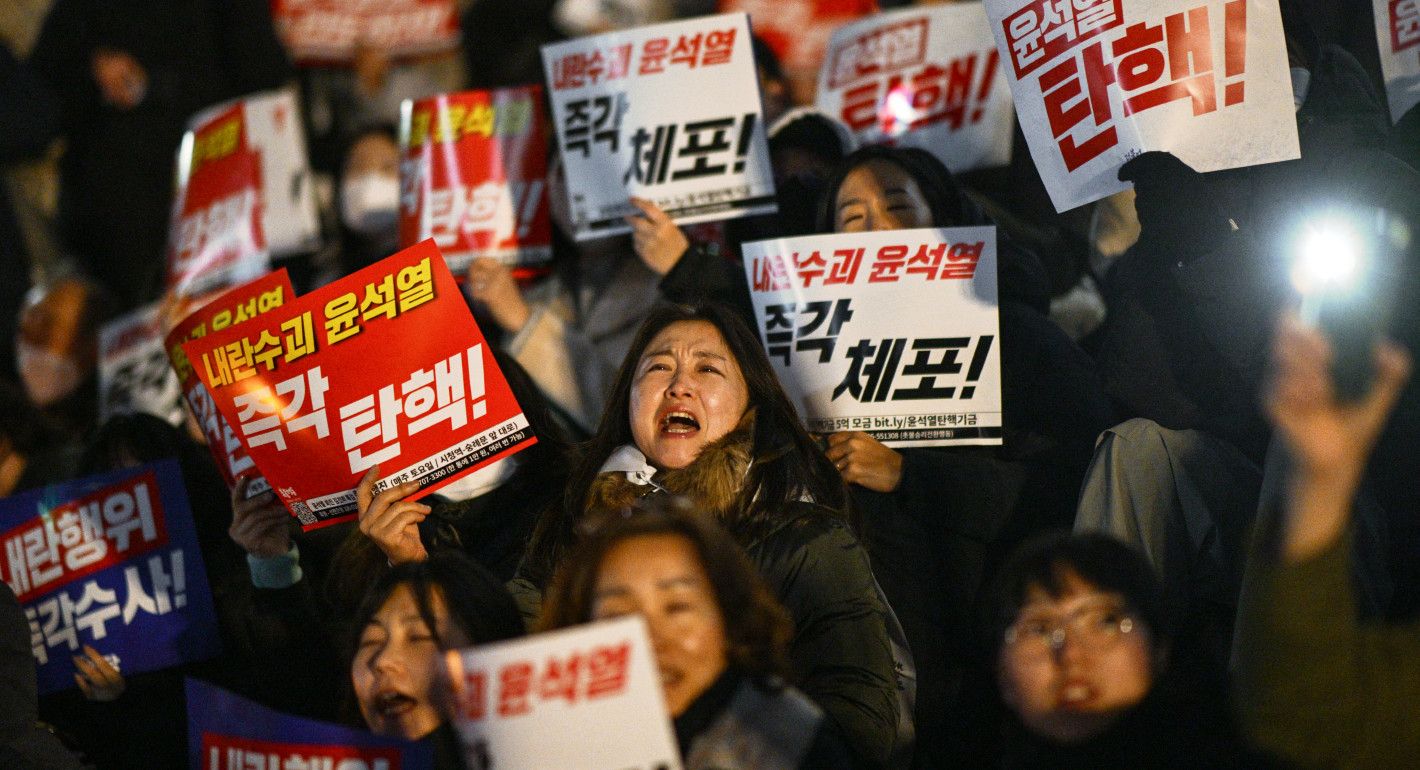
Protesters in Seoul on December 4. (Photo by Anthony Wallace/AFP via Getty Images)
While the focus has been on Seoul’s domestic crisis, Yoon may also have done serious damage to his country’s alliance with the United States, as well as his emphasis on democratic defense of shared values.
On Tuesday night, South Korean President Yoon Suk-yeol declared—and then, under pressure, quickly reversed—martial law. Disapproval spanned the political spectrum, including prominent members of Yoon’s own conservative party, and at the time of writing, the opposition Democratic Party had issued a statement telling Yoon to resign or face impeachment.
Yoon’s move, which appeared to be motivated by his frustration with policy gridlock in a divided government, stunned observers around the world. His subsequent climb-down raised questions about why he had failed to anticipate the legislative and public response and what exactly he had hoped to achieve with such a high-stakes gamble.
While the immediate crisis was short-lived, the South Korean president’s miscalculation will likely have longer-term policy ramifications both at home and abroad. Domestically, Yoon’s political survival is in doubt: he won the presidency in 2022 by a narrow margin, lost ground in the legislative elections earlier this year, and entered this episode with (at best) a 25 percent approval rating. If Yoon is impeached, as appears likely, the incident will add another layer of turbulence to South Korea’s post-democratization politics. Most of South Korea’s democratically elected presidents have eventually been investigated and imprisoned, either during or after their tenures. The previous conservative president, Park Geun-hye, was impeached and convicted of corruption following widespread popular demonstrations.
Some observers have used the swift denouement of this week’s crisis to highlight the resilience of South Korean democracy. In the face of an ill-planned power grab by the president—who backed down in the face of easily anticipated legislative and public backlash, and who apparently failed to notify his own police forces and aides of his plans—there’s no question that South Korea’s pro-democratic assertiveness was inspiring, and successful.
But longer-term concerns simmer beneath the surface. In particular, this incident spotlights the tension between the country’s vibrant civil society, unafraid to demonstrate and voice grievances with elected officials, and the illiberal partisan actors who can stymie previously authoritarian political systems’ efforts to consolidate democracy. South Korea’s experience showcases a theme of the past decade, which has been marked by global concern over democratic backsliding: liberal democracy is surprisingly hard to consolidate and maintain. “A republic, if you can keep it” turns out to be quite the challenge.
And although much focus so far has been on the crisis’s domestic stakes, many of the global consequences are yet to come. Indeed, Yoon’s decision could be particularly damaging on the international front.
With his domestic agenda largely stalled, Yoon has staked much of his legacy on a foreign policy agenda and national security strategy centered on South Korea’s identity as a leading liberal democracy—which his actions this week have now undermined. South Korea hosted the global Summit for Democracy in March, and Yoon has touted his country’s leadership as a “global pivotal state”—one that “advances freedom, peace, and prosperity through liberal democratic values and substantial cooperation.” Much of Seoul’s bilateral cooperation with Washington, as well as its strengthened trilateral cooperation with the United States and Japan, has also been framed as a democratic defense of shared values. South Korean democracy was hard-earned—and was well-defended this week at the National Assembly—but Yoon’s actions make much of his administration’s soaring rhetoric seem hollow.
Advocacy for North Korean human rights could be another casualty of Yoon’s miscalculations. His administration had reactivated South Korean leadership on human rights issues at the UN and proposed “freedom-based unification” policies that emphasized substantive improvement to the rights of the North Korean people over formal rapprochement with the Pyongyang government. Yoon’s foreign minister, Cho Tae-yul, even raised objections to the repatriation of North Korean defectors by China in calls and meetings with his Chinese counterpart, which South Korea has historically been reluctant to do. North Korea is highly likely to exploit this episode to discredit Yoon’s efforts and deflect pressure, both internally and in its foreign policy.
Yoon may also have done serious damage to his country’s alliance with the United States, undercutting recent work to expand and institutionalize security cooperation both bilaterally and multilaterally. The current U.S. administration’s public response to Yoon’s decree was remarkably milquetoast, especially for an administration that has—like Yoon’s—framed much of its strategy in terms of democratic values and cooperation.
But the costs may be yet to come. Yoon’s decision to deploy the South Korean military to impose martial law, and to do so without notifying the Combined Forces Command or U.S. Forces Korea—which are on the peninsula to deter and defend against possible North Korean aggression or provocation—raises serious questions for alliance management. Had North Korea decided to take advantage of the crisis in Seoul to stage actual military operations—unlikely, but never a possibility to ignore—the United States would have suddenly assumed operational control over a military that had just been pulled away from defending its own citizens and ordered to suppress them instead. American policymakers might reasonably object to being put in that situation without so much as a heads up.
Improving alliance coordination has been a priority of the current U.S. administration, which has used recent steps such as the Special Measures Agreement, just signed for 2026-2030, to insulate defense cooperation from the kind of acrimony over burden-sharing that consumed time and attention during the first administration of Donald Trump. On the heels of that and other efforts, however, Yoon may have unintentionally given advocates of decreased commitment to South Korea a major boon by allowing them to paint Seoul as a rogue and unreliable partner that keeps Washington in the dark and jeopardizes stable deterrence on the peninsula for its own political purposes. And in light of possible upcoming economic friction between Washington and its Asian allies over tariffs and tech policy, anything that weakens South Korea’s hand is not helpful.
Finally, if Yoon’s days in office are short-lived, a larger shift in South Korea’s grand strategic orientation may emerge. The country’s next president may not be willing to ruffle feathers in China the same way over North Korean human rights or defense cooperation with the United States, and may instead actively seek to reduce tensions with Beijing. Yoon’s successor also may not continue his efforts to condition inter-Korean rapprochement and pursuit of unification on North Korea’s democratization, and may not be willing to expend the political capital Yoon did to further institutionalize security cooperation with Japan. Reversals or shifts in policy toward the United States, China, Japan, and North Korea—just to start—could all be ahead as the crisis in South Korea moves into its next phase.
The latest from Carnegie scholars on the world’s most pressing challenges, delivered to your inbox.
Carnegie does not take institutional positions on public policy issues; the views represented herein are those of the author(s) and do not necessarily reflect the views of Carnegie, its staff, or its trustees.
Venezuelans deserve to participate in collective decisionmaking and determine their own futures.

Jennifer McCoy
A conversation with Karim Sadjadpour and Robin Wright about the recent protests and where the Islamic Republic might go from here.

Aaron David Miller, Karim Sadjadpour, Robin Wright
When democracies and autocracies are seen as interchangeable targets, the language of democracy becomes hollow, and the incentives for democratic governance erode.
Sarah Yerkes, Amr Hamzawy
From Sudan to Ukraine, UAVs have upended warfighting tactics and become one of the most destructive weapons of conflict.

Jon Bateman, Steve Feldstein
And how they can respond.
Sophia Besch, Steve Feldstein, Stewart Patrick, …