

Commentary
Washington’s decision to support some UN functions while letting others wither is pulling the organization apart at the seams.
Stewart Patrick, Theodore Zaritsky
{
  "authors": [
    "Aaron David Miller",
    "Karim Sadjadpour",
    "Robin Wright"
  ],
  "type": "questionAnswer",
  "blog": "Emissary",
  "centerAffiliationAll": "dc",
  "centers": [
    "Carnegie Endowment for International Peace"
  ],
  "englishNewsletterAll": "americanStatecraft",
  "nonEnglishNewsletterAll": "",
  "primaryCenter": "Carnegie Endowment for International Peace",
  "programAffiliation": "ASP",
  "programs": [
    "American Statecraft"
  ],
  "regions": [
    "Middle East",
    "Iran"
  ],
  "topics": [
    "Security",
    "Military",
    "Domestic Politics"
  ]
}
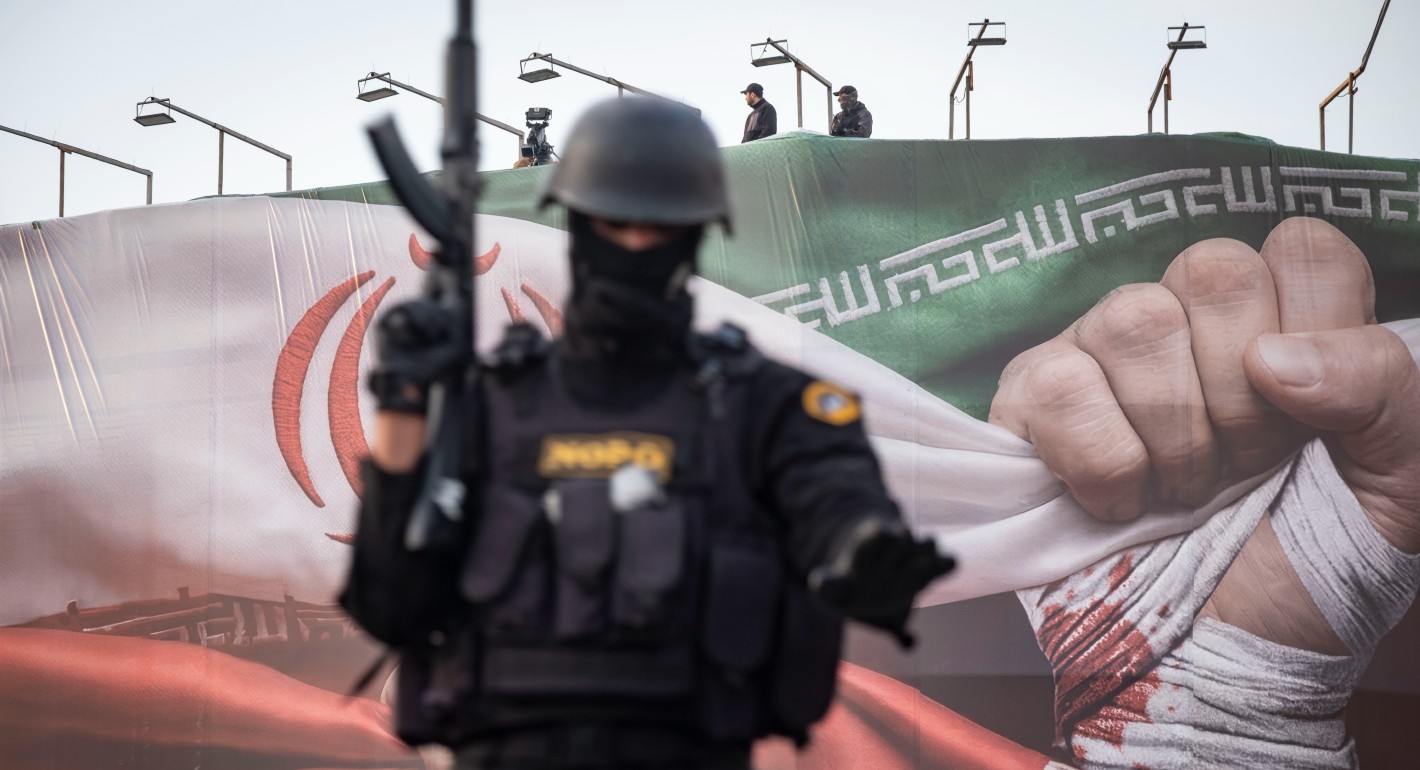
Iranian policy monitor a pro-government rally in Tehran on January 12, 2026. (Photo by Morteza Nikoubazl/NurPhoto via Getty Images)
A conversation with Karim Sadjadpour and Robin Wright about the recent protests and where the Islamic Republic might go from here.
On a recent episode of Carnegie Connects, Aaron David Miller spoke with Carnegie senior fellow Karim Sadjadpour and New Yorker writer Robin Wright about the protests in Iran. Excerpts from their conversation, which have been edited for clarity, are below. Watch the full discussion here.
Aaron David Miller: What’s happening with the protests?
Robin Wright: When we look at this moment, we need to put it in context. The revolution in 1978–79 took fourteen months. We’ve seen a series of protests beginning in 2009, but which have accelerated since 2017, over diverse issues. The economy was in 2017-18. The Women, Life, Freedom protests were over personal freedoms. Today, you see it playing out really over the system. But each of these protests in the end evolved into calls for death to the dictator, down with the regime. So we can’t just look at what happened in the past month, but in context of what’s happened over the past eight to nine years, and the steady rhythm over a lot of different issues.
Now, the regime still has tools that it has used brutally, ruthlessly against its own people. But I think that is only going to backfire against it. The theocracy is rotting from within. It has become a tighter and tighter inner circle around the supreme leader that has detained and discredited and discarded many of its own kind in order to survive. The odds are not in its favor. The crowd at Friday prayers has grown grayer and grayer and older and older. At Ayatollah Khomeini’s mausoleum, the crowds are very small—except on national holidays when the regime mobilized people—and they’re often Shiite pilgrims or foreign tourists.
This is a system that does not have the kind of support it needs to survive long-term. It promised to help the oppressed, which was the message of the revolution, and the oppressed now are in worse shape in day-to-day living, in participation in the system, than they were under the shah.
Karim Sadjadpour: One of the reasons we don’t even know a clear death count is that the regime has shut off all communications inside Iran. The internet, cellular communications, and satellite communications have been shut down. There have been brief periods in which people can communicate with the outside world, but this is a population that has had 1 percent connectivity over the last eight to nine days. This is a typical move by the Islamic Republic—to shut down all communications, put a digital blanket over the nation, and kill people in the dark.
Aaron David Miller: Does it surprise you that these demonstrations remain leaderless? There’s no internal coherent alternative [to the regime]. Why is that?
Karim Sadjadpour: When I was based in Tehran many years ago, I used to sometimes attend anti-government protests, just as an observer. It is an incredibly intimidating atmosphere when you leave your home and you see many thousands of men holding machine guns. Roads are blocked. Highways are blocked. So when you see tens of thousands, probably collectively millions, of protesters throughout the country, that’s very significant, because each of these people knows that they’re taking the ultimate risk. They’re risking their lives.
The Islamic Republic is now essentially not really governing anymore. It’s just set up not to collapse. One of the distinctions between this regime and the shah’s regime is that many of the shah’s political and military elite had studied in the United States and Europe. When the going got tough 1978, they could remake their lives elsewhere abroad. Whereas the Islamic Republic’s political and military elite have much more provincial backgrounds. They’re probably, after North Korea, the most isolated, friendless regime in the world. So their mentality is kill or be killed.
What we haven’t yet seen inside the Islamic Republic are [Boris] Yeltsin-type figures, figures that belong to the regime who have broken away in a meaningful way and say, “This ship is sinking, and I’m going to join the opposition.” And that’s partly due to the fact that its regime is like an onion: It’s purged so many layers over the past two decades. When it’s essentially a one-man rule, there are a few Yeltsins. The Yeltsins have already been purged from the system.
But what we haven’t also seen are, at least publicly, splinters within the security forces. That is essentially what is keeping this regime in power for now.
The Islamic Republic is now essentially not really governing anymore. It’s just set up not to collapse.
Robin Wright: One problem is that some of the most outspoken figures, like Narges Mohammadi, who won the Nobel Peace Prize, are in jail. It’s very hard for them to mobilize. She’s been incredibly brave in making statements attacking the regime.
But the government is so penetrated. People are afraid to talk on the phone. I remember on one of my trips, I was told to take my SIM card out of my phone so that they can’t tap into what I was saying. But if you take your SIM card out, there’s suspicion that maybe you’re doing something that you shouldn’t be doing or that’s anti-government.
When you ask where the leaders are, you look at President Mohammad Khatami, who was a reformer who held office [from 1997 to 2005]. He’s now banned from speaking to the Iranian media. He’s banned from travel overseas—his passport was confiscated. So even at the highest levels, the theocracy is limiting everybody’s ability to challenge it from within.
Aaron David Miller: When we talk about fracturing or divisions within the security and military elite, what are we really talking about? What would have to happen in order to challenge the existing order?
Robin Wright: That’s really the key question, because the end of the revolution in 1979 was largely because the military defected from the monarchy—refused to fire on Iranians to keep the shah in power. That’s just as true today.
I remember in 2009 during the Green Movement that there were young members of the Revolutionary Guards from on top of a barracks in Tehran shouting “Death to the dictator.” We overseas tend to band all of the military, the Revolutionary Guards, Iran’s conventional military into one lump sum, when they’re very different and diverse.
The reality is that young Iranian men have to do national service. Some of them will opt to enlist in the Revolutionary Guard because they get off earlier in the day and they can get a second job to make more money. Or it’s better to have the Revolutionary Guard on your résumé to get into a university or a better job. They don’t necessarily share the rigid ideology of those at the top. The conventional military sometimes has had leaders who were not as ideological in terms of their commitment, but they believed in that national preservation. Nationalism is a huge factor and always has been.
Although we all focus so heavily on the protesters—the numbers, the places where people are taking to the streets—we also ought to be paying a lot of attention to the fractures within the military. I don’t think they’re sufficient enough yet that you’re going to see people lay down their arms or refuse to shoot or take action against protesters. The reality is life is really tough now, and to lose your job because you refuse military orders—those in the military face the same day-to-day problems that every other Iranian does. Do you want to take on the system by yourself? That’s really tough to do.
We overseas tend to band all of the military, the Revolutionary Guards, Iran’s conventional military into one lump sum, when they’re very different and diverse.
Aaron David Miller: Where are you on [exiled Crown Prince] Reza Pahlavi?
Karim Sadjadpour: I’ve known him for two decades, and I consider him a friend.
I think one of the reasons why his name has resonated among people is that his position has been very consistent over the past forty-five years. His message has always been patriotic and democratic.
Among Iranians—and I’m not talking about the diaspora—there’s this what I call a forward-looking nostalgia among Iranians, similar to Make America Great Again: Make Iran Great Again—that there was a time prior to 1979 when Iran’s economy was growing, when Iranians had social freedoms, and when the country had a positive name. It wasn’t associated with terrorism and repression. By default, given that the regime is decapitating other potential leaders inside the country, many people have been chanting Reza Pahlavi’s name.
There are a couple challenges he obviously has. One is that he hasn’t been inside the country for forty-seven years. We know from history that all revolutions require both inspirational leaders and organizational leaders to have a ground game. The second challenge he has is that he’s been very consistent in saying that his end game is to be a transitional figure. At most, if people vote to have a constitutional monarchy, he would play that role. But he’s not interested in being an absolute autocrat or an absolute monarch. That’s not what many of his most passionate supporters would like to see—I think they would like to see him rule as an absolute monarch. This is a source of tension within the opposition, and it somewhat inhibits his ability to peel people away from the regime if they feel like the next rulers of Iran could come after them.
Aaron David Miller: We may be at the beginning of the end, but maybe we’re also at the end of a beginning—which will create a transitional regime that may not be to our liking. Because whoever controls the guns, the money, and the oil strikes me as the most likely structure to inherit power from the regime that now exists. Is that a flawed logic?
Robin Wright: I think we need to remember that at the beginning of the twentieth century, Iran had the first democratic parliament in all of Asia. It had the first democratic constitution in all of Asia. That system was pushed aside by the first shah, who was forced from power during World War II because of his pro-Nazi sentiments. Iranian history goes back to Cyrus the Great, who was the first one to talk about power could only be legitimate when it came from the people.
When we look at the Middle East, we often group all these countries together, when they have very diverse histories. I think Iranians do have a sense of democracy. That’s what the revolution was all about, and it was hijacked—in part because of the diversity and divisions within the nationalists and the Democrats and so forth, and they let the clergy hijack it when it came to writing a new constitution. Everyone looks at the death of Ayatollah Khamenei as a turning point. It may be, but the Revolutionary Guard and military could move in to make sure that the system survives, especially because the Revolutionary Guard has such a strong economic interest in preserving the system. So there are a lot of diverse ideas within Iran, and many of them were democratic. When you find five Iranians, you’ll find six different opinions. So don’t count on aspirations to be just one thing or the future to hold just one possibility.
Everyone looks at the death of Ayatollah Khamenei as a turning point. It may be, but the Revolutionary Guard and military could move in to make sure that the system survives, especially because the Revolutionary Guard has such a strong economic interest in preserving the system.
Karim Sadjadpour: Iran has the political maturity for representative government. It’s a society that is ripe for democracy. But democracy doesn’t just all of a sudden break out. It requires enormous organization and enlightened leadership. And under brutal authoritarian regimes, those are the types of people that they target—people who are potential democratic leaders capable of organization.
I would say that just because the odds of a transition to Denmark are not great, that [doesn’t] mean that a political transition will not be to [the United States’] liking. From the vantage point of the United States, it is a regime with no redeeming qualities. It’s arguably our fiercest adversary. No other government in the world has spent the political and economic capital trying to undermine the United States and our allies over the past four or five decades. So even if it’s a transition from the status quo to a government that may not be democratic but its organizing principle is the economic and national interests of Iran, that would be better for the Iranian people, and it would be better for United States interest as well.
Use the player below to listen to the whole conversation, or watch it on YouTube.
Invalid video URL

Senior Fellow, American Statecraft Program
Aaron David Miller is a senior fellow at the Carnegie Endowment for International Peace, focusing on U.S. foreign policy.

Senior Fellow, Middle East Program
Karim Sadjadpour is a senior fellow at the Carnegie Endowment for International Peace, where he focuses on Iran and U.S. foreign policy toward the Middle East.
Robin Wright
Contributing Writer and Columnist, The New Yorker
Robin Wright, a contributing writer and columnist, has written for The New Yorker since 1988. Her first piece on Iran won the National Magazine Award for best reporting. A former correspondent for The Washington Post, CBS News, The Los Angeles Times, and The Sunday Times of London, she has reported from more than a hundred and fifty countries and all seven continents. She has also been a senior fellow at the Woodrow Wilson International Center for Scholars, the U.S. Institute of Peace, the Brookings Institution and the Carnegie Endowment for International Peace as well as at Yale, Duke, Dartmouth, and the University of California.
Carnegie does not take institutional positions on public policy issues; the views represented herein are those of the author(s) and do not necessarily reflect the views of Carnegie, its staff, or its trustees.

Washington’s decision to support some UN functions while letting others wither is pulling the organization apart at the seams.

Stewart Patrick, Theodore Zaritsky
They face an uphill climb, but they could draw on a strategy that other diplomats have used in the past.


Shana Tabak, Alejandro Martin Rodriguez

The books, podcasts, and films that explain the world it made.

Andrew Leber

U.S. trading partners in Asia are closely watching the dispute for signs of how it may affect their own interests.

Barbara Weisel
The ninety-three-year-old Biya’s absence and refusal to name a vice president threaten to upend domestic and regional stability.

Lesley Anne Warner