

Commentary
When democracies and autocracies are seen as interchangeable targets, the language of democracy becomes hollow, and the incentives for democratic governance erode.
Sarah Yerkes, Amr Hamzawy
{
  "authors": [
    "Thomas Carothers"
  ],
  "type": "legacyinthemedia",
  "centerAffiliationAll": "",
  "centers": [
    "Carnegie Endowment for International Peace"
  ],
  "collections": [],
  "englishNewsletterAll": "",
  "nonEnglishNewsletterAll": "",
  "primaryCenter": "Carnegie Endowment for International Peace",
  "programAffiliation": "",
  "programs": [
    "Democracy, Conflict, and Governance"
  ],
  "projects": [],
  "regions": [],
  "topics": [
    "Political Reform",
    "Democracy",
    "Foreign Policy"
  ]
}
REQUIRED IMAGE
Source: Carnegie
The Washington Post, January 29, 2001
It has been fashionable in recent years for political analysts to cluck reprovingly at U.S. efforts to promote free and fair elections abroad. Elections in shaky democracies may produce illiberal leaders, they warn, or ignite ethnic conflicts or simply fall apart. Naive Americans, their argument goes, should stop trying to export their fascination with elections to inhospitable climes.
Yet last year something interesting happened: Elections were the key steps in democratic transitions on several continents. Mexico was one clear case. The election of Vicente Fox to the presidency and the transfer of power after the 70-year rule of the Institutional Revolutionary Party was a breakthrough for democracy there. A gradual process of political liberalization dating from the late 1980s paved the way for this historic change, but it was the successive presidential elections themselves -- in 1988, '94 and above all last year -- that gave structure and focus to the process of change.
In Serbia, Slobodan Milosevic made the classic blunder of the isolated strongman -- underestimating the depth of opposition and believing he could use elections, manipulating them as need be, to legitimate his continued rule. After challenger Vojislav Kostunica was denied victory in the first round, the country rose up against Milosevic and within two weeks drove him from power. Again, the elections were only part of a longer process of democratic ferment, but they served as a critical turning point.
Former Peruvian president Alberto Fujimori sought to extend his authoritarian rule into a third term by strong-arming Peru's national elections of last April. His main opponent, Alejandro Toledo, withdrew from the second round of a badly flawed process, and the normally cautious Organization of American States described the elections as neither free nor fair and the regime as "sinister." Fujimori's electoral shenanigans galvanized his domestic opposition and the international community, setting in motion a legitimacy crisis that led within several months to the collapse of his presidency.
Ghana's December elections brought a peaceful, orderly end to the 20-year rule of President Jerry Rawlings, a regime that started as a dictatorship but gradually evolved into something more democratic. As in Mexico, the willingness of the ruling elite to carry out a gradual political liberalization set the stage for a democratic transition. But elections were the defining moment.
With U.S. foreign policy in transition, and amid renewed debate about the wisdom of America's trying to promote its values abroad, these four cases highlight another important fact: While pro-democratic outcomes in all four countries were principally the work of domestic political actors, the United States played a positive, facilitating role in each.
Bringing Mexico into the North American Free Trade Agreement created a broader context of integration that reinforced pressure on the Mexican political elite to move ahead with liberalization. U.S.-funded efforts to aid Mexican nongovernmental groups promoting a clean election helped ensure the integrity of the process.
In Serbia, U.S. pressure on many levels, including wide-ranging support for civic and political activists, added to the mix of political forces that brought down Milosevic.
After years of supporting Fujimori because of his cooperation in the drug war, the U.S. government finally turned against him. U.S. aid to Peruvian human rights groups and other civic organizations bolstered democrats at key moments.
A first-ever U.S. presidential visit to Ghana in March 1998 gave heft to U.S. support for the delicate process of democratic transition there. A small but sustained aid program for the Ghanaian electoral commission strengthened the electoral process.
The jury is still out on whether the democratic tide that swept through the world in the past two decades is receding or still rising. But the record of the past year reminds us that elections do have a valuable place in the process, even with the risks and shortcomings they often entail. And with appropriately modest expectations but genuine commitment, the United States has a critical role to play in helping out.
Carnegie does not take institutional positions on public policy issues; the views represented herein are those of the author(s) and do not necessarily reflect the views of Carnegie, its staff, or its trustees.
When democracies and autocracies are seen as interchangeable targets, the language of democracy becomes hollow, and the incentives for democratic governance erode.
Sarah Yerkes, Amr Hamzawy
Unexpectedly, Trump’s America appears to have replaced Putin’s Russia’s as the world’s biggest disruptor.
Alexander Baunov
And how they can respond.

Sophia Besch, Steve Feldstein, Stewart Patrick, …
They cannot return to the comforts of asymmetric reliance, dressed up as partnership.
Sophia Besch
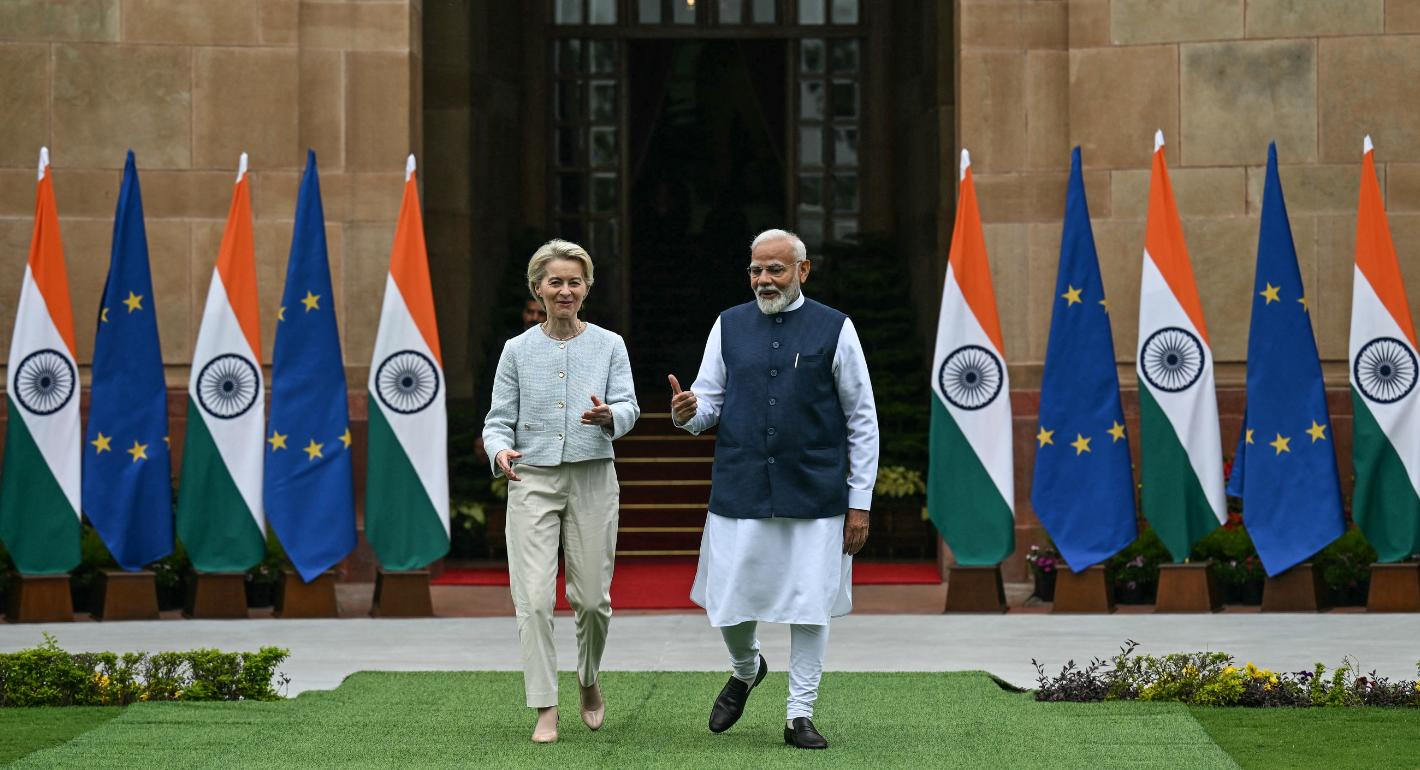
As European leadership prepares for the sixteenth EU-India Summit, both sides must reckon with trade-offs in order to secure a mutually beneficial Free Trade Agreement.

Dinakar Peri