

Commentary
Dmitri Trenin
{
  "authors": [
    "Dmitri Trenin"
  ],
  "type": "legacyinthemedia",
  "centerAffiliationAll": "",
  "centers": [
    "Carnegie Endowment for International Peace",
    "Carnegie Russia Eurasia Center"
  ],
  "collections": [],
  "englishNewsletterAll": "",
  "nonEnglishNewsletterAll": "",
  "primaryCenter": "Carnegie Russia Eurasia Center",
  "programAffiliation": "",
  "programs": [],
  "projects": [],
  "regions": [
    "North America",
    "United States",
    "Middle East",
    "East Asia",
    "China",
    "Central Asia",
    "Caucasus",
    "Russia",
    "Eastern Europe",
    "Ukraine",
    "Western Europe"
  ],
  "topics": [
    "Political Reform",
    "Economy",
    "Trade",
    "Climate Change",
    "Security",
    "Foreign Policy",
    "Nuclear Policy",
    "Nuclear Energy",
    "Domestic Politics"
  ]
}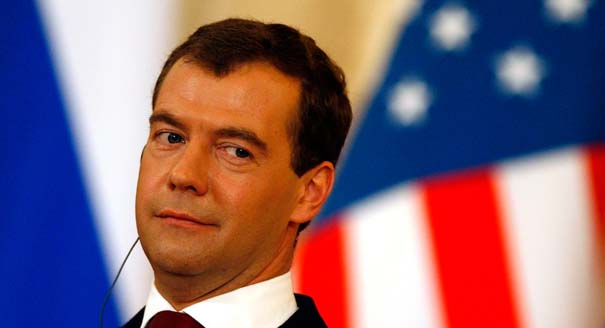
Source: Getty
By embracing a soft power foreign policy fueled by a new focus on economic, intellectual and social renewal, Russia can emerge as a serious and indispensable global actor.
Source: Foreign Affairs

Throughout the 1990s, Moscow attempted to integrate into, and then with, the West. These efforts failed, both because the West lacked the will to adopt Russia as one of its own and because Russian elites chose to embrace a corporatist and conservative policy agenda at home and abroad.
As a result, in the second presidential term of Vladimir Putin, Russia abandoned its goal of joining the West and returned to its default option of behaving as an independent great power. It redefined its objectives: soft dominance in its immediate neighborhood; equality with the world's principal power centers, China, the European Union, and the United States; and membership in a global multipolar order.
Half a decade later, this policy course has revealed its failures and flaws. Most are rooted in the Russian government's inability and unwillingness to reform the country's energy-dependent economy, the noncompetitive nature of Russian politics, and a trend toward nationalism and isolationism. In terms of foreign policy, Russia's leaders have failed to close the book on the lost Soviet empire. It is as if they exited the twentieth century through two doors at the same time: one leading to the globalized market of the twenty-first century and the other opening onto the Great Game of the nineteenth century.
As the current global economic crisis has demonstrated, the model that Russia's contemporary leaders have chosen -- growth without development, capitalism without democracy, and great-power policies without international appeal -- cannot hold forever. Not only will Russia fail to achieve its principal foreign policy objectives, it will fall further behind in a world increasingly defined by instant communication and open borders, leading to dangers not merely to its status but also to its existence. Russia's foreign policy needs more than a reset: it requires a new strategy and new policy instruments and mechanisms to implement it.
Reprinted by permission of FOREIGN AFFAIRS, October 22, 2009. Copyright 2009 by the Council on Foreign Relations, Inc.
Former Director, Carnegie Moscow Center
Trenin was director of the Carnegie Moscow Center from 2008 to early 2022.
Recent Work
Dmitri Trenin
Dmitri Trenin
Carnegie does not take institutional positions on public policy issues; the views represented herein are those of the author(s) and do not necessarily reflect the views of Carnegie, its staff, or its trustees.

As we close out another season of Strategic Europe, it is worth taking stock of the deep shifts underway.

Rym Momtaz

The hybrid warfare landscape is evolving rapidly, leaving policymakers without clear strategies. To better inform their work in addressing emerging challenges, governments must dig deeper into the underlying dynamics at play.


Raluca Csernatoni, Alicia Wanless
The EU had to compromise to adopt a twenty-first sanctions package against Russia, exposing growing cracks in the union’s resolve. Is this latest, weaker round worth it to keep pressure on Moscow?
Rym Momtaz, ed.

Trump is distracted and Ukraine wants Europe to step up. The continent’s leaders must find their voice and assert it in talks with Russia.

Alissa de Carbonnel

Mounting economic strain and battlefield losses will not necessarily make the Kremlin less dangerous. They could instead push Moscow toward a more aggressive hybrid campaign designed to test NATO’s Eastern flank, exploit allied hesitation, and fracture European resolve.

Maksym Beznosiuk