

Commentary
Dmitri Trenin
{
  "authors": [
    "Dmitri Trenin"
  ],
  "type": "commentary",
  "centerAffiliationAll": "",
  "centers": [
    "Carnegie Endowment for International Peace",
    "Carnegie Russia Eurasia Center"
  ],
  "collections": [],
  "englishNewsletterAll": "",
  "nonEnglishNewsletterAll": "",
  "primaryCenter": "Carnegie Russia Eurasia Center",
  "programAffiliation": "",
  "programs": [],
  "projects": [],
  "regions": [
    "Russia"
  ],
  "topics": [
    "Political Reform",
    "Economy",
    "Security",
    "Military",
    "Foreign Policy",
    "Civil Society"
  ]
}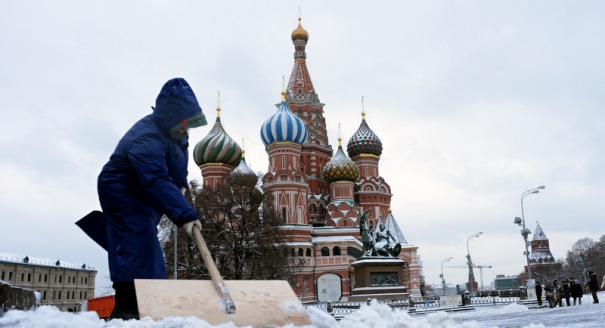
Source: Getty
The 20th anniversary of Russia’s Constitution and the Russian president’s State of the Nation Address delivered before the Federal Assembly are an opportune moment to sum up the state of Russia in 2013 and look ahead, in terms of its political system, economic, foreign, and security policies.
Last week, the Russian Federation marked the 20th anniversary of its Constitution; the Russian president delivered his annual State of the Nation Address before the Federal Assembly; as commander-in-chief of the armed forces, he also met with the military top brass. This is an opportune moment to sum up the state of Russia in 2013 and look ahead, in terms of its political system, economic, foreign, and security policies.
The current Russian Constitution is sometimes criticized for being the basis of a personalized political regime. This is certainly true, but the issue is deeper. The 1993 basic law of the Russian Federation, which borrowed from the best Western models, still remains a bit too advanced for the bulk of the Russian people, including the elites. No wonder it has been appropriated by the neo-czarist system which was established by the mid-1990s and consolidated in the 2000s. Politically, Russia is a monarchy adjusted to the conditions of the 21st century. For it to become a republic, a Russian political nation has to emerge first. The process may well take another 20 years.
Meanwhile, President Vladimir Putin's main concern is the worsening economic situation, which he candidly ascribed to internal rather than international factors. Vladimir Putin sees a direct link between the tightening budgets and domestic sociopolitical stability, and vows to honor his earlier commitments. So far, Putin seems not to have made a decision about the future course of economic policy, his measures are either technocratic, such as raising Russia's ranking in the Doing Business rating, or administrative, as with "de-offshorization" of the economy, but the point of decision is drawing closer. Putin's choice of economic course will be made clear when he appoints a new prime minister.
Russia's foreign policy, by contrast, has hardly lacked clarity. It is based on the worldview according to which international relations are a highly competitive field with several power centers, including Russia, vying for power and influence. Recently, Moscow has expanded its heretofore pragmatic stance by adding a normative dimension to it, as a self-conscious champion of conservative values. These include not only the traditional family and religious faith, but national sovereignty and non-interference in internal affairs of others. Syria's chemical disarmament and the interim nuclear accord with Iran, both co-brokered by Russia under threat of U.S. military action, are first evidence of Moscow becoming a producer of international public goods: a welcome development amidst all the inter-polar competition in the world.
Yet, Commander-in-Chief Putin is anything but relaxed. Russia needs to build its defense tous azimuts: west, east, and south. The Arctic has recently added a fourth flank, which Putin is now working to cover. Globally, the main threat is still perceived to come from the United States. Besides ballistic missile defense, a new major concern has surfaced: the U.S. concept of a Prompt Global Strike. If realized, Putin has warned, these plans can disrupt the global strategic balance and undo all the achievements of arms control. In response, the Russian president is continuing—all the budgetary problems notwithstanding—with his massive military rearmament plans.
This year, Russia has marked the 400th anniversary of the Romanov dynasty. A very popular exhibition devoted to the former royal family is running at the Manège, near the Kremlin. A TV series recounts the feats of the czars and emperors, and describes their failings. It is more than teaching history: rather, these are parts of the Kremlin's nation-building project, which aims to highlight the values of patriotism and to depict revolution as a crime not only against the state, but society as well. Yet, subconsciously, many Russians cannot escape an eerie feeling of a déjà vu: 2013-1913, 2017-1917? There is no reason to believe that Russia is doomed to experience a new mega-upheaval as it did century ago. Yet, its domestic problems are serious and the global environment is fast-moving. One thing is clear: Vladimir Putin may be a modern czar, but he is not Nicholas II.
Former Director, Carnegie Moscow Center
Trenin was director of the Carnegie Moscow Center from 2008 to early 2022.
Recent Work
Dmitri Trenin
Dmitri Trenin
Carnegie does not take institutional positions on public policy issues; the views represented herein are those of the author(s) and do not necessarily reflect the views of Carnegie, its staff, or its trustees.

In supporting Europe’s far-right, MAGA and Russia both want the same thing: a weaker EU. Europe must defend itself without abandoning the openness these forces exploit.

Armida van Rij

As we close out another season of Strategic Europe, it is worth taking stock of the deep shifts underway.

Rym Momtaz

The hybrid warfare landscape is evolving rapidly, leaving policymakers without clear strategies. To better inform their work in addressing emerging challenges, governments must dig deeper into the underlying dynamics at play.


Raluca Csernatoni, Alicia Wanless
The EU had to compromise to adopt a twenty-first sanctions package against Russia, exposing growing cracks in the union’s resolve. Is this latest, weaker round worth it to keep pressure on Moscow?
Rym Momtaz, ed.

Trump is distracted and Ukraine wants Europe to step up. The continent’s leaders must find their voice and assert it in talks with Russia.

Alissa de Carbonnel