

Commentary
The EU can impose sanctions but struggles to enforce them without the United States. With Washington increasingly disinterested in backing European interests, the bloc must now fend for itself.
Nicu Popescu, Tiago Antunes
{
  "authors": [
    "Akio Kawato"
  ],
  "type": "commentary",
  "centerAffiliationAll": "",
  "centers": [
    "Carnegie Endowment for International Peace",
    "Carnegie Russia Eurasia Center"
  ],
  "collections": [],
  "englishNewsletterAll": "",
  "nonEnglishNewsletterAll": "",
  "primaryCenter": "Carnegie Russia Eurasia Center",
  "programAffiliation": "",
  "programs": [],
  "projects": [],
  "regions": [
    "North America",
    "United States",
    "South Asia",
    "India",
    "East Asia",
    "China",
    "Japan",
    "Russia"
  ],
  "topics": [
    "Economy",
    "Trade",
    "Climate Change",
    "Security",
    "Military",
    "Foreign Policy",
    "Nuclear Policy",
    "Arms Control",
    "Global Governance"
  ]
}
Source: Getty
The recent developments in Asia-Pacific indicate a necessity to start serious talks for “stock-taking” of the military forces in the region. Also, Russia’s active involvement in regional security affairs is needed.
The question of security is becoming more acute in Asia-Pacific. Many things are being realigned in accordance with the rise of Chinese power.
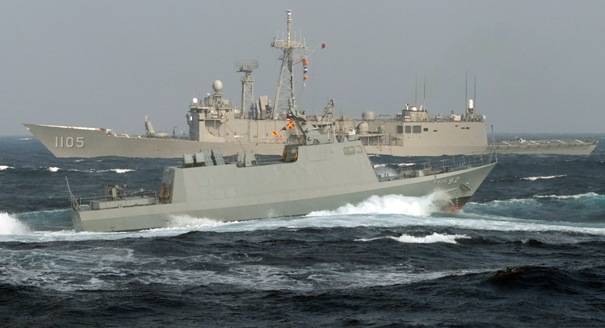
The Chinese show interest in natural resources in the Arctic, and they are eager to use the North Pole navigation route via the Bering Strait; that may eventually prompt a Chinese naval foray into the Sea of Okhotsk. Indeed, when Russia and China conducted joint naval exercise offshore Vladivostok late July, five Chinese vessels peacefully advanced to the Sea of Okhotsk, the sanctuary for the Russian strategic nuclear submarines. China has rented a quay in Port of Rajin, North Korea, and someday it may want to station their navy in this port, which is very close to Vladivostok. Chinese naval presence in the Sea of Okhotsk and the Sea of Japan will substantially affect security of Japan, South Korea, and Russia. If things go on like this, Russia will have to reconsider the strategic meaning of Petropavlovsk, the Sea of Okhotsk and the four disputed islands offshore Japan.
Russian Gazprom is now drilling oil and natural gas in the seabed offshore Vietnam, so the Russian Minister of Defense Sergei Shoigu expressed a wish to regain the right to use the Kamran Bay facility (the Russian Navy rented it until 2002). Further in the south the Malacca Strait and the South China Sea lie as vital sea lane for tankers and cargo ships of many countries, Japan, China, India, and even the United States (tankers, carrying a chunk of the crude oil produced in the Gulf countries, pass through this area en route to the United States). India will import oil and liquefied gas from Russia’s Far East via this sea lane, too.
But China is attempting to enhance its control over the South China Sea by asserting ownership of several islands in dispute with surrounding countries; China probably wants to make the South China Sea a sanctuary for its future strategic nuclear submarines. All this means a necessity to have candid dialogues among interested countries to sort out each country’s interest and to find ways to avoid unnecessary collisions.
The situation on land is even more intricate. The vast Chinese land is now crisscrossed by modern highways and railways with rapid trains (though their number is not many), with which China is now able to move their armed forces en masse very rapidly. Large transport airplanes have a capacity to move troops across the continent. In a joint SCO (Shanghai Cooperation Organization) exercise in Kazakhstan in 2010 China demonstrated its capability to refuel transport airplanes in the air. Moreover, neither Russia nor the United States does not have proper means to deter the Chinese intermediate-range nuclear missiles, the number of which may well exceed one hundred.
These developments indicate a necessity to start serious talks for “stock-taking” of the military forces in the region in order to reach agreements on confidence-building measures (the “Vienna Document” of the OSCE would be a good model), military control, and eventual disarmament. We do not have Munich in Asia, but similar venues are many: ASEAN Regional Forum (ARF) and the Shangri-la Dialogue.
The security situation in Asia-Pacific is becoming more acute, and it now affects Russia in a more real way than in the past. Russia’s active involvement in security affairs of the region is needed.
Akio Kawato
Writer
Akio Kawato is a former Japanese diplomat and blogger.
Carnegie does not take institutional positions on public policy issues; the views represented herein are those of the author(s) and do not necessarily reflect the views of Carnegie, its staff, or its trustees.

The EU can impose sanctions but struggles to enforce them without the United States. With Washington increasingly disinterested in backing European interests, the bloc must now fend for itself.


Nicu Popescu, Tiago Antunes

Russia is testing the waters of NATO’s mutual defense clause. What do strikes in Romanian territorial waters mean for the alliance’s posture toward Moscow?

Dimitar Bechev

With its public finances in shambles, the far right polling at 35 percent ahead of the 2027 presidential election, and a growing protest movement, is France’s crisis a threat to the EU’s geopolitical awakening?

Rym Momtaz, ed.

Ahead of a tough winter for Ukraine, Donald Trump’s swing back toward Russia bodes ill. But instead of panicking, Kyiv’s European allies are focusing on action.
Rym Momtaz

Funding Ukraine remains a priority for European leaders. As Russia’s war of aggression heads into another winter, two feasible options to mobilize support for Kyiv should be fast-tracked.


Vladyslav Rashkovan, Gregory P. Wilson