

Commentary
Alexey Malashenko
{
  "authors": [
    "Alexey Malashenko"
  ],
  "type": "commentary",
  "centerAffiliationAll": "",
  "centers": [
    "Carnegie Endowment for International Peace",
    "Carnegie Russia Eurasia Center"
  ],
  "collections": [],
  "englishNewsletterAll": "",
  "nonEnglishNewsletterAll": "",
  "primaryCenter": "Carnegie Russia Eurasia Center",
  "programAffiliation": "",
  "programs": [],
  "projects": [],
  "regions": [
    "Russia",
    "Eastern Europe",
    "Ukraine"
  ],
  "topics": [
    "Political Reform",
    "Foreign Policy"
  ]
}
Source: Getty
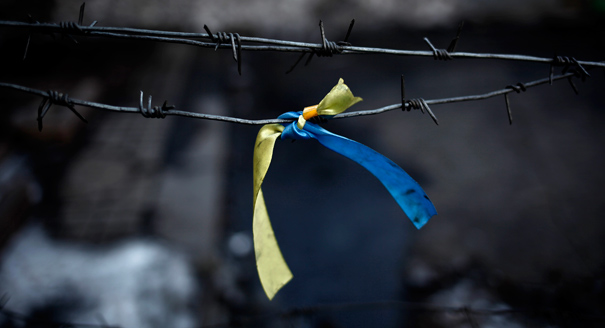
The collapse of the Yanukovych regime in Ukraine became another posthumous chapter in the breakup of the Soviet Union. It will severely curtail Russia’s leadership ambitions in the post-Soviet space.
The Sochi Olympics were more successful than was expected: the Putin Security Team scored a clean sweep victory over the Potential Terrorist Club, while the Team Russia has won the record number of Olympic medals.
But with that came the Ukrainian events, drowning the Russian Olympic victory in their storm. President Vladimir Putin got saddled with the Kiev Maidan before he even got a chance to bask in his Olympic glory.
The Olympic Games are over, while the Ukrainian race is just getting underway. It is hard to predict how it will end, but one thing is clear: there is no more Ukraine as we once knew it, nor will there ever be. The Maidan victory is reformatting post-Soviet Ukraine, creating a new state in its place. Perhaps, there will even be several quasi-state formations, which may change Eastern Europe’s political landscape.
All of the international actors want Ukraine to remain a unified nation state, thus staving off the Yugoslav scenario (that being said, the term “Yugoslavization of Ukraine” is already floating in the media). However, the internal rift between “the East” and “the West” will be a fixture on the Ukrainian scene in the near future. Besides, the Ukrainian Parliament has clearly jumped the gun with its repeal of the recently-adopted Russian language law. The responsible segment of the former opposition will soon realize that it should proceed more cautiously now. The euphoric feelings will soon wear off. The victors have already figured that Ukraine will need a 35-billion-euro stabilization package. It will be hard to cobble this sum together, even with Europe willing to help. Then Russia is also likely to get involved.
How will the Kremlin act? The Russian ruling class cannot help but notice an entirely different state “suddenly” appearing at Russia’s western borders. The Russian President Vladimir Putin must come to this realization after the initial shock that came at the close of the Olympics. Siding with President Viktor Yanukovych, who set his partner up and fled, as well as other mistakes by the Kremlin, have made the changes in Ukraine irreversible. But Moscow will eventually recognize any Ukrainian regime under the pretext of “respecting people’s choice.” Just remember the recognition of the Egyptian President Mohamed Morsi of the Muslim Brotherhood—an organization outlawed in Russia. Most likely, Moscow will not wait until the May elections to recognize the new Ukrainian regime; waiting for too long may have only negative ramifications.
The Ukrainian events are certain to have an impact on Russia and Russian society. This impact may vary. First, the Russians saw that an authoritarian or borderline authoritarian regime may be defeated by harsh, radical means. This time it happened an 8-hour train ride away from Moscow, not in some remote Kyrgyzstan. Second, putting Yanukovych’s palace on display in the media and on the Internet makes one wonder about the conditions his more powerful Russian counterpart is living in. As the saying goes, “tell me who your friend is…” This aspect may have an indirect negative effect on the Russian president’s rating, although now, according to Russian Public Opinion Research Center (VCIOM), it has risen to 67 percent. Third, as a reaction to the Ukrainian “rebels’” success, the Russian authorities may embark on another round of repressive measures. Even before the Maidan victory, some experts predicted regime’s shift into a more repressive mode right after the Olympics. But it actually began even earlier, before the Sochi Games were over, at least with respect to the media. Fourth, the rise of Ukrainian nationalism will facilitate the growth of Russian nationalism. In any event, analyzing the influence of Ukrainian developments on the situation in Russia will become a hot topic for journalists and political pundits. So we will certainly see a lot of exciting and controversial commentaries, as well as some useful analysis.
But we can already identify a very painful problem Moscow will face. The collapse of the Yanukovych regime in Ukraine followed by the country’s obvious turn to Europe will severely curtail Russia’s leadership ambitions in the post-Soviet space and cast doubt on its integration course. Having watched the Ukrainian struggle closely, Kazakhstan, Kyrgyzstan, and Armenia could assess the range of Russia’s capabilities, its helplessness, and inability to realize its ambitions. Perhaps, the Belarusian leader Alexander Lukashenko has started giving some thought to his future as well. In a sense, the February of 2014 became another posthumous chapter in the breakup of the Soviet Union, furthering the demise of the post-Soviet space. This is probably the major takeaway from the Ukrainian changes.
Former Scholar in Residence, Religion, Society, and Security Program
Malashenko is a former chair of the Carnegie Moscow Center’s Religion, Society, and Security Program.
Recent Work
Alexey Malashenko
Alexey Malashenko
Carnegie does not take institutional positions on public policy issues; the views represented herein are those of the author(s) and do not necessarily reflect the views of Carnegie, its staff, or its trustees.

Funding Ukraine remains a priority for European leaders. As Russia’s war of aggression heads into another winter, two feasible options to mobilize support for Kyiv should be fast-tracked.


Vladyslav Rashkovan, Gregory P. Wilson

While the EU and European governments are embracing the much-lauded middle-power moment, this entails three difficult conundrums.

Richard Youngs

Europe is facing rising populism internally as well as external pressures from Russia, China, Turkey, and the United States.

Dimitar Bechev

A notable degree of participative democracy has firmly arrived in Europe. But to have more far-reaching impact, democratic deliberation needs to move into a radically new phase.
Richard Youngs

Much has been said of the changes Brussels is trying to make to the EU enlargement process. Here’s why gradual integration might—or might not—be the answer.
Dimitar Bechev