

Commentary
Marc Pierini
{
  "authors": [
    "Marc Pierini"
  ],
  "type": "legacyinthemedia",
  "centerAffiliationAll": "dc",
  "centers": [
    "Carnegie Endowment for International Peace",
    "Carnegie Europe",
    "Malcolm H. Kerr Carnegie Middle East Center"
  ],
  "collections": [
    "Turkey’s Transformation"
  ],
  "englishNewsletterAll": "ctw",
  "nonEnglishNewsletterAll": "",
  "primaryCenter": "Carnegie Europe",
  "programAffiliation": "EP",
  "programs": [
    "Europe"
  ],
  "projects": [],
  "regions": [
    "Middle East",
    "Europe",
    "Türkiye",
    "Western Europe",
    "Iran"
  ],
  "topics": [
    "Foreign Policy",
    "EU",
    "Political Reform"
  ]
}
Source: Getty
The appointments of a new European Council president and EU foreign policy chief will impact EU-Turkey relations, but the critical test will be how both players respond to events in the Middle East.
Source: Hürriyet Daily News
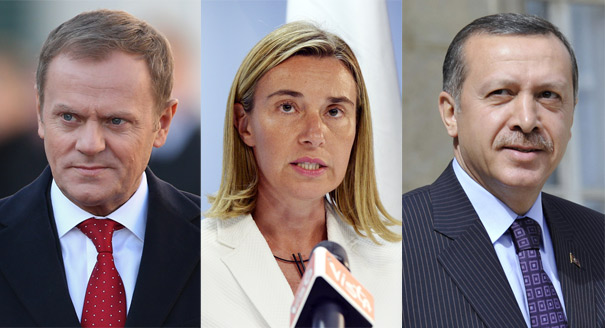
The European Union has now appointed both Donald Tusk as President of the European Council (the EU’s Heads of State and Government), and Federica Mogherini as its High Representative for foreign policy. This nearly completes a series of nominations initiated by President of the European Parliament Martin Schulz and President of the European Commission Jean-Claude Juncker. The latter is about to finalize the composition of his 28-member Commission.
With the eastern and southeastern borders of the EU on fire and with a new leadership just installed in Turkey, it is worth asking what’s next for relations between the two entities.
When the EU’s last institutional reshuffle took place five years ago, the foreign policy scene was much quieter than today’s deep turmoil facing Iraq and Syria, Libya, Ukraine and Gaza. During the past five years, the EU’s foreign policy profile has been discrete, both by design (the “big three” member states aimed to keep control of it) and as a result of the appointment of Catherine Ashton as High Representative (her task was essentially to set up the new system). Looking back, most observers agree the EU’s vast diplomatic apparatus and array of available competences could have been better used. This could perhaps be corrected with the new appointments.Choosing Tusk is a decision of major significance: 10 years after its accession, Poland is now taking its full place among the large member states, while central Europe’s key role in the European Union is recognized. With his personal involvement in the Solidarnosc trade union movement in Poland, Tusk carries a powerful symbol: the historical return of the central European peoples to the European family and rule of law. In the current EU-Russia context, this is no small message.
Mogherini carries another symbol: She comes from Italy’s young, social-democratic government and from the party that garnered the largest number of votes anywhere in the EU at the last European Parliament elections. She also embodies Italy’s return to the center-stage in European politics.
What is the significance of these appointments for Ankara, beyond saying both Tusk and Mogherini are “friends of Turkey?” The answer to this question will very much depend on how inter-institutional mechanics in Brussels are rekindled after a rather disappointing five years and how Turkey itself decides to act on the fundamentals of its relations with the EU.
Mogherini has a major challenge from the outset: rebuilding the “European toolbox” that was split between institutions by the Lisbon Treaty and largely ignored by her predecessor. The strengths of the incoming “EU foreign minister” are her sizeable and competent diplomatic service and the availability of diversified policy tools: trade, finance, humanitarian aid, development, energy, counter-terrorism, domestic affairs. All these instruments are waiting to be used in a coordinated and efficient manner.
This, of course, assumes harmony between the External Service (Mogherini), the Commission (Juncker and his future Commissioners), the Council of Ministers (the Counter-Terrorism Coordinator), the European Council and Parliament. If these synergies are rebuilt during the next few months, it will represent a major step forward.
Concerning the EU and Turkey, it is predictable that there will be a shift in emphasis over the next few years.
The three most influential factors will be: first, counter-terrorism and humanitarian issues (due to Syria and Iraq); second, domestic affairs issues (visa liberalization and irregular migrations); and third, the necessary revamping of the Customs Union (including the implications of the Transatlantic Trade and Investment Partnership negotiations between the EU and the U.S.). These are areas where both Turkey and the EU have deep common interests and some divergences, but a strong incentive to act together.
A crucial testing ground for EU-Turkey relations will be the Middle East: Will Turkey elect to act jointly with the EU? This is clearly the expectation in European capitals, in the U.S. and in NATO.
By contrast, Turkey’s accession negotiations will not proceed very far for the simple reason that Turkey has vastly backtracked during the past 15 months on the rule of law, media freedoms and civil liberties. To put it bluntly, as a civil society observer, Turkey no longer sufficiently fulfills the EU political criteria.
The Commission’s 2014 Progress Report may not say it in such stark terms, but one can nevertheless foresee that, unless there is a fast and clear return to a better rule of law architecture, Turkey’s accession process will remain a pro-forma operation for the time being. Looking from a different angle, one could say there is currently an incompatibility of sorts between Turkey’s domestic politics (and political tactics) and its EU ambitions, although the latter figure more prominently than ever in the government’s narrative.
This article was originally published in the Hürriyet Daily News.

Senior Fellow, Carnegie Europe
Marc Pierini is a senior fellow at Carnegie Europe, where his research focuses on developments in the Middle East and Turkey from a European perspective.
Recent Work
Marc Pierini
Marc Pierini
Carnegie does not take institutional positions on public policy issues; the views represented herein are those of the author(s) and do not necessarily reflect the views of Carnegie, its staff, or its trustees.

With its public finances in shambles, the far right polling at 35 percent ahead of the 2027 presidential election, and a growing protest movement, is France’s crisis a threat to the EU’s geopolitical awakening?

Rym Momtaz, ed.

Ahead of a tough winter for Ukraine, Donald Trump’s swing back toward Russia bodes ill. But instead of panicking, Kyiv’s European allies are focusing on action.
Rym Momtaz

Funding Ukraine remains a priority for European leaders. As Russia’s war of aggression heads into another winter, two feasible options to mobilize support for Kyiv should be fast-tracked.


Vladyslav Rashkovan, Gregory P. Wilson

While the EU and European governments are embracing the much-lauded middle-power moment, this entails three difficult conundrums.

Richard Youngs

Europe is facing rising populism internally as well as external pressures from Russia, China, Turkey, and the United States.

Dimitar Bechev