

Commentary
Judy Dempsey
{
  "authors": [
    "Judy Dempsey"
  ],
  "type": "legacyinthemedia",
  "centerAffiliationAll": "dc",
  "centers": [
    "Carnegie Endowment for International Peace",
    "Carnegie Europe"
  ],
  "collections": [
    "Transatlantic Cooperation",
    "Europe’s Southern Neighborhood"
  ],
  "englishNewsletterAll": "ctw",
  "nonEnglishNewsletterAll": "",
  "primaryCenter": "Carnegie Europe",
  "programAffiliation": "EP",
  "programs": [
    "Europe"
  ],
  "projects": [],
  "regions": [
    "Europe",
    "Western Europe",
    "Germany",
    "Iran"
  ],
  "topics": [
    "Foreign Policy",
    "Security",
    "Military"
  ]
}
Source: Getty
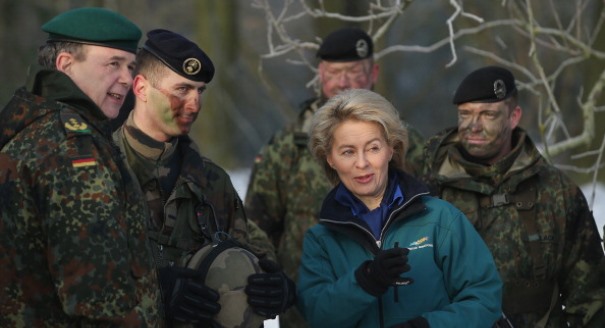
Germany has expressed its readiness to join the coalition of the willing against the Islamic State. But can the country’s military forces live up to its NATO engagement?
Source: Deutsche Welle
Speaking to Deutsche Welle’s Quadriga, Judy Dempsey discussed the German public’s low appetite for warfare, which in turn partly explains the relative poor state of the German military forces. However, Dempsey argued that this was a problem not only for Germany, and that demilitarization had also been witnessed in France, the UK, and the Netherlands over the last few years, demonstrating that there was clearly a “war weariness after Iraq, after Afghanistan, and after the botched mission in Libya.”Dempsey explained that even though public opinion in Germany might be opposed to war, the country’s political elite is now choosing to go against it and rethink the world order’s “predictability.” She also recommended that German Defense Minister Ursula von der Leyen and her advisers should not let the issue of the present state of the German army disappear, but should make the subject accessible and widen the debate.

Nonresident Senior Fellow, Carnegie Europe
Judy Dempsey is a nonresident senior fellow at Carnegie Europe
Recent Work
Judy Dempsey
Judy Dempsey
Carnegie does not take institutional positions on public policy issues; the views represented herein are those of the author(s) and do not necessarily reflect the views of Carnegie, its staff, or its trustees.

As we close out another season of Strategic Europe, it is worth taking stock of the deep shifts underway.

Rym Momtaz

The hybrid warfare landscape is evolving rapidly, leaving policymakers without clear strategies. To better inform their work in addressing emerging challenges, governments must dig deeper into the underlying dynamics at play.


Raluca Csernatoni, Alicia Wanless
The EU had to compromise to adopt a twenty-first sanctions package against Russia, exposing growing cracks in the union’s resolve. Is this latest, weaker round worth it to keep pressure on Moscow?
Rym Momtaz, ed.

Trump is distracted and Ukraine wants Europe to step up. The continent’s leaders must find their voice and assert it in talks with Russia.

Alissa de Carbonnel

Mounting economic strain and battlefield losses will not necessarily make the Kremlin less dangerous. They could instead push Moscow toward a more aggressive hybrid campaign designed to test NATO’s Eastern flank, exploit allied hesitation, and fracture European resolve.

Maksym Beznosiuk