

Commentary
Cornelius Adebahr
{
  "authors": [
    "Cornelius Adebahr"
  ],
  "type": "legacyinthemedia",
  "centerAffiliationAll": "dc",
  "centers": [
    "Carnegie Endowment for International Peace",
    "Carnegie Europe"
  ],
  "collections": [
    "EU Integration and Enlargement",
    "Brexit and UK Politics"
  ],
  "englishNewsletterAll": "ctw",
  "nonEnglishNewsletterAll": "",
  "primaryCenter": "Carnegie Europe",
  "programAffiliation": "EP",
  "programs": [
    "Europe"
  ],
  "projects": [],
  "regions": [
    "Europe",
    "Western Europe",
    "United Kingdom",
    "Iran"
  ],
  "topics": [
    "EU",
    "Political Reform",
    "Foreign Policy"
  ]
}
Source: Getty
This is the beginning of a new era, an era of great uncertainty for all Europeans.
Source: Global Policy
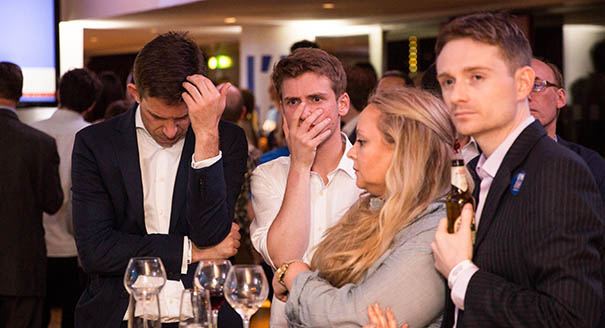
Like you, I’m devastated. Stunned. Heart-broken. Like you, I was hoping, pleading for a Remain vote – if only by the slightest of margins so that we could repair our house together. Like you, I feel this is the beginning of a new era; an era of great uncertainty for all Europeans.
The EU referendum was always a British thing: The sovereign right of any nation to decide on a matter it deems important, regardless of the consequences for third countries. Others have gone down this route before, though with less impact – sinking the European Constitution or the EU-Ukraine agreement isn’t the same as being the first country ever to leave the Union.Still, I’m not asking, what did you do? Instead, I’m wondering how could we let this happen? It’s us who believe in an open rather than closed society who have failed. Plus this wasn’t so much about doing something than about not doing the right thing. A sin of omission: of not engaging more strongly in how our societies are changing under the pressures of globalisation; of not making a forceful case for openness and inclusiveness; and, yes, of not defending the many good sides of European integration against those scoring cheap victories over its apparent weaknesses.
Brexit, however, is not a British problem, just as much as the reasons for this vote are not uniquely British. We have naysayers in all our countries, and they will be emboldened by the 17,4 million Brits who voted to “take back control”. So are we now supposed to warm up to those who divide our societies into “decent people” and, well, indecent people? Into natural-born and foreign-born citizens? Into us versus them? Let’s not fall into this trap.
It’s true that we have a different vision of society than those who voted to leave the EU. Yet it’s also true that our vision is more inclusive, giving a place even to those who do not support it. Liberty and openness, tolerance and empowerment – these are values for everyone to thrive. Still they are in danger in all our countries and within the EU.
The naysayers have the anger, the frustration, and the disillusionment on their side. They don’t care about the wider consequences of their parochialism: Hastened decline of Europe as a continent; emboldened autocrats from Moscow to Beijing; global challenges like migration, economic inequality, terrorism, and climate change that Europeans in disarray and busy with themselves won’t be able to tackle. The momentum is clearly with the naysayers – but only if we leave it to them.
Obviously, we’ve been too complacent about what we had reached. We presumed some kind of continuous drive towards more integration, which was out of touch with what a majority of the Brits voting – and large minorities in all other European countries – wanted. And we’re not even used to fight, because developments were on ‘our side’. Now that’s been reversed.
What we have to realise is that it’s up to us to regain the lead. This is not about some distant federalist dream that has always been more divisive than uniting, but about maintaining the relative openness and dynamism of our societies that we’ve gotten used to over the past decades. From today on, we need to fight for preserving the status quo – because only it has the potential for a better tomorrow.
Sincerely,
Cornelius

Former Nonresident Fellow, Carnegie Europe
Cornelius Adebahr was a nonresident fellow at Carnegie Europe. His research focuses on foreign and security policy, in particular regarding Iran and the Persian Gulf, on European and transatlantic affairs, and on citizens’ engagement.
Recent Work
Cornelius Adebahr

Cornelius Adebahr, Barbara Mittelhammer
Carnegie does not take institutional positions on public policy issues; the views represented herein are those of the author(s) and do not necessarily reflect the views of Carnegie, its staff, or its trustees.

Are Germany’s economic, industrial, and political struggles becoming a liability for the EU’s ability to rise to the geopolitical moment?

Rym Momtaz, ed.

European Commission President Ursula von der Leyen is about to give her annual address on the state of the EU. Here’s what she won’t—but should—say.
Rym Momtaz

Radical-right parties are expected to do well in upcoming elections in four of the EU's biggest member states. If successful, they could prevent the union from addressing key challenges ahead.

Stefan Lehne

The aftermath of the Ceuta crisis shows Europe has drawn the wrong lessons. Rather than doubling down on failed migration policies, the EU needs to address the underlying roots of such episodes.

Richard Youngs

An overwhelming victory by a far-right-wing party in a small state in eastern Germany will have major repercussions for Chancellor Friedrich Merz’s coalition.

Judy Dempsey