

Article
C. Raja Mohan, Darshana M. Baruah
{
  "authors": [
    "C. Raja Mohan"
  ],
  "type": "legacyinthemedia",
  "centerAffiliationAll": "dc",
  "centers": [
    "Carnegie Endowment for International Peace",
    "Carnegie India"
  ],
  "collections": [],
  "englishNewsletterAll": "ctw",
  "nonEnglishNewsletterAll": "",
  "primaryCenter": "Carnegie India",
  "programAffiliation": "SAP",
  "programs": [
    "South Asia"
  ],
  "projects": [],
  "regions": [
    "United States",
    "Asia",
    "South Asia",
    "Pakistan",
    "India",
    "North America",
    "East Asia",
    "China",
    "Japan",
    "Russia",
    "Western Europe",
    "France",
    "Germany"
  ],
  "topics": [
    "Economy",
    "Foreign Policy",
    "Technology"
  ]
}
Source: Getty
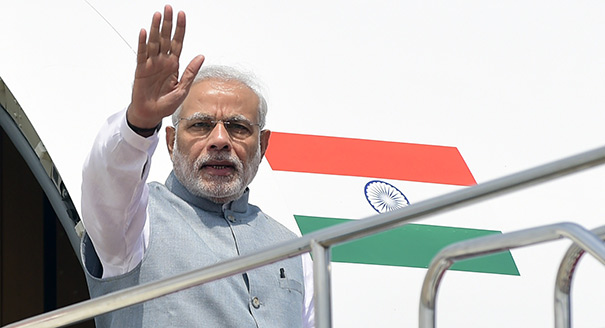
To sustain India's rise, Delhi must advance its economic policies, engage in defense sector reform, and construct strategic partnerships to navigate the power shifts among America, China, and Russia
Source: India Express
Few would disagree with the proposition that Prime Minister Narendra Modi has had a great run with foreign policy over the last three years. His personal energy and pragmatism, coupled with an emphasis on problem-solving, had allowed Modi to rejuvenate India’s post-Cold War foreign policy. But the harder part for the PM may have already begun. India’s problems with Pakistan and China and the difficulties, for example, with the membership of the Nuclear Suppliers Group over the last year are symptomatic of the larger challenge that confronts Modi.
In India, the foreign policy discourse has become increasingly partisan. Both admirers and critics of Modi are quick to see every diplomatic development as a triumph or a failure. The shared presumption is that the Indian PM is a free actor on the international stage and that foreign policy is all about “us” and not “them”. Any Indian PM deals with multiple other sovereigns, big and small. Delhi can’t bend the political will or shape the domestic dynamics of other sovereigns.
Nor can India regulate the frequent flips in the relationships amongst other independent actors. Nor can it predict, let alone control, sweeping political and technological revolutions that produce systemic change. Even a carefully constructed foreign policy strategy could go awry if the external circumstances change radically. Prime Minister Narendra Modi may have arrived at that juncture three years into his tenure.
In the first half of his five-year term, Modi could win quick gains on the diplomatic front by the mere application of his strong political will and the stronger domestic position that he enjoyed over his predecessor, Manmohan Singh. The policy path was, in fact, largely laid down way back at the turn of the 1990s when the Cold War ended and Delhi had to embark on economic reforms.
The unstated diplomatic guidelines included a greater emphasis on economic goals and improved relations with all major powers. There was a special focus on normalising ties with China and ending the estrangement with America. Delhi also sought to limit the conflict with Pakistan, promote regional cooperation in the Subcontinent, reconnect with Asia and the Indian Ocean, and bring Delhi’s multilateral diplomacy in tune with India’s changing national needs in the reform era.
All governments since 1991 have followed these policies with varying degrees of success. A number of external factors facilitated India’s advances in this period. One was the relative harmony among the major powers, thanks to the uncontested American unipolar moment. The second was the widespread acceptance of economic globalisation or the Washington consensus. The third was the digital revolution that allowed India to create a niche for itself in the IT sector.
Modi accepted the imperatives of the external world and pushed vigorously for improving ties with the US, reaching out to China and Pakistan, welcoming foreign investment, strengthening India’s regionalism and raising its international profile. But Modi’s world has changed considerably over the last three years. He had considerable successes with America, but must now cope with a great power that is distracted by internecine battles in Washington. The PM’s effort to strengthen ties with Russia have entered a complex phase, as President Vladimir Putin tightens the China embrace and seeks a deal with US President Donald Trump.
President Xi Jinping has decided that China’s moment in the sun has arrived, thanks to the huge and growing power differential between Beijing and its neighbours. As Modi found out, being nice to Beijing does not mean China will reciprocate on NSG membership. Xi’s enhanced bet on Pakistan has also made Islamabad less vulnerable to Western pressures, such as they are, on terrorism. Pakistan will neither be seduced by an Indian outreach, nor give into Delhi’s threats. Finding ways to deal with a rising China and manage Pakistan’s intransigence will remain big problems for India.
The shifting dynamic amidst great powers and the continuing trouble on the borders is matched by the political backlash in the West against free trade and immigration. The new external constraints come amidst the deepening of India’s interdependence with the world. Nearly 40 per cent of India’s GDP is linked to the world and for half a century, its skilled personnel enjoyed open doors in many markets. Some of those are beginning to close.
On top of it all, the dramatic acceleration of technological change has put pressure on the one sector that has come to
generate nearly a tenth of India’s GDP and symbolised India’s rise.
These negative developments are not a call for pessimism about India’s prospects. As its economy grows at seven percent and more, India’s net weight in the international system can only improve. But to sustain India’s rise, Delhi must necessarily focus on three important elements: It must shed the current complacency about growth and bring its economic and technology policies in line with the rapidly evolving external environment. Second, India needs urgent and significant defence sector reform to lend purpose and effect to its growing military mass. Third, sharper commercial, security and technology policies will help India better navigate the unfolding power shifts amongst America, China and Russia and construct durable strategic partnerships with such middle powers as Japan, France and Germany.
This article was originally published in the Indian Express.
Former Nonresident Senior Fellow, Carnegie India
A leading analyst of India’s foreign policy, Mohan is also an expert on South Asian security, great-power relations in Asia, and arms control.
Recent Work

C. Raja Mohan, Darshana M. Baruah


Alexander Gabuev, Paul Haenle, C. Raja Mohan, …
Carnegie does not take institutional positions on public policy issues; the views represented herein are those of the author(s) and do not necessarily reflect the views of Carnegie, its staff, or its trustees.

European Commission President Ursula von der Leyen is about to give her annual address on the state of the EU. Here’s what she won’t—but should—say.

Rym Momtaz

Radical-right parties are expected to do well in upcoming elections in four of the EU's biggest member states. If successful, they could prevent the union from addressing key challenges ahead.

Stefan Lehne

The aftermath of the Ceuta crisis shows Europe has drawn the wrong lessons. Rather than doubling down on failed migration policies, the EU needs to address the underlying roots of such episodes.

Richard Youngs

An overwhelming victory by a far-right-wing party in a small state in eastern Germany will have major repercussions for Chancellor Friedrich Merz’s coalition.

Judy Dempsey

Canadian Prime Minister Mark Carney has twice inspired praise for standing up to U.S. President Donald Trump: at the 2026 World Economic Forum in Davos and on Canada-U.S. trade negotiations. Is Carney showing a third way better than the EU has in dealing with the Trump administration?
Rym Momtaz, ed.