

Commentary
Gwendolyn Sasse
{
  "authors": [
    "Gwendolyn Sasse"
  ],
  "type": "legacyinthemedia",
  "centerAffiliationAll": "dc",
  "centers": [
    "Carnegie Endowment for International Peace",
    "Carnegie Europe"
  ],
  "collections": [
    "Europe’s Eastern Neighborhood",
    "Transatlantic Cooperation"
  ],
  "englishNewsletterAll": "ctw",
  "nonEnglishNewsletterAll": "",
  "primaryCenter": "Carnegie Europe",
  "programAffiliation": "EP",
  "programs": [
    "Europe"
  ],
  "projects": [],
  "regions": [
    "Russia",
    "Europe",
    "North America",
    "Eastern Europe",
    "United States",
    "Ukraine",
    "Iran"
  ],
  "topics": [
    "Foreign Policy",
    "Security"
  ]
}
Source: Getty
Developments before and after the 2017 G20 Summit in Hamburg have brought new elements into East-West relations, and the Minsk peace process.
Source: Centre for East European and International Studies
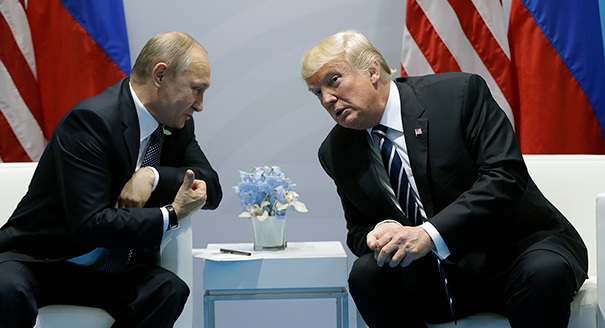
A lot has been written about the meeting between US president Donald Trump and Russian president Vladimir Putin in Hamburg on 7 July. Interpretations of the encounter as a ‘victory’ for Putin, speculation about the ‘personal chemistry’ between the two men, and the many attempts to read the body language and handshakes accompanying the meeting primarily confirm one thing: it is good that the meeting is over. Months of frenzied anticipation are now being replaced by the realisation that everything substantive at the heart of US-Russian relations is still undecided.
A long list of issues was apparently mentioned at the bilateral meeting, but apart from the concrete proposal to enact a partial ceasefire in Syria, the parameters of which remain unclear, and a general agreement to create communication channels on a number of issues, including cyber, nothing tangible emerged. The fact that the meeting lasted much longer than scheduled is not simply, as commentators suggested, a sign that the two presidents had a lot to discuss. The bilateral meeting conveniently took place when the other G20 leaders were talking about the Paris climate deal, which Trump had withdrawn from previously. Trump and Putin drew attention away from these discussions and underlined their shared scepticism about multilateralism more generally.
Expectations had been unrealistically high, for example with regard to informal discussions about Ukraine. However, three developments before and after the G20 summit—some of them deliberately timed—have a more direct bearing on the relations between Russia and the West and on the war in Ukraine than the summit itself.
Firstly, just before the G20 summit, the US administration announced the appointment of a special US envoy for Ukraine tasked with advancing conflict resolution. Kurt Volker, a career diplomat, associate of senator John McCain, and former permanent representative to NATO, was appointed to this post. On 9 July, Volker embarked immediately on his first trip to Ukraine, where he appeared alongside US secretary of state Rex Tillerson, who had travelled to Kyiv from Hamburg. In Kyiv, Tillerson confirmed the US commitment to Ukraine’s sovereignty and territorial integrity and the sanctions imposed on Russia following the March 2014 annexation of Crimea and the outbreak of war in the Donbas. For Ukrainian president Petro Poroshenko, who had focused his attention on a clearer US stance on Ukraine, Volker’s appointment counts as a personal victory that buys him some time in a domestic political context characterised by a stalling reform process and a stalemate over the war in the Donbas.
Tillerson emphasised that the US special envoy would coordinate his actions closely with the Normandy format, which brings together the French, German, Russian, and Ukrainian leaders, and the more detailed Minsk process which seeks to facilitate the implementation of the Minsk accords. How this cooperation will work in practice remains to be seen. Tillerson also told the press in Kyiv that in Hamburg, German chancellor Angela Merkel, French president Emmanuel Macron, and Putin had talked about continuing the Normandy format on the phone in July, followed by a face-to-face meeting later this summer.
In describing the new envoy’s responsibilities, Tillerson peddled the familiar myth of a ‘full implementation’ of the Minsk agreement. The language emerging from the meeting between Merkel, Macron, and Putin on the sidelines of the summit referred to implementing Minsk ‘comprehensively’, suggesting an adjustment in language and possibly in substance. Until recently, a greater role for the US in the negotiations had been seen sceptically, not only by Russia, but also by Germany and France as the key Normandy negotiators. The scope for action for the newly appointed special envoy may well prove limited, as the experience of Victoria Nuland, special Ukraine envoy in the administration of former US president Barack Obama, showed. For the moment, however, a dedicated US envoy for Ukraine adds a new institutional and personal dynamic to the process—something that is urgently needed.
Volker is not an unknown entity. His close associations with McCain, a NATO and Russia hawk, please the current Ukrainian government and are bound to meet with continuous criticism in Moscow. During the visit of yet another high-ranking official, NATO secretary general Jens Stoltenberg, to Kyiv right after the G20 summit, Poroshenko immediately used the opportunity to outline a plan for Ukraine to meet NATO membership standards by 2020.
Secondly, by making Poland Trump’s first stop in Europe in the run-up to the G20 summit, the US administration aimed to reassure Poland and its neighbours that Washington remains committed to NATO. Poland under its current right-wing government was a well-chosen arena for Trump’s rhetoric about the common struggle to preserve Western values, including family values and patriotism. The visit served a dual purpose: it ensured Trump’s soft landing in Europe and smoothed over uncertainties linked to the current US position on NATO, while also sending the strongest signal yet to Russia that the US takes seriously the security threat Russia poses in the region. The ultimate effect of the trip on the meeting between Trump and Putin was limited: both presidents know all too well how to target their messages to different audiences.
Thirdly, the OSCE Parliamentary Assembly passed a surprisingly frank Ukraine resolution at its annual meeting in Minsk on 9 July. It spells out explicitly the nature of Russia’s annexation of Crimea and intervention in the Donbas and the necessary consequences. Russia abstained from the vote on the resolution, but compared with the other institutional levels in the OSCE, the Parliamentary Assembly is less bound by consensus and the smallest common denominator. The resolution is a timely reminder of the OSCE’s basic principles.
In sum, developments before and after the G20 summit—rather than during the meeting itself—have brought a few new elements into East-West relations and the Minsk peace process. As a result, the new US envoy Volker and the Normandy negotiators are bound to step up their engagement in the coming months.
Nonresident Senior Fellow, Carnegie Europe
Gwendolyn Sasse is a nonresident senior fellow at Carnegie Europe. Her research focuses on Eastern Europe, with a particular focus on Ukrainian politics and society, EU enlargement, and comparative democratization.
Recent Work
Gwendolyn Sasse
Gwendolyn Sasse
Carnegie does not take institutional positions on public policy issues; the views represented herein are those of the author(s) and do not necessarily reflect the views of Carnegie, its staff, or its trustees.

Trump is distracted and Ukraine wants Europe to step up. The continent’s leaders must find their voice and assert it in talks with Russia.

Alissa de Carbonnel

Mounting economic strain and battlefield losses will not necessarily make the Kremlin less dangerous. They could instead push Moscow toward a more aggressive hybrid campaign designed to test NATO’s Eastern flank, exploit allied hesitation, and fracture European resolve.

Maksym Beznosiuk

Over the past ten years, NATO has held almost as many summits as it did during the entirety of the Cold War. Are they still useful, or is it time to stop holding annual meetings?

Rym Momtaz, ed.

As the EU confronts profound challenges, several leaders have called for fundamental reform to the union’s model—but only modest, superficial changes have resulted. What if Europe really could be reimagined from zero today: What should such a redesigned European order look like?

Richard Youngs, ed.
Nearly a year and a half after Europeans leaned into sucking up to Trump, the strategy has produced some benefits when it comes to Ukraine.
Rym Momtaz