

Commentary
Funding Ukraine remains a priority for European leaders. As Russia’s war of aggression heads into another winter, two feasible options to mobilize support for Kyiv should be fast-tracked.
Vladyslav Rashkovan, Gregory P. Wilson
{
  "authors": [
    "C. Raja Mohan",
    "Darshana M. Baruah"
  ],
  "type": "legacyinthemedia",
  "centerAffiliationAll": "dc",
  "centers": [
    "Carnegie Endowment for International Peace",
    "Carnegie India"
  ],
  "collections": [],
  "englishNewsletterAll": "ctw",
  "nonEnglishNewsletterAll": "",
  "primaryCenter": "Carnegie India",
  "programAffiliation": "SAP",
  "programs": [
    "South Asia"
  ],
  "projects": [
    "Security Studies"
  ],
  "regions": [
    "India",
    "Indo-Pacific",
    "France",
    "South Asia",
    "Western Europe"
  ],
  "topics": [
    "Foreign Policy"
  ]
}
Source: Getty
The India–France partnership could form the model for burden-sharing between India and its Western friends.
Source: East Asia Forum
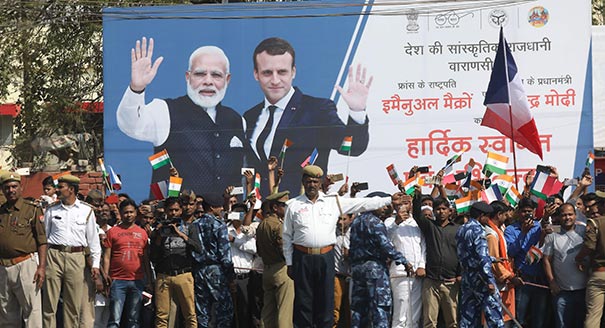
In New Delhi in March 2018, Indian Prime Minister Narendra Modi and French President Emmanuel Macron unveiled an expansive strategic partnership focussing on the maritime domain. This does not fit traditional patterns of alignment in the Indo-Pacific region.
Ever since Britain withdrew most of its forces from east of Suez at the turn of the 1970s, strategic equations in the region have been largely defined by the policies of Washington, which replaced London as the arbiter of regional security. Amidst the United States’ now uncertain external orientation and China’s emerging efforts to reshape the global order, second-tier powers like India and France are beginning to seek a greater say in world affairs through more intensive collaboration.
India has sought to consolidate its natural geographic advantages in the Indian Ocean and raise its political and military profile in the littoral. Unlike in the past, India has shed some of its military isolationism and has sought partnerships — especially with the United States and its Asian allies, Japan and Australia — to shore up its regional standing. Until recently, Europe seemed marginal to India’s regional coalition building. That has changed with the ambitious program for maritime collaboration announced by Modi and Macron.
France, a long-standing military ally of the United States, is looking beyond NATO to forge security partnerships with Asian democracies like India. For its part, Delhi does not want to cede Asia and the world to the rigidity of a new bipolar framework between the United States and China. By taking on more responsibilities unilaterally and deepening their bilateral partnership, Delhi and Paris hope to improve their relative national positions in a changing world.
The Indo-Pacific has emerged as the new arena for cooperation between Delhi and Paris. Although India’s strategic partnership with France is its oldest such relationship and dates back to the late 1990s, it has always lacked a regional anchor. The focus was mainly on expanding bilateral defence and technological cooperation. With their long-standing national advantages in the Indo-Pacific threatened by the global power shift, India and France have chosen to band together. Their shared maritime vision seeks to uphold the law of the sea in the Indian Ocean, prevent the military unilateralism that grips the western Pacific, secure sea lines of communication, respond to humanitarian disasters and promote a sustainable blue economy.
In pursuit of these objectives, Delhi and Paris have agreed to deepen their cooperation in three important areas: mutual logistical support, shared maritime domain awareness and collaboration with third countries. The agreement on logistical support gives India and France access to each other’s military facilities and extends the reach of both navies in the Indian Ocean.
In the past, Delhi and Paris ignored each other in their maritime calculus. India was primarily focussed on the northern and eastern Indian Ocean and France’s presence was limited to the western Indian Ocean. Access to each other’s facilities and mutual logistical support can lend more robustness to India’s naval presence in the western Indian Ocean and Delhi can support French interests in the east.
This is the second logistical support agreement that India has signed. While the negotiations with the United States took nearly 15 years, India and France finalised their agreement within a year. This reflects the level of comfort that India has with France and presages quick movement towards more effective operational cooperation between the two forces in the Indian Ocean.
On maritime domain awareness, Modi and Macron welcomed the early implementation of the White Shipping agreement signed in 2017 and the signing of a new Memorandum of Understanding on the joint development of a maritime surveillance satellite system focussed on the Indian Ocean. The two sides also signed an agreement on the ‘exchange and reciprocal protection of classified or protected information’ that will strengthen mutual trust and facilitate substantive intelligence sharing between their respective security establishments.
The agreement between Modi and Macron on collaboration with third parties is receiving an enthusiastic response in the region. The United States is apparently quite eager to develop trilateral naval engagements with India and France. Delhi and Paris are said to be seriously consulting on potential trilateral arrangements with the United Arab Emirates, which hosts a French naval base and has drawn closer to India in recent years. Australia and Japan, which have cooperated with France on maritime issues in the Pacific, are open to extending that cooperation to the Indian Ocean. This would reinforce maritime cooperation between Delhi and Paris.
The India–France partnership could form the model for burden-sharing between India and its Western friends. Burden-sharing allows allies to pool precious resources and share responsibilities in addressing common challenges and securing shared interests. Without multiple overlapping partnerships, middle powers like India and France will find it increasingly difficult to cope with the extraordinary turbulence that they now confront in the Indo-Pacific.
This article was originally published in the East Asia Forum.
Former Nonresident Senior Fellow, Carnegie India
A leading analyst of India’s foreign policy, Mohan is also an expert on South Asian security, great-power relations in Asia, and arms control.

Former Nonresident Scholar, South Asia Program
Darshana M. Baruah was a nonresident scholar with the South Asia Program at the Carnegie Endowment for International Peace where she directs the Indian Ocean Initiative.
Carnegie does not take institutional positions on public policy issues; the views represented herein are those of the author(s) and do not necessarily reflect the views of Carnegie, its staff, or its trustees.

Funding Ukraine remains a priority for European leaders. As Russia’s war of aggression heads into another winter, two feasible options to mobilize support for Kyiv should be fast-tracked.


Vladyslav Rashkovan, Gregory P. Wilson

While the EU and European governments are embracing the much-lauded middle-power moment, this entails three difficult conundrums.

Richard Youngs

A notable degree of participative democracy has firmly arrived in Europe. But to have more far-reaching impact, democratic deliberation needs to move into a radically new phase.
Richard Youngs

Much has been said of the changes Brussels is trying to make to the EU enlargement process. Here’s why gradual integration might—or might not—be the answer.

Dimitar Bechev

The European Commissioner for Trade is headed to China. But after President Xi’s bridge-building visit to Washington, can a more isolated EU overcome Beijing’s stranglehold on critical raw materials? Who will blink first?

Rym Momtaz, ed.