

Commentary
Funding Ukraine remains a priority for European leaders. As Russia’s war of aggression heads into another winter, two feasible options to mobilize support for Kyiv should be fast-tracked.
Vladyslav Rashkovan, Gregory P. Wilson
{
  "authors": [
    "Erik Brattberg",
    "Tim Maurer"
  ],
  "type": "legacyinthemedia",
  "centerAffiliationAll": "dc",
  "centers": [
    "Carnegie Endowment for International Peace",
    "Carnegie Europe"
  ],
  "collections": [],
  "englishNewsletterAll": "ctw",
  "nonEnglishNewsletterAll": "",
  "primaryCenter": "Carnegie Endowment for International Peace",
  "programAffiliation": "EP",
  "programs": [
    "Europe",
    "Technology and International Affairs"
  ],
  "projects": [],
  "regions": [
    "Russia",
    "Western Europe",
    "Europe",
    "Iran"
  ],
  "topics": [
    "Political Reform",
    "Democracy",
    "Security",
    "Foreign Policy",
    "EU",
    "Technology"
  ]
}
Source: Getty
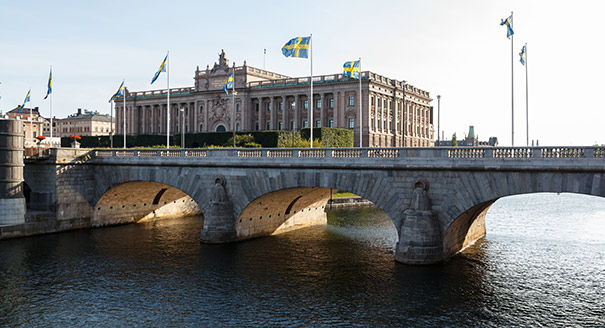
With the election of a new prime minister and parliament in September, Sweden is working to make sure its polls are free from hacking and interference.
Source: BBC
As campaigning intensified in the French election, the team of now President Emmanuel Macron said it was a target for "fake news" by Russian media and the victim of "hundreds if not thousands" of cyber-attacks from inside Russia.
In Washington, sanctions were recently imposed on 19 Russians accused of interference in the 2016 US election and "destructive" cyber-attacks.
While the Kremlin denies interfering in foreign elections - with Vladimir Putin saying there is "nothing to discuss" - concerns remain.
With a new prime minister and parliament to be elected in September, Sweden is already working hard to make sure its polls are free from any meddling.
If successful, its efforts could serve as a guide for other elections, including the US mid-terms in November.
Sweden, a country of 10 million people, has good reason to take action.
In 2014, it moved further from its historic position of neutrality to officially become an "enhanced partner" of Nato, which considers Russia's annexation of Crimea to be illegal.
Officials have reported an increase in hacking and dissemination of fake news. The aim, they say, is to undermine the stability of Swedish society and spread falsehoods.
A study by researchers at the Swedish Institute of International Affairs reported a "wide array" of Russian actions to influence public opinion.
It suggested there had been misleading media reports and that fake news was being used to "frame Nato as an aggressor and military threat, the EU as in terminal decline, and Russia as under siege from hostile Western governments".
And earlier this year Anders Thornberg, head of Sweden's security service, spoke to the BBC about its fears of foreign political interference, saying: "The biggest threat to our security in that perspective is Russia."
Having seen elections elsewhere in the West targeted by cyber-attacks and disinformation, Swedish officials are taking the possibility of Russian meddling seriously.
Protecting the democratic system has been placed at the heart of its national security objectives.
Sweden's approach involves government working with the private sector, social media companies, broadcasters and newspapers.
A "Facebook hotline" has been created to allow officials to quickly report fake Swedish government Facebook pages. Facebook itself has pledged to report suspicious behaviour around the election to Swedish authorities.
A nationwide education programme has been launched to teach high school students about propaganda and a leaflet distributed to 4.7 million homes includes tips on spotting such misinformation.
Some 7,000 government officials have received basic training in spotting "influence operations" and how they could put the elections at risk.
Public awareness has been raised further by the willingness of Swedish officials at all levels of government to discuss openly the threat of interference.
Prime Minister Stefan Lofven has called attempts to meddle in the elections "completely unacceptable" and has pledged to expose them "without mercy".
Cyber-security is being improved across government and work is under way to raise awareness of the risks of hacking and disinformation.
It is not only Sweden that is taking action, with other countries drawing similar conclusions about the possibility of Russian interference.
During Europe's "super election year" of 2017, the governments of the Netherlands, France and Germany all made significant efforts to protect themselves.
Dutch officials decided to abandon electronic counting of ballots for fears over hacking, for example.
The German and French governments are considering new laws to make social media and technology companies responsible for tackling fake news.
It could be that such efforts are having an impact.
Despite the hack of the German parliament in 2015, no significant attempts to interfere in the country's September 2017 elections were reported.
Other countries have warned Russia against election meddling, with UK Prime Minister Theresa May arguing that it was trying to "undermine free societies" by "planting fake stories".
Nevertheless, the possibility of Russian interference remains a serious challenge, both in Europe and the US, as well as other parts of the world such as Latin America.
Dan Coats, the US director of national intelligence, has warned: "There should be no doubt that Russia perceives its past efforts as successful and views the 2018 US mid-term elections as a potential target."
Countries might want to consider sharing best practices and lessons learned if they are to ensure their polls are free and fair.
The possibility of Russian interference in elections is likely to remain a serious challenge for some time.
The world will be watching to see whether Sweden's tactics work and what can be learned from them.
Former Director, Europe Program, Fellow
Erik Brattberg was director of the Europe Program and a fellow at the Carnegie Endowment for International Peace in Washington. He is an expert on European politics and security and transatlantic relations.
Former Senior Fellow, Technology and International Affairs Program
Dr. Tim Maurer was a senior fellow in Carnegie’s Technology and International Affairs program.
Carnegie does not take institutional positions on public policy issues; the views represented herein are those of the author(s) and do not necessarily reflect the views of Carnegie, its staff, or its trustees.

Funding Ukraine remains a priority for European leaders. As Russia’s war of aggression heads into another winter, two feasible options to mobilize support for Kyiv should be fast-tracked.


Vladyslav Rashkovan, Gregory P. Wilson

While the EU and European governments are embracing the much-lauded middle-power moment, this entails three difficult conundrums.

Richard Youngs

Europe is facing rising populism internally as well as external pressures from Russia, China, Turkey, and the United States.

Dimitar Bechev

A notable degree of participative democracy has firmly arrived in Europe. But to have more far-reaching impact, democratic deliberation needs to move into a radically new phase.
Richard Youngs

Much has been said of the changes Brussels is trying to make to the EU enlargement process. Here’s why gradual integration might—or might not—be the answer.
Dimitar Bechev