

Commentary
- +5
Zaha Hassan, Sarah Yerkes, Yasmine Farouk, …
{
  "authors": [
    "Federiga Bindi"
  ],
  "type": "legacyinthemedia",
  "centerAffiliationAll": "dc",
  "centers": [
    "Carnegie Endowment for International Peace"
  ],
  "collections": [
    "European Foreign Policy in a New Transatlantic Context"
  ],
  "englishNewsletterAll": "ctw",
  "nonEnglishNewsletterAll": "",
  "primaryCenter": "Carnegie Endowment for International Peace",
  "programAffiliation": "EP",
  "programs": [
    "Europe"
  ],
  "projects": [],
  "regions": [
    "East Asia",
    "China",
    "Western Europe",
    "Iran"
  ],
  "topics": [
    "Economy",
    "Trade",
    "Security"
  ]
}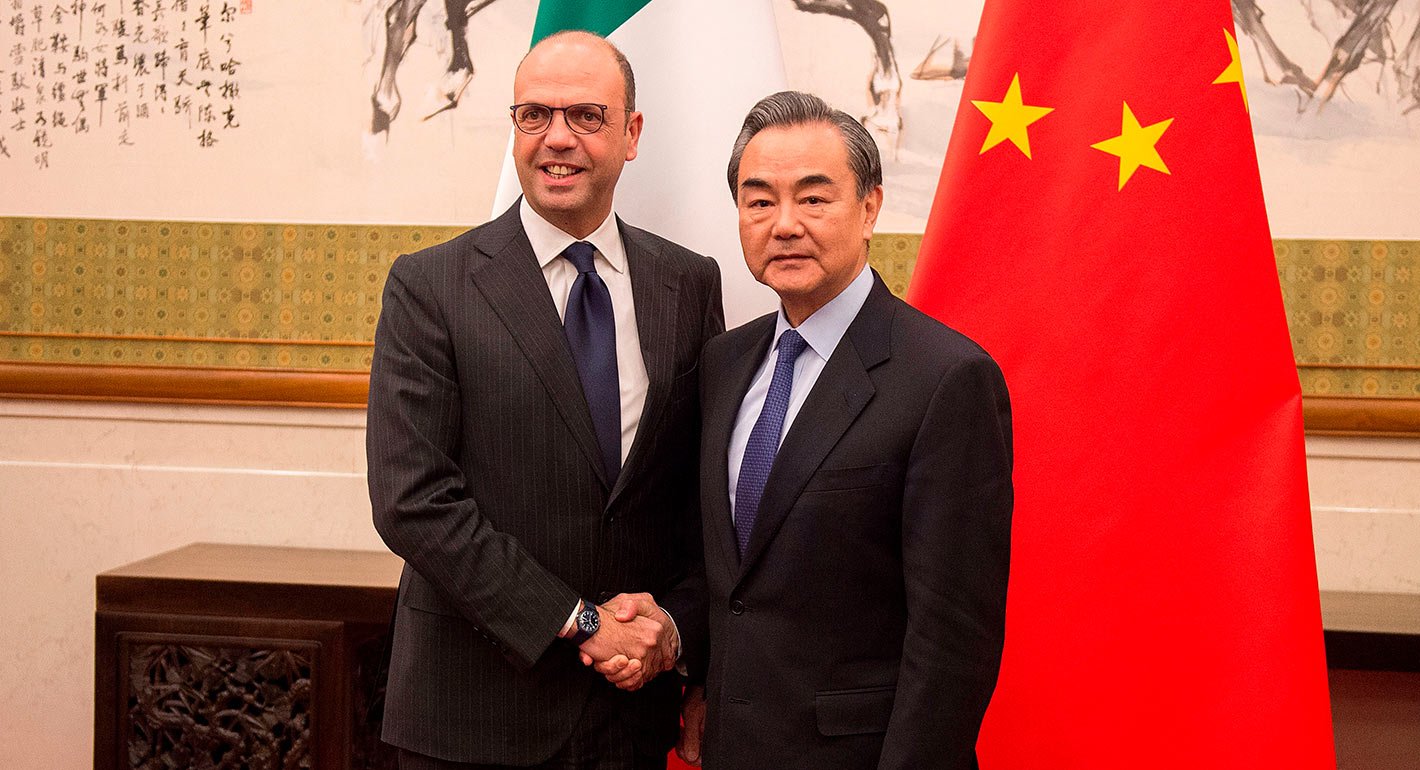
Source: Getty
Still suffering from the economic crises, feeling betrayed by Europe for the lack of solidarity on the immigration and economic crises, Rome has slowly turned to the emerging actor on the globe, brushing up on its historical ties.
Source: E!Sharp
There has been much ado about Italy’s decision to join the Belt and Road Initiative (BRI), with fingers pointed at the current Green-Yellow government; an analysis, however, that fails to capture reality and where the problems lie.
Italian foreign policy is the result of many different, and at times competing, variables. The country’s history, running from the long and glorious Roman era with its pretensions to civilizing all within its orbit, to the short run of a fascist unitary state, has resulted in a mixed legacy in foreign policy. With its unique geographical location in the middle of the Mediterranean Sea, between East and West, Italy held a privileged geopolitical role during the Cold War, making it possible for Rome to benefit of continued interest and support from the United States, while maintaining a good relationship with the Soviet Union. This “blocked” foreign policy, suspended between the East and the West, and domestically between communist and anticommunist political forces, well suited Italy, a midsize country that could thus play the role of a “big” Western state, a status confirmed through its participation in the G-7/G-8.
Italy viewed itself as a bridge between the East and West and pursued open dialogue and economic partnerships with both the United States and the Soviet Union. As the Berlin Wall collapsed in 1989, no longer a geostrategic partner for the United States nor the Soviet Union, Italy found itself deprived of a role, attention, and means. Since then, Italy has struggled to redefine itself in the twenty-first century. Cuts to the state budget due to unresolved economic issues hurt the country’s foreign policy strategy. Rome was also the big looser of the failed Libyan war, which exposed the country to massive illegal immigration and to fierce competition with France over the country’s oil. It is in this complex scenario that one has to examine Italy’s relations with China.
China – much like Italy – views foreign policy through an historical prospective. Self-conscious of its Imperial past, Beijing feels a special relation exist with both Italy and Egypt because of their similar history. Fast forward to the thirteenth century, it was Venetian explorer Marco Polo who “inaugurated” the Silk Road. In more recent times, industrial relations between Italy and China date back to the mid-1980s. When Romano Prodi was President of IRI, he was asked by China to build a twin factory in Tianjin, which was quickly completed. In turn, the Chinese helped IRI finish to build a factory in the USSR. Once Prime Minister of Italy, in 1997, Prodi led a massive mission to China bringing along over 100 companies to promote joint ventures in fields such as mechanics, chemistry, food, textiles, fashion and financial credit.
Following China’s acquisition of 67 percent of the Piraeus port, by 2015, 13 percent of trades with China passed by Greece, as compared to 2 percent in 2008. Maritime transportation is the most relevant part of the BRI, as 93% of China-Europe trades travel on ships, for a total of 61% of the total value. Between 2008 and 2015, Gioia Tauro, the biggest port in Italy, saw its share of trades diminish by 30 percent. Venezia and Trieste – which together with Koper e Rijeka had signed in 2010 the North Adriatic Ports Association (Napa) - also went under stress. This is when Italians started to worry.
A paper by Enrico Fardella and Giorgio Prodi from the University of Bologna analyzed the impact of the Belt and Road Initiative on Europe, with a specific focus on Italy. The paper pointed out how the development of the Port of Piraeus has increased the importance of the Mediterranean Sea as an import/export hub for China, but warned that the development of new railway connections will benefit most Northern and Central European countries, and that Italian ports in the high Adriatic Sea could be displaced by Piraeus’ capacity, should this be linked through railways with the center of Europe. The conclusion was that Italy needed to coordinate its ports together with its railway network to take advantage of Belt and Road Initiative opportunities, too.
Fardella and Prodi’s opinion is shared by most past Prime Ministers: from the mentioned Romani Prodi, to Massimo D’Alema, Matteo Renzi, and Paolo Gentiloni. The only dissenting voice is Silvio Berlusconi who – after having sold his beloved Milan soccer team to Chinese investors – presented his candidacy for the 2019 European elections as a response to Chinese hegemonic designs, asserting that in the antagonism between the United States and China, Italy and Europe should side with the first.
Berlusconi’s electoral cry apart, signing up to the BRI, is therefore a shared policy in Italy. Still suffering from the economic crises, feeling betrayed by the US because of the Libya disaster, and by Europe for the lack of solidarity on the immigration and economic crises, Rome has slowly turned to the emerging actor on the globe, brushing up on its historical ties. The fact that political actors like Finance Minister Giovanni Tria – whose first official visit abroad was a week-long mission to China in August 2018 that started the Memorandum process – or that junior minister for trades Michele Gerace has long-established ties with China, are eventual variables. It maybe quickened and smoothed the process, which however was built on past work and shared consensus. Analyses stressing the difference between the two government actors – with Lega more in favor of Trump’s views and M5S supposedly as the BRI’s kingmaker – forget how the Northeast – a Lega’s stronghold - is one of the regions that will benefit most of the BRI.
Finally, the Trump’s administration disappointment with the BRI is out of place, as it was the failures of the TTP and TTIP that made of the Belt and Road Initiative– launched in 2013 – the only global initiative bringing together the Euro Asiatic region, not only in terms of infrastructures but also of trades and finances.
Former Nonresident Scholar, Europe Program
Federiga Bindi was a nonresident scholar in the Europe Program at the Carnegie Endowment for International Peace working on European politics, EU foreign policy, and transatlantic relations.
Recent Work


Zaha Hassan, Sarah Yerkes, Yasmine Farouk, …
Federiga Bindi

Russia is testing the waters of NATO’s mutual defense clause. What do strikes in Romanian territorial waters mean for the alliance’s posture toward Moscow?

Dimitar Bechev

With its public finances in shambles, the far right polling at 35 percent ahead of the 2027 presidential election, and a growing protest movement, is France’s crisis a threat to the EU’s geopolitical awakening?

Rym Momtaz, ed.

While the EU and European governments are embracing the much-lauded middle-power moment, this entails three difficult conundrums.

Richard Youngs

Europe is facing rising populism internally as well as external pressures from Russia, China, Turkey, and the United States.
Dimitar Bechev

A notable degree of participative democracy has firmly arrived in Europe. But to have more far-reaching impact, democratic deliberation needs to move into a radically new phase.
Richard Youngs