

Commentary
With its public finances in shambles, the far right polling at 35 percent ahead of the 2027 presidential election, and a growing protest movement, is France’s crisis a threat to the EU’s geopolitical awakening?
Rym Momtaz, ed.
{
  "authors": [
    "Sinan Ülgen",
    "Asli Aydıntaşbaş"
  ],
  "type": "legacyinthemedia",
  "centerAffiliationAll": "dc",
  "centers": [
    "Carnegie Endowment for International Peace",
    "Carnegie Europe",
    "Malcolm H. Kerr Carnegie Middle East Center"
  ],
  "collections": [
    "Turkey’s Transformation"
  ],
  "englishNewsletterAll": "ctw",
  "nonEnglishNewsletterAll": "",
  "primaryCenter": "Carnegie Europe",
  "programAffiliation": "EP",
  "programs": [
    "Europe"
  ],
  "projects": [],
  "regions": [
    "Europe",
    "Türkiye",
    "Middle East",
    "United Arab Emirates",
    "Iran"
  ],
  "topics": [
    "Foreign Policy",
    "Security",
    "Political Reform"
  ]
}
Source: Getty
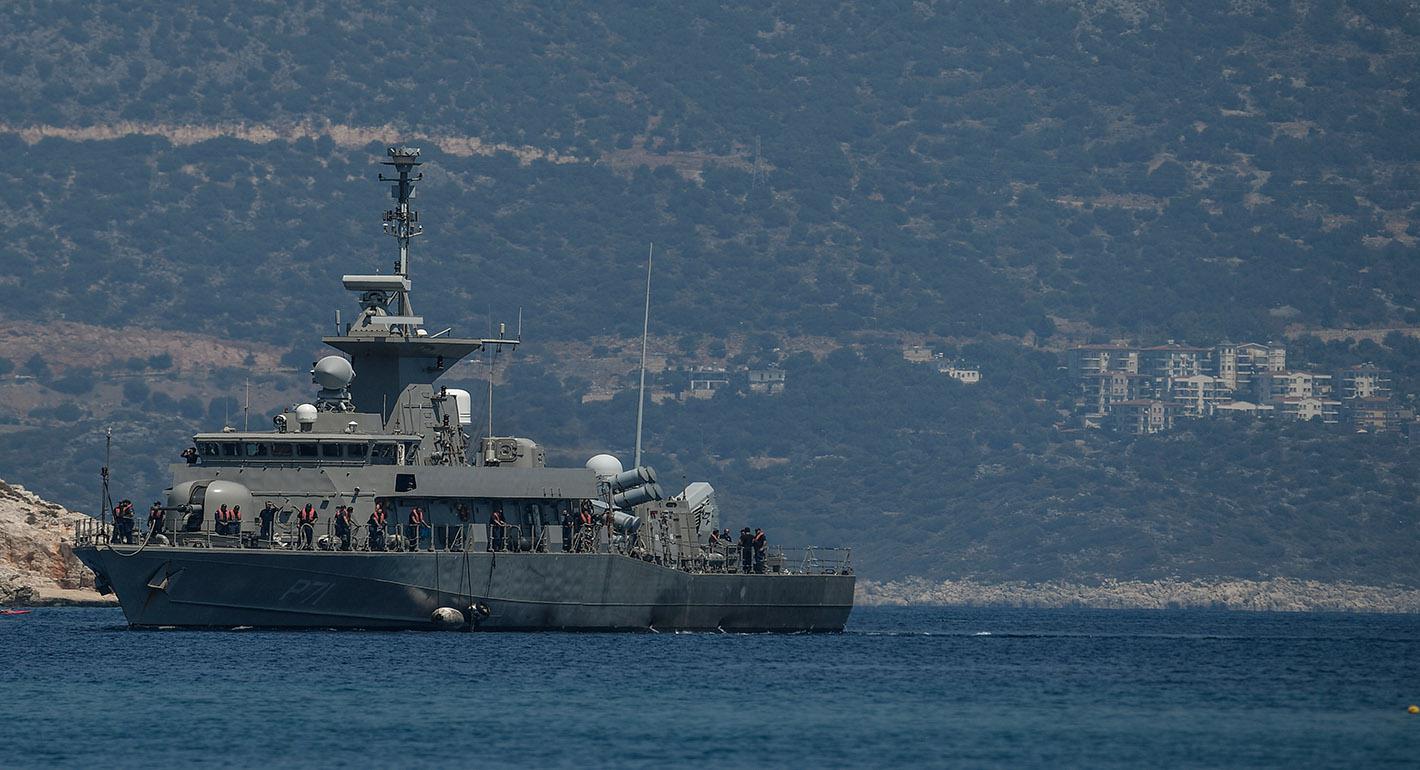
The discovery of hydrocarbons in the Eastern Mediterranean has raised tensions in the region. Europe must act to to prevent an actual war from breaking out between Greece and Turkey.
Source: Washington Post
On Sunday, Turkey pulled back its seismic exploration vessel, Oruc Reis, from the contested areas of the eastern Mediterranean to pave the path for the beginning of negotiations with Greece. Just as well. Tensions in “the East Med” — the shorthand for a corner of the Mediterranean with rich gas reserves and contested maritime boundaries — run so high that no one is ruling out an actual war between Turkey and Greece.
Turkey, Greece and Cyprus are at loggerheads about how to allocate zones to explore the newly discovered hydrocarbon resources in the area — with France throwing its weight behind the Greek position and the United Arab Emirates sending warplanes to Crete. The specter of a confrontation between NATO allies could spiral into a conflict that draws in much of Europe. And with Turkey’s involvement in the Libyan war and a bitter Turkish-UAE feud running in the background, Europe risks being sucked into a wider Middle East conflict.
At the heart of the matter are two conflicts: the old Cyprus problem — it was partitioned since 1974 into Greek and Turkish zones by U.N. peacekeeping forces — and an even more ancient disagreement between Greece and Turkey about how the maritime boundaries of Greek islands adjacent to Turkey are to be drawn. Greeks say that under international maritime law, Greece’s islands should be granted an extensive maritime economic zone. Turks argue that with its long shores, the Anatolian mainland generates its own continental shelf, limiting the scope of the Greek islands.
Europe is torn. France, Cyprus and Greece want sanctions to contain what they see as a resurgent Turkey, but remain somewhat isolated. While wanting to show solidarity with Cyprus and Greece, many European countries feel it is a bad idea to alienate Turkey — and that Ankara’s concerns about being frozen out of the eastern Mediterranean are not unwarranted. While paying lip service to European Union solidarity, they are reluctant to support crippling sanctions.
The only way out of this deadlock is to get Turkey and Greece to sit and talk — which is what Germany has been trying to do. Chancellor Angela Merkel is playing the role that U.S. presidents traditionally play, periodically calling Turkish President Recep Tayyip Erdogan and Greek Prime Minister Kyriakos Mitsotakis separately.
Europeans need to recognize that recent conflict in the East Med cannot be addressed in isolation from broader issues that involve Turkey’s involvement in Libya, its regional isolation, the long-standing Cyprus dispute and the overlapping claims on the Aegean. These issues are now interwoven. For example, Turkish troop deployment to Libya in January in support of the Tripoli-based Government of National Accord, and its subsequent maritime deal with the GNA, was out of a desire to stake its claim in the East Med.
Legally and politically, this is not a black-and-white case. The E.U. has called for an emergency session on Sept. 24 to discuss sanctions on Turkey, but those would only add oil to the fire.
Instead, the E.U. should press Greece and Turkey to return to “exploratory” talks, suspended since 2016, which cover the gamut of legal and political disputes — from maritime boundaries to overhead flights. With simultaneous announcements in Ankara and Athens, the new round of talks should start immediately and also cover the East Med. Turkey and Greece (and perhaps later Turkish and Greek Cypriots) should be encouraged to explore the possibility of joint ventures for the exploration of undersea resources in the disputed maritime geographies. Alternatively, the talks could also eventually lead to an agreement on a joint framework for international adjudication.
Europe and Turkey need one another on a wide range of issues, from migration to security. Ankara needs to tone down the “conquest” rhetoric. But in the absence of U.S. leadership, it is up to Europeans to develop a set of policy options to create a positive agenda and a new bargain with Turkey. Convening a wider conference on the East Med could be a start. Another option could be to give Turkey access to the East Med Gas Forum, a planned pipeline to run across the region, with the purpose of creating an axis that excludes Turkey. The pipeline, a brainchild of the Trump administration, triggered a siege mentality in Ankara, eventually contributing to Turkey’s entry into the Libyan war.
Europeans should also appoint an East Med envoy who can engage in shuttle diplomacy among the different parties for the goals of conflict mitigation and settlement.
And finally, NATO should get involved to prevent a confrontation. The organization can develop a deconflict mechanism between Turkey and Greece, possibly including France, with a view to preempt naval accidents that could lead to war.
In a world so interconnected, there can be no clear winners in a confrontation in the East Med. Best to sit and talk — and share.

Senior Fellow, Carnegie Europe
Sinan Ülgen is a senior fellow at Carnegie Europe in Brussels, where his research focuses on Turkish foreign policy, transatlantic relations, international trade, economic security, and digital policy.

Asli Aydıntaşbaş
European Council on Foreign Relations
Asli Aydıntaşbaş is a senior policy fellow at the European Council on Foreign Relations.
Carnegie does not take institutional positions on public policy issues; the views represented herein are those of the author(s) and do not necessarily reflect the views of Carnegie, its staff, or its trustees.

With its public finances in shambles, the far right polling at 35 percent ahead of the 2027 presidential election, and a growing protest movement, is France’s crisis a threat to the EU’s geopolitical awakening?

Rym Momtaz, ed.

Ahead of a tough winter for Ukraine, Donald Trump’s swing back toward Russia bodes ill. But instead of panicking, Kyiv’s European allies are focusing on action.
Rym Momtaz

Funding Ukraine remains a priority for European leaders. As Russia’s war of aggression heads into another winter, two feasible options to mobilize support for Kyiv should be fast-tracked.


Vladyslav Rashkovan, Gregory P. Wilson

While the EU and European governments are embracing the much-lauded middle-power moment, this entails three difficult conundrums.

Richard Youngs

Europe is facing rising populism internally as well as external pressures from Russia, China, Turkey, and the United States.

Dimitar Bechev