

Commentary
While the EU and European governments are embracing the much-lauded middle-power moment, this entails three difficult conundrums.
Richard Youngs
{
  "authors": [
    "James Goldgeier"
  ],
  "type": "commentary",
  "centerAffiliationAll": "dc",
  "centers": [
    "Carnegie Endowment for International Peace"
  ],
  "collections": [
    "Debating NATO Enlargement",
    "A More Disciplined American Global Leadership"
  ],
  "englishNewsletterAll": "americanStatecraft",
  "nonEnglishNewsletterAll": "",
  "primaryCenter": "Carnegie Endowment for International Peace",
  "programAffiliation": "ASP",
  "programs": [
    "American Statecraft"
  ],
  "projects": [],
  "regions": [
    "North America",
    "United States",
    "Eastern Europe",
    "Ukraine",
    "Western Europe"
  ],
  "topics": [
    "Security",
    "Foreign Policy",
    "Global Governance",
    "NATO",
    "Defense"
  ]
}
Source: Getty
Ukrainian membership in the security alliance is the only basis for a more stable relationship with Russia.
As Russia’s invasion of Ukraine continues, the United States is grappling with how to sustain Kyiv and create a larger framework for European security. Should Ukraine join the North Atlantic Treaty Alliance (NATO)? To what extent has enlarging NATO promoted or damaged U.S. interests since the Cold War ended? Should the United States double down on its commitment to European security and provide more forces to face down a hostile and aggressive Russia? Or should it instead seek ways to bring the temperature down while shifting European defense burdens to its allies?
Carnegie’s American Statecraft Program invited James Goldgeier and Joshua Shifrinson, two leading scholars of NATO enlargement, to discuss and debate these timely questions in a twenty-first-century exchange of letters. The two have worked together extensively but disagree about the central questions of U.S. security policy toward post–Cold War Europe. Jim has typically supported the enlargement of NATO, whereas Josh regards the alliance’s expansion as a strategic mistake. This format aims to facilitate direct, public dialogue and reflective argumentation, encouraging the participants to delve into the assumptions that lie behind their positions and identify what kind of empirical evidence could resolve parts of the debate.
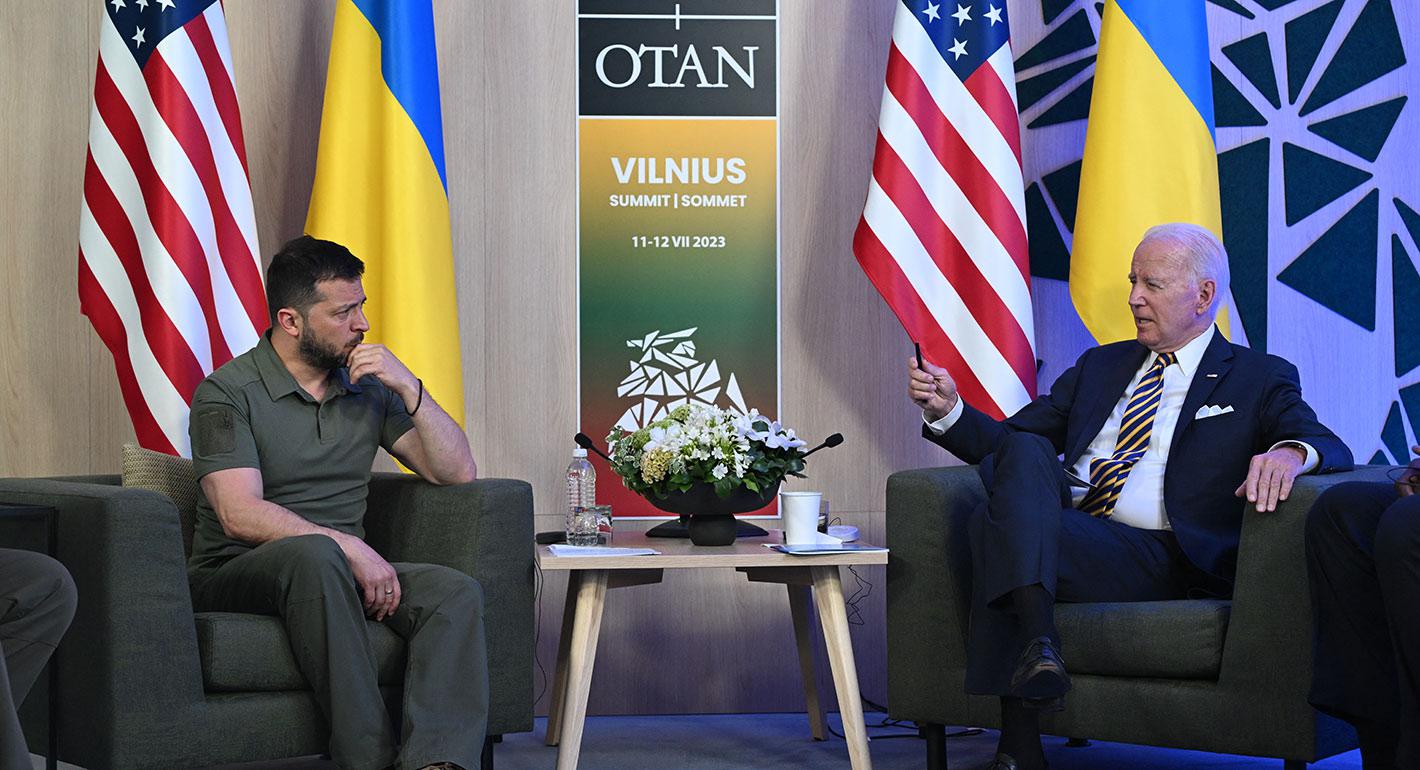
Now that the NATO summit in Vilnius has concluded, Jim begins the exchange by arguing that Ukraine should be welcomed into NATO once the current war ends. He and Josh will continue the exchange over the coming days and weeks, so check back here as the story unfolds.
Jim and Josh, take it away!
—Stephen Wertheim
July 13, 2023
Dear Josh,
I read with great interest your recent Foreign Affairs piece with Justin Logan arguing that NATO should “close the door to Ukraine.” Fortunately, the NATO heads of state and government did not listen and reaffirmed at their summit in Vilnius this week that Ukraine “will become a member of NATO.” The alliance’s open-door policy reflects Article 10 of the 1949 Washington Treaty (NATO’s founding document), which states that NATO can “invite any other European State in a position to further the principles of this Treaty and to contribute to the security of the North Atlantic area” to join. In Vilnius, NATO heads of state and government announced in their summit communiqué, “We will be in a position to extend an invitation to Ukraine to join the Alliance when Allies agree and conditions are met.” While that statement was quite vague because of a lack of consensus among members on when and how to move forward with Ukrainian membership at a time of war, members also declared that Ukraine “has moved beyond the need for the Membership Action Plan,” as they sought to give Kyiv a reason to believe that the accession process will not be never-ending.
When NATO issued its Bucharest Summit Declaration in 2008 saying that Ukraine and Georgia “will become members of NATO,” without giving them an actual path to membership, I thought it was a huge mistake. As you and I have discussed before, I long believed in the argument that William J. Burns—former ambassador to Russia, former Carnegie president, and current CIA director—made in the run-up to the Bucharest Summit and later in his memoirs. Burns judged that even though Russia accommodated itself to the 1999 and 2004 rounds of NATO enlargement, putting membership for Ukraine and Georgia on the table in 2008 was needlessly provocative, particularly since it was just a rhetorical move anyway. Fifteen years later, I believe NATO membership for Ukraine is the only way to guarantee security and stability.
The greatest threat today to European security is Russian imperialism. You and Justin frame the issue as one of “enlargement into areas that Moscow views as uniquely central to its national security.” Kimberly Marten’s chapter in our recent edited volume—Evaluating NATO Enlargement: From Cold War Victory to the Russia-Ukraine War—argues from a deep study of the Russian military that “NATO enlargement has had a significant negative impact on Russia’s relations with the West—but because of its symbolic and status-related components, not its military implications.” Perhaps you would say that Ukraine qualifies as more “uniquely central to [Russia’s] national security” compared to other countries that have joined NATO, and maybe that’s true, but the issue seems less one of Russian concerns over national security and more a question of identity. The Russian government doesn’t believe Ukraine has a right to exist as an independent country, and surveys of Russian citizens suggest that a majority are unwilling to see Russian-occupied territory returned to Ukraine. If Russia really feared NATO as a military threat, it wouldn’t have moved so many of its troops from the north down to Ukraine. NATO is a defensive alliance, and Putin’s decisions on these military deployments since February 2022 suggest he understands that fact quite well.
You and Justin raise an important point that if Ukraine becomes a member of NATO, the alliance could be faced with a difficult choice whenever Russia next decides to attack its neighbor: NATO would have to decide whether to go to war with Russia or to lower the credibility of the Article 5 guarantee that an attack against one member would be considered an attack against all. And so, you argue, why put NATO in that position?
I look at the problem differently. Imperialist Russia isn’t content to live within its internationally recognized 1991 borders. If it were, the West would happily discuss Russia’s legitimate national security interests in ensuring the security of those borders. But Moscow has made clear that it isn’t. At the same time, Russia has chosen not to attack an alliance member militarily because doing so would bring it directly into a war with NATO. Ukrainian membership in NATO thus provides the basis for a more stable relationship with Russia rather than living with continued uncertainty. Without NATO membership for Ukraine, the Russian threat against the country will continue, as will the need for the West to respond to Moscow’s aggression. The only way to take care of that threat over the long term is to bring Ukraine into NATO and deter a future Russian invasion. There are a lot of good ideas being put forward for how NATO’s Article 5 could cover territory under Ukrainian administrative control without giving up on the ultimate return of Russian-occupied territory. Ukrainian membership in NATO would also pave the way for more outside investments in the country’s reconstruction and increase its chances of gaining European Union membership, thanks to the security that would come with joining the alliance.
Where I do agree with you and Justin is that too much of the cost of defending Ukraine and upholding the commitment to Article 5 falls on the United States. It’s long past time for Europe and Canada to step up. The Vilnius Summit Communiqué laid out a very ambitious set of goals for NATO defense production and planning, but the proof of the pudding will be in the actual steps that member states take. Perhaps most important was the summit announcement that NATO has “put in place a new generation of regional defence plans.” I’m hopeful, but not necessarily optimistic, about what this will mean in practice, since too many alliance members still are not investing as they should in defense. Perhaps that should be the subject of another letter!
Sincerely,
Jim
Read more from Debating NATO Enlargement:
James Goldgeier
James Goldgeier is a visiting scholar at Stanford University’s Center for International Security and Cooperation, a visiting fellow at the Brookings Institution, and a professor of international relations at American University.
Carnegie does not take institutional positions on public policy issues; the views represented herein are those of the author(s) and do not necessarily reflect the views of Carnegie, its staff, or its trustees.

While the EU and European governments are embracing the much-lauded middle-power moment, this entails three difficult conundrums.

Richard Youngs

Europe is facing rising populism internally as well as external pressures from Russia, China, Turkey, and the United States.

Dimitar Bechev

A notable degree of participative democracy has firmly arrived in Europe. But to have more far-reaching impact, democratic deliberation needs to move into a radically new phase.
Richard Youngs

Much has been said of the changes Brussels is trying to make to the EU enlargement process. Here’s why gradual integration might—or might not—be the answer.
Dimitar Bechev

The European Commissioner for Trade is headed to China. But after President Xi’s bridge-building visit to Washington, can a more isolated EU overcome Beijing’s stranglehold on critical raw materials? Who will blink first?

Rym Momtaz, ed.