

Q&A
Dara Massicot, Aaron David Miller, Andrew S. Weiss
{
  "authors": [
    "Aaron David Miller"
  ],
  "type": "commentary",
  "centerAffiliationAll": "dc",
  "centers": [
    "Carnegie Endowment for International Peace"
  ],
  "collections": [],
  "englishNewsletterAll": "americanStatecraft",
  "nonEnglishNewsletterAll": "",
  "primaryCenter": "Carnegie Endowment for International Peace",
  "programAffiliation": "ASP",
  "programs": [
    "American Statecraft"
  ],
  "projects": [],
  "regions": [
    "North America",
    "United States",
    "Middle East",
    "Israel",
    "Palestine"
  ],
  "topics": [
    "Security",
    "Military",
    "Foreign Policy"
  ]
}
Source: Getty
The U.S. administration seems to be attempting to maximize trust with Israel to prepare for tougher conversations later.
Caught off guard like most of the world, U.S. President Joe Biden and his administration are scrambling to find ways to reassure and restrain Israel, ameliorate a catastrophic humanitarian crisis in Gaza, deter the involvement of Hezbollah and Iran, and find opportunities to free approximately 200 hostages held by Hamas, including many Americans.
Unfortunately, Washington lacks real on-the-ground leverage and is more an observer to events than a shaper of them. This is especially true for the looming, unprecedented Israeli ground campaign in Gaza to destroy Hamas as a military organization and to create a so-called post-Hamas reality there. If there is a central role for the United States to play, it may well come in trying to shape the scenario certain to emerge in the wake of Israel’s military operations.
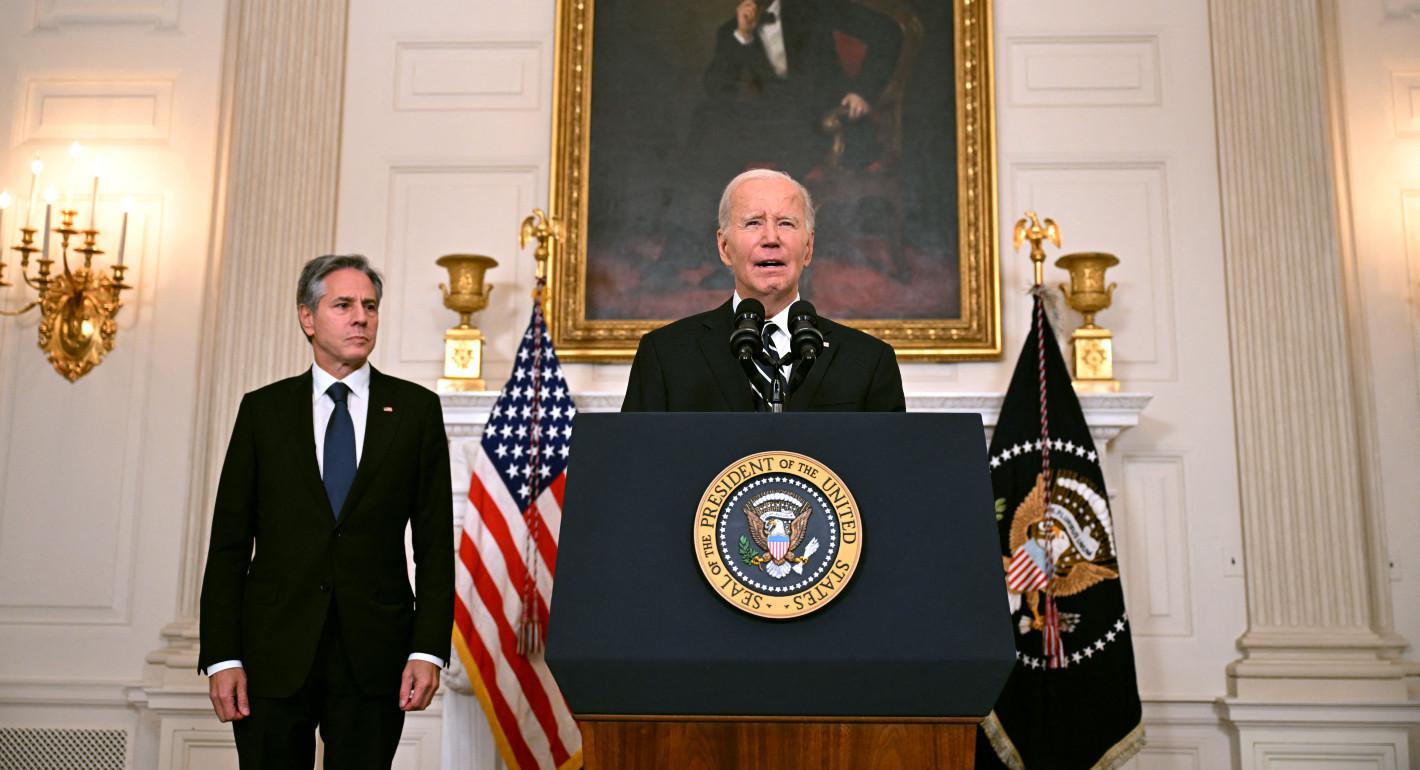
The tone of the administration’s reaction to the horrific Hamas attack was set by Biden’s October 10 address. The clear impression he left was that his administration would give the Israelis the time, space, and support to deal with Hamas in the way they saw fit. The administration has also proposed a $2 billion assistance package, including interceptors for Iron Dome, precision-guided munitions, and ammunition, with a possible supplemental to follow.
But as Palestinian deaths have mounted due to Israeli airstrikes and the humanitarian crisis in Gaza has worsened, the administration’s tone toughened somewhat, with an emphasis on the need for the Israelis to avoid civilian casualties and adhere to international laws of war. It has also cautioned Israel on occupying Gaza and pressured it to allow humanitarian aid into the strip. Still, Biden—whose love for Israel and high sensitivity to its security is deeply imprinted on his emotional and political DNA—remains determined to stand by the country. The logic of the administration’s policy seems to be to bind the United States closely to Israel now to maximize trust and confidence so that it would have currency in the bank for tougher conversations and even pressure later. Biden’s visit to Israel on Wednesday will likely further support this logic.
Biden has three objectives on his trip. First, he’ll want to press Israeli Prime Minister Benjamin Netanyahu to open up a reliable, stable humanitarian corridor to allow assistance to surge into southern Gaza.* Second, he’ll aim to reassure an Israeli public that has lost faith in its own leadership with a message of support and hope from America. Third, he’ll want to have a tough, frank conversation with Israeli leaders about their looming ground campaign—the objectives and complexities, with an eye toward getting them to think even harder about the depth, scope, and dangers of disproportionality, along with reoccupation of Gaza and civilian deaths.
As for the challenge of the humanitarian crisis in Gaza, the administration’s efforts are being hampered by time, space, and politics. Israel has been extending a twenty-four-hour deadline for the evacuation of Gaza City, which has an estimated population of 1.1 million, to move to southern Gaza, where there are not enough social services or basic necessities to care for them. Meanwhile, Hamas is discouraging Palestinians from leaving, Egypt is refusing to accept them, and Israeli airstrikes and blockades have made movement difficult and dangerous.
Gaza, which has a population density of approximately 21,000 human per square mile, was already stressed to provide services to its more than 2 million residents—half of whom are under the age of fifteen—during normal times. And the Israeli ground campaign hasn’t yet begun. It seems hard to imagine that anything more than ameliorating the current humanitarian crisis will be possible.
The administration’s other major challenge is trying to deter and contain the conflict from escalating. The West Bank front has already heated up, with more than fifty Palestinians killed in confrontations with Israeli settlers and the Israel Defense Forces. Jerusalem has remained relatively calm. But the real concern is the Israeli-Lebanese border, where confrontations between Israel and Hezbollah have occurred almost daily.
The administration has deployed two carrier strike groups to the Eastern Mediterranean, clearly signaling to Hezbollah and Iran that there will be consequences should they push for a major escalation. It’s unclear what Iran’s and Hezbollah’s calculations are. Iran clearly does not want to get involved in a major clash with Israel, let alone the United States. And one can wonder, with Hamas doing its work for Hezbollah in striking Israel, why the Shia group would want to risk its fortunes and military assets on behalf of the Palestinians. Much may come to turn on the breadth and depth of Israel’s ground war in Gaza and on any miscalculations by Israel or Hezbollah along the Israeli-Lebanese border.
It’s impossible to predict how the Gaza crisis will play out. Depending on how it does, there may well be a role for the U.S. administration—among others, including the Arab states, the UN, and the EU—in picking up the pieces and stabilizing Gaza. Alone among modern American presidents, Biden views himself as part of Israel’s story and is in a unique position to help moderate this crisis and pick up the pieces. At the risk of finding any silver linings in this otherwise dark tragedy, it could help to build a better future for Palestinians and more peaceful relations with Israel. The whole situation underscores how badly a comprehensive Israeli-Palestinian peace is needed—but anyone, including Biden, would be hard-pressed now, in the middle of this crisis, to divine how, if, and when that might play out.
*Update: Shortly after publication, Biden’s meeting with Egyptian President Abdel Fattah el-Sisi in Amman, Jordan, was canceled. The reference to the meeting has been removed from the piece.

Senior Fellow, American Statecraft Program
Aaron David Miller is a senior fellow at the Carnegie Endowment for International Peace, focusing on U.S. foreign policy.
Recent Work


Dara Massicot, Aaron David Miller, Andrew S. Weiss


Sophia Besch, Eric Ciaramella, Steve Feldstein, …
Carnegie does not take institutional positions on public policy issues; the views represented herein are those of the author(s) and do not necessarily reflect the views of Carnegie, its staff, or its trustees.

While the EU and European governments are embracing the much-lauded middle-power moment, this entails three difficult conundrums.

Richard Youngs

Europe is facing rising populism internally as well as external pressures from Russia, China, Turkey, and the United States.

Dimitar Bechev

Much has been said of the changes Brussels is trying to make to the EU enlargement process. Here’s why gradual integration might—or might not—be the answer.
Dimitar Bechev

The European Commissioner for Trade is headed to China. But after President Xi’s bridge-building visit to Washington, can a more isolated EU overcome Beijing’s stranglehold on critical raw materials? Who will blink first?

Rym Momtaz, ed.

European NATO countries are wrestling with the possibility of U.S. disengagement from the alliance. With the continent’s security increasingly uncertain, governments must restore the credibility of their collective defense.



Hans-Dieter Lucas, Adam Thomson, Pierre Vimont