Christopher Boucek
Source: Getty
Yemen: Avoiding a Downward Spiral
If the Yemeni central government cannot fully control its territory, violent extremists will have a space to regroup and launch new attacks. Yemen's problems potentially threaten the region and the international community.
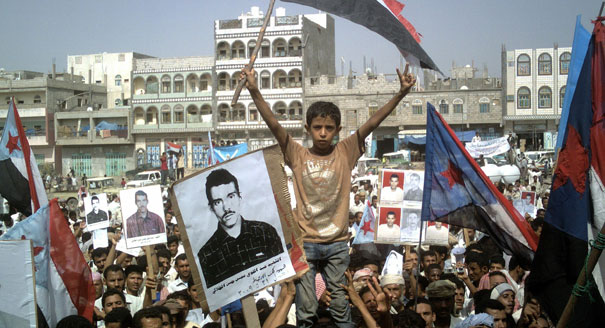
A confluence of looming challenges—economic ruin, an emerging water shortage, violent extremism, and a growing secessionist movement—threaten to overwhelm the Yemeni government, provide a breeding ground for terrorists, and destabilize the region. Yemen has survived past crises but the current risks are unprecedented in their scope and interconnectivity, warns a new paper by Christopher Boucek.
Key Conclusions:
- There are increasing indications that al-Qaeda is regrouping in Yemen. Recent counterterrorism measures in Saudi Arabia have forced extremists to seek refuge elsewhere, with a steady flow relocating to Yemen’s under-governed areas.
- The ceding of authority by the weak central government to local government has proved counterproductive by limiting control over volatile under-governed territories.
- The security situation is rapidly deteriorating. Fighting with Shi’i rebels in north Yemen has strained the army, and Yemen is unable to protect its coast from the recent surge in piracy.
- The poorest in the Arab world, with unemployment at 35 percent, Yemen’s economy has been severely effected by the dramatic fall in oil prices and has few sustainable post-oil, economic options.
- Yemen is running out of water. Rising domestic consumption, poor water management, corruption, the absence of resource governance, and wasteful irrigation techniques are creating frequent and widespread shortages.
- Yemen’s lack of food and water is complicated by the population’s dependence on qat, a quick-cash crop that requires heavy irrigation to thrive. Farmers devote so much land to qat production that Yemen is now a net food importer.
Recommendations:
- Yemen must build local capacity in law enforcement and its legal and judicial systems by enacting counterterrorism legislation, passing terror finance laws, improving police training, and professionalizing the prison service.
- The Gulf states should make Yemen’s membership of the Gulf Cooperation Council contingent on tough steps, including progress on curbing government subsidies, addressing corruption, and enacting measures to curtail security concerns.
- U.S. aid to Yemen is disproportionately small given its importance to U.S. national security. Development assistance, education and technical cooperation, capacity building, institution strengthening, and direct financial assistance can better address the interconnected challenges facing Yemen than military and security aid.
Boucek concludes:
“If left unaddressed, Yemen’s problems could potentially destabilize Saudi Arabia and the other Gulf states. The inability of the Yemeni central government to fully control its territory will create space for violent extremists to regroup and launch attacks against domestic and international targets. The international community must be realistic about the limitations of intervention in Yemen. In the near term, however, inaction is not an option.”

About the Author
Former Associate, Middle East Program
Boucek was an associate in the Carnegie Middle East Program where his research focused on security challenges in the Arabian Peninsula and Northern Africa.
- Yemen After Saleh’s Return and Awlaki’s ExitQ&A
- Rivals—Iran vs. Saudi ArabiaQ&A
Christopher Boucek, Karim Sadjadpour
Recent Work
Carnegie does not take institutional positions on public policy issues; the views represented herein are those of the author(s) and do not necessarily reflect the views of Carnegie, its staff, or its trustees.

More Work from Carnegie Europe
- Taking the Pulse: Is it NATO’s Job to Support Trump’s War of Choice?Commentary
Donald Trump has demanded that European allies send ships to the Strait of Hormuz while his war of choice in Iran rages on. He has constantly berated NATO while the alliance’s secretary-general has emphatically supported him.
Rym Momtaz, ed.
- Time to Merge the Commission and EEASCommentary
The EU is structurally incapable of reacting to today’s foreign policy crises. The union must fold the EEAS into the European Commission and create a security council better prepared to take action on the global stage.
Stefan Lehne
- Russia’s Imperial Retreat Is Europe’s Strategic OpportunityCommentary
The war in Ukraine is costing Russia its leverage overseas. Across the South Caucasus and Middle East, this presents an opportunity for Europe to pick up the pieces and claim its own sphere of influence.
William Dixon, Maksym Beznosiuk
- Planetary vs International Security: Economic Growth at the CrossroadsResearch
Economic growth is at the heart of a dilemma between planetary and international security.
Olivia Lazard
- Europe and the Arab Gulf Must Come TogetherCommentary
The war in Iran proves the United States is now a destabilizing actor for Europe and the Arab Gulf. From protect their economies and energy supplies to safeguarding their territorial integrity, both regions have much to gain from forming a new kind of partnership together.
Rym Momtaz