

Commentary
Dmitri Trenin
{
  "authors": [
    "Dmitri Trenin"
  ],
  "type": "commentary",
  "blog": "Strategic Europe",
  "centerAffiliationAll": "",
  "centers": [
    "Carnegie Endowment for International Peace",
    "Carnegie Europe",
    "Carnegie Russia Eurasia Center"
  ],
  "collections": [
    "Turkey’s Transformation"
  ],
  "englishNewsletterAll": "",
  "nonEnglishNewsletterAll": "",
  "primaryCenter": "Carnegie Russia Eurasia Center",
  "programAffiliation": "",
  "programs": [],
  "projects": [],
  "regions": [
    "Türkiye",
    "Russia",
    "Europe",
    "Middle East"
  ],
  "topics": [
    "Security",
    "Foreign Policy"
  ]
}
Source: Getty
An interesting relationship is emerging between Turkey and Russia, which may impact on a range of countries that once used to be part of either the Ottoman or Russian/Soviet empires, or both.
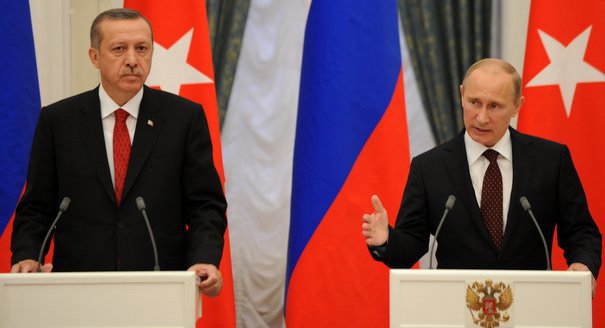
Moscow and Ankara take vastly different views of the developments in Syria. Yet, the Russian government and the Kremlin-friendly media only rarely chide Turkey for the position it has taken on Syria. At the height of the battle in Damascus, Prime Minister Erdogan traveled to Russia for talks with Vladimir Putin. It is clear that Moscow considers Ankara not only an economic partner, but also a key regional player, and is prepared to work with it. Thus, an interesting relationship is emerging, one which may impact on a range of countries that once used to be part of either the Ottoman or Russian/Soviet empires, or both.
Moscow clearly appreciates Turkey's new strengths—economic, diplomatic, military, and its soft power. Even as the Soviet Union unraveled and the new Russian Federation underwent a difficult and painful change, Turkey rapidly urbanized and industrialized, its GDP rising tenfold, and its exports growing a hundredfold. Russia acknowledged, with visible satisfaction, Turkey's redefinition of its relations with the United States toward more autonomy from Washington. Moscow also noted, with clear interest, that Turkey's membership in the European Union started to look increasingly unlikely.
Turkey's current "neo-Ottoman" foreign policy in the neighborhood has been more controversial, from the Russian perspective. Turkey rediscovered its interest and gained a measure of influence in the Balkans, the Black Sea area, the Caucasus, and Central Asia. Over time, however, Moscow has grown more relaxed about what Ankara could actually achieve there beyond expanding trade relations. In addition, Russia's foreign policy philosophy usually recognizes other great powers' legitimate security interests in their own regions, even as it vehemently opposes what it calls U.S. global meddling.
As a result, the Russo-Turkish relationship has fundamentally improved since the breakup of the Soviet Union. A steep rise in bilateral trade, especially on the energy side, and human contacts, to include thousands of Turkish workers and businesspeople in Russia and millions of Russian vacationers on Turkey's Mediterranean coast paved the way to reconciliation. This does not make the two countries allies, or even strategic partners, but the relations today are light years from the situation in 1991, when Air Marshal Yevgeny Shaposhnikov, the Soviet Union's last defense minister, was threatening "a third world war" in case Ankara interfered militarily in the Azeri-Armenian conflict over Nagorno-Karabakh. Now, a war seems to be out of the equation. A security community has de facto emerged between Russia and Turkey, similar to the ones existing between Russia and Germany, or Russia and Finland.
This is a sound basis for expanding Russo-Turkish regional cooperation while managing their conflicting interests. Both countries share an interest in stabilizing their joint neighborhood. Where Moscow and Ankara can collaborate, is more or less clear. The area stretches from the Balkans and Cyprus to the Arab world and the Caucasus to Iran and Afghanistan and Central Asia. How precisely Russia and Turkey can go about it and what can be expected of that cooperation is a more interesting question.
On Syria, much of the opportunity to cooperate was lost in 2011. However, ending the Syrian civil war and preventing it from spilling over to other countries in the area should be in the national interests of both Turkey and Russia. Similarly, despite the very different relationships that Moscow and Ankara maintain with Iran, neither would be happy to see Iran acquiring nuclear weapons or Israel and/or the United States attacking Iran. Russia has some expertise and even leverage with regard to the issues of immediate security concern to Turkey: Armenia, Cyprus, and Kurdistan. On the issue of Nagorno-Karabakh, Moscow and Ankara share an interest in moving the Azeris and Armenians toward a final settlement.
Abkhazia's case will be particularly intriguing. Turkey was not amused by the short Russo-Georgian war four years ago. Ankara recognizes Georgia's sovereignty over Abkhazia and South Ossetia. Yet, the Turks have long learned to live with the realities on the ground, whether in Kurdistan or the Caucasus. They also host a large ethnic Abkhaz community. If Abkhazia is to emerge as a genuinely independent state, its relations with Turkey—and Ankara's position on the issue—will be crucial.
Moscow and Ankara are not yet cooperating systematically on any of these dossiers. Before they are able to, they need to learn to better understand where each side is coming from and where it is headed, so as to decide what is desirable and what is doable in terms of a potential common effort. It would make sense for a track two type dialogue to begin even now among the experts with access to their respective governments. Having fought a dozen wars in the past two-plus centuries, and fully reconciled themselves in the last two-plus decades, Russia and Turkey should now move ahead to jointly produce stability for the regions over which they used to fight in the past.
Former Director, Carnegie Moscow Center
Trenin was director of the Carnegie Moscow Center from 2008 to early 2022.
Recent Work
Dmitri Trenin
Dmitri Trenin
Carnegie does not take institutional positions on public policy issues; the views represented herein are those of the author(s) and do not necessarily reflect the views of Carnegie, its staff, or its trustees.

The European Commissioner for Trade is headed to China. But after President Xi’s bridge-building visit to Washington, can a more isolated EU overcome Beijing’s stranglehold on critical raw materials? Who will blink first?

Rym Momtaz, ed.

The domestic impacts of how long it is taking to end the war in Ukraine have pushed the French electorate to the political extremes and compromised the country’s diplomatic capacity.
Rym Momtaz

Before the next wave of EU enlargement takes place, the union needs to grapple with thorny questions of how power is distributed among its members.


Emil Sondaj Hansen, Ditte Brasso Sørensen

A summer of escalation in the Black Sea has hurt Ukraine economically and is exacerbating world food security. A truce is needed—as is a broader reframing of Europe’s Ukraine strategy.

Thomas de Waal

Are Germany’s economic, industrial, and political struggles becoming a liability for the EU’s ability to rise to the geopolitical moment?
Rym Momtaz, ed.