

Commentary
Judy Dempsey
{
  "authors": [
    "Judy Dempsey"
  ],
  "type": "commentary",
  "blog": "Strategic Europe",
  "centerAffiliationAll": "",
  "centers": [
    "Carnegie Endowment for International Peace",
    "Carnegie Europe"
  ],
  "collections": [],
  "englishNewsletterAll": "",
  "nonEnglishNewsletterAll": "",
  "primaryCenter": "Carnegie Europe",
  "programAffiliation": "",
  "programs": [],
  "projects": [],
  "regions": [
    "Europe",
    "Middle East",
    "North America"
  ],
  "topics": [
    "EU",
    "Security"
  ]
}
Source: Getty
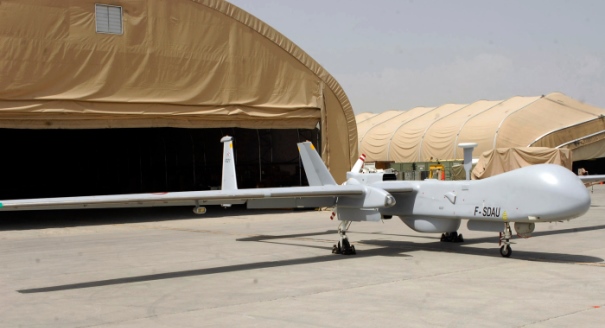
The United States and Europe should promote a common code of conduct for the use of drones, not least to project a united stance toward undemocratic regimes.
Steven Watt, senior staff attorney for the American Civil Liberties Union, is used to attending court hearings about human rights issues in the United States.
But when he got a request from the German parliament’s human rights committee to attend a public hearing on fighting terrorism, he was surprised.
“I was also very pleased,” Watt told me before attending the hearing. “It shows that German lawmakers want to know America’s thinking on, for example, the use of drones in the fight against terrorism and the implications for human rights,” he added.
Watt has spent the past several years trying to gain access to and defend some of the individuals held at the Guantanamo Bay detention center. He has also defended victims of former president George W. Bush’s “renditions” policy, which entailed U.S. special forces or Secret Service agents kidnapping suspects and bringing them to secret detention centers in Lithuania, Poland, or Romania for torture and interrogation.
Guantanamo Bay and the renditions policy called into question whether the United States and Europe still share the same values of respect for human rights, the rule of law, accountability, and the right enshrined in habeas corpus. After the terrorist attacks of September 11, 2001, and the U.S.-led invasion of Iraq in 2003, the gap between Americans and Europeans on these issues widened.
Those European countries that cooperated with the United States over renditions are now paying the price. The European Court for Human Rights is dealing with cases against Lithuania, Poland, and Romania. It recently ruled against Macedonia. The government there had colluded with the United States over the kidnapping of Khalid al-Masri, a German national suspected of involvement in terrorism.
“The fact that these countries have been taken to court means that they will not be in a hurry next time to do America’s bidding,” Watt said. “The issue is the rule of law. It is also about accountability.”
During Wednesday’s hearing, Watt and the other participants focused on a more recent issue of accountability in U.S. policy: the use of drones, which is still shrouded in secrecy, and its implications for human rights.
Watt could give the committee few answers about how exactly the Obama administration takes decisions about drone attacks. But German lawmakers wanted to know his appreciation of the legal context of using this particular weapon.
Thomas de Maizière, Germany’s defense minister, recently announced that the German armed forces would acquire armed drones for protection. This signals a major shift, as Germany has so far used only unarmed drones for surveillance purposes.
Berlin has concluded that if the drones can help to protect its soldiers from being injured or killed, they are worth it. Yet de Maizière will have a difficult job convincing the German public, which is set against drones because the United States uses them for targeted killings. Germans are also very uneasy about the legal implications of that policy.
John Brennan, the new chief of the Central Intelligence Agency, has insisted that the United States acts within the law. Because the United States is engaged in a war against terrorism, he argues, international law allows it to use drones for targeted killings.
Yet what many European lawmakers and advocacy groups want to know is the chain of command and responsibility. This is important not only in the case of civilian casualties but also because drones make it possible to leave the conventional theater and conduct “combat” from a much greater distance.
“The problem is that we just don’t know who takes responsibility,” Watt said. “Because the details are assumed to fall under national security, there is no transparency or accountability. The public—and indeed governments—in Europe are being asked to trust the United States and its adherence to the law. Trust is not enough. What is needed is some kind of agreed legal code of conduct over the use of drones.”
Of course, it is precisely this lack of transparency that makes it harder for Europe and the United States to consider such a code of conduct. But finding some kind of agreement is important, and not just because it would reinforce shared values. The United States and Europe urgently need to project a united stance because, in the near future, nondemocratic countries may also acquire the technology to make drones.
A united stance matters. If undemocratic countries use drones to quash dissenters, claiming they are terrorists, those governments can easily defend their position by referring to America’s secretive policy of targeted killings.
A free-for-all in the use of armed drones is not in the interests of the West. Civil society movements in authoritarian countries need a code of conduct as a benchmark when regimes there resort to using drones to suppress dissent. They need to believe that the democratic world has shared values and a common standard over the use of drones.

Nonresident Senior Fellow, Carnegie Europe
Judy Dempsey is a nonresident senior fellow at Carnegie Europe
Recent Work
Judy Dempsey
Judy Dempsey
Carnegie does not take institutional positions on public policy issues; the views represented herein are those of the author(s) and do not necessarily reflect the views of Carnegie, its staff, or its trustees.
Trump is distracted and Ukraine wants Europe to step up. The continent’s leaders must find their voice and assert it in talks with Russia.

Alissa de Carbonnel

Mounting economic strain and battlefield losses will not necessarily make the Kremlin less dangerous. They could instead push Moscow toward a more aggressive hybrid campaign designed to test NATO’s Eastern flank, exploit allied hesitation, and fracture European resolve.

Maksym Beznosiuk

Over the past ten years, NATO has held almost as many summits as it did during the entirety of the Cold War. Are they still useful, or is it time to stop holding annual meetings?

Rym Momtaz, ed.
Nearly a year and a half after Europeans leaned into sucking up to Trump, the strategy has produced some benefits when it comes to Ukraine.
Rym Momtaz
Far-right leader Marine Le Pen can—and will—run in France’s next presidential election. What does the outcome of her appeal against a 2025 embezzlement conviction mean for the country’s political future?
Catherine Fieschi