

Paper
Richard Youngs, Thomas Carothers
{
  "authors": [
    "Richard Youngs"
  ],
  "type": "commentary",
  "blog": "Strategic Europe",
  "centerAffiliationAll": "dc",
  "centers": [
    "Carnegie Endowment for International Peace",
    "Carnegie Europe"
  ],
  "collections": [],
  "englishNewsletterAll": "democracy",
  "nonEnglishNewsletterAll": "",
  "primaryCenter": "Carnegie Europe",
  "programAffiliation": "DCG",
  "programs": [
    "Democracy, Conflict, and Governance"
  ],
  "projects": [],
  "regions": [
    "Europe",
    "Middle East"
  ],
  "topics": [
    "Democracy",
    "EU",
    "Security"
  ]
}
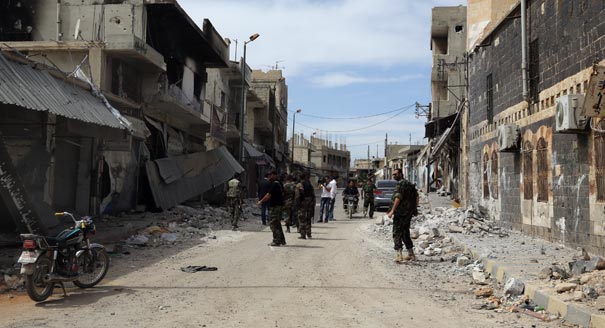
Source: Getty
Recent tragic events in the Middle East show that the EU needs to adopt a comprehensive, multilateral regional strategy in its dealings with its Southern neighborhood.
Recent events in Egypt and Syria—a military coup and chemical weapons attacks, respectively—were triggered by specific national circumstances. Yet they compound the need for Europe to adopt a more comprehensive regional strategy in the Middle East. More than anything, the tragic events demonstrate the need for the EU to multilateralize its approach to its Southern neighborhood.
European responses to the twin crises display a curious discrepancy. In Syria, reactions have been extremely cautious because of regional spillover dangers. In Egypt, they have been equally hedged despite the risks of regional ramifications. Both positions risk underplaying important geopolitical trends.
Since the start of the Syrian crisis, EU member states and the European External Action Service, the EU’s foreign policy arm, have worried that intrusive engagement or assertive pressure on the regime of President Bashar al-Assad might unsettle regional power balances. The EU has drifted into a passivity nourished by fear that any alternative to the current impasse between regime and rebels would be worse than the status quo.
The arguments in favor of caution and against injudicious military action have enormous merit. But it is questionable whether a prolonged, unresolved conflict is the best protection against regional contagion. The regime-rebel stalemate is already a source of growing instability and regional fragility. The fear that the only alternative now to the Assad regime is al-Qaeda is, at least for the moment, unduly fatalistic: most rebels are not from jihadist groups. It is unsatisfactory to believe that inaction amounts, by default, to a wise regional strategy.
European governments have hardly harnessed their hands-off prudence as a platform for a regional security policy in the Middle East. Indeed, with the exception of France, they now risk being marginalized. While cooperation with Russia over Syria is eminently sensible—and has indeed been the focus of much European diplomacy since early 2012—leaving Moscow as the lowest-common-denominator arbiter is a highly dubious basis for Middle Eastern stability. This will continue to be the case even if Russia’s proposal to place Syria’s chemical weapons beyond use gains traction.
In contrast to its eclipse in Syria, the EU has played an impressively high-profile diplomatic role in Egypt. It became clear over the summer that the EU has invested sufficient diplomatic capital in creating a sensitive partnership to be invited to build bridges between Egypt’s different factions.
However, the EU and its member states need to be more aware of how their actions and positions in Egypt have contributed to wider shock waves across the Middle East. The ultracautious nature of the European policy response to the Egyptian coup of June 30 is not without cost in relation to the EU’s wider regional agenda.
The military takeover has soured the EU’s relations with Turkey, whose Justice and Development Party (AKP) government accuses the EU of spineless neutrality in its reaction to the ousting of former president Mohamed Morsi. Whether or not this is a fair criticism, the discrepancy between the positions of Brussels and Ankara endangers a vitally important strategic partnership with a key rising power. The army’s takeover has also increased the risk of a major division between Egypt and Turkey, which should be of utmost concern to the EU’s strategic interest in a stable Middle East.
The Egyptian military’s actions against the Muslim Brotherhood also affect Egypt’s more immediate neighbors. The coup adds another level of inflammatory complication to Lebanon’s vicariously balanced confessional politics. It makes Tunisia’s Ennahda party more nervous about the reprisals it might face and has encouraged opposition figures to pull back from the country’s now-stuttering constitutional process. It may make Hamas feel more defensive and wary of compromising, and therefore unwilling to participate fully in mainstream Palestinian politics. And it will add grist to the mill of those wishing to limit incremental reforms in Morocco, Jordan, Algeria, Kuwait, and Yemen—with a destabilizing impact in the medium term.
Iran is also likely to use the perception of Western support for the Egyptian coup as a means of rebuilding its own regional brand image, which suffered much in the wake of the first Arab revolts. States like Saudi Arabia and the United Arab Emirates that have openly sought to contain the Muslim Brotherhood as a central plank of a counterreform agenda now feel emboldened.
The EU has talked often of the need for a truly regional geostrategy to mitigate such knock-on effects. Yet for all the skillful diplomacy shown since the Egyptian military takeover, there is little evidence so far of such a strategy. And, in many parts of the region, EU member states still pull in opposing directions, with manifestly different diplomatic strategies.
The Egyptian and Syrian tragedies raise doubts about whether the Mediterranean basin functions like a single, communal neighborhood capable of resolving its problems through agreed rules of peaceable co-existence. Some EU governments have made tentative attempts to construct a wider, international framework for Middle Eastern diplomacy. But the ramifications of the huge numbers of deaths in Cairo and Damascus enjoin European governments to go much further in this direction.
The EU’s neighborhood policy in the Southern Mediterranean must in future serve less as a self-contained, EU-centered framework. Instead, the EU should use this instrument more as a platform for engaging other global powers on challenges related to North Africa and the Middle East.

Senior Fellow, Democracy, Conflict, and Governance Program
Richard Youngs is a senior fellow in the Democracy, Conflict, and Governance Program, based at Carnegie Europe. He works on EU foreign policy and on issues of international democracy.
Recent Work

Richard Youngs, Thomas Carothers
Richard Youngs
Carnegie does not take institutional positions on public policy issues; the views represented herein are those of the author(s) and do not necessarily reflect the views of Carnegie, its staff, or its trustees.
Far-right leader Marine Le Pen can—and will—run in France’s next presidential election. What does the outcome of her appeal against a 2025 embezzlement conviction mean for the country’s political future?

Catherine Fieschi
While Russia is not ready to sue for peace on Europe’s terms, it could still either seek a ceasefire in Ukraine or try escalation. Brussels needs to prepare for both and prioritize that preparation over normative discussions.

Kadri Liik
When Giorgia Meloni very publicly rebuked Donald Trump’s disparaging remarks about her, it surprised many who saw her as a European extension of Trumpism. Is the spat a sign of trouble in the radical right’s transatlantic axis?

Rym Momtaz, ed.

Western Europe’s dual-use infrastructure melted down during its latest heat wave. If a predicted hot weather event can take the continent by surprise, what chance does it have to withstand unexpected geopolitical crises?
Rym Momtaz

There is an elephant in the room when it comes to the EU’s upcoming security strategy: Donald Trump. Unless European leaders acknowledge the depth of the transatlantic crisis, true autonomy will remain out of reach.

Stefan Lehne