

Commentary
Judy Dempsey
{
  "authors": [
    "Judy Dempsey"
  ],
  "type": "commentary",
  "blog": "Strategic Europe",
  "centerAffiliationAll": "",
  "centers": [
    "Carnegie Endowment for International Peace",
    "Carnegie Europe"
  ],
  "collections": [],
  "englishNewsletterAll": "",
  "nonEnglishNewsletterAll": "",
  "primaryCenter": "Carnegie Europe",
  "programAffiliation": "",
  "programs": [],
  "projects": [],
  "regions": [
    "Western Europe",
    "Germany",
    "Europe"
  ],
  "topics": [
    "Climate Change",
    "EU"
  ]
}
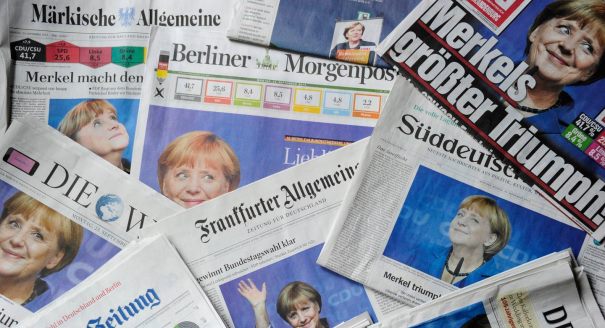
Source: Getty
As Angela Merkel begins her third term as German chancellor, she must embrace political integration to give the EU the cohesion, credibility, and ambition it has been lacking.
Last Monday evening, German Chancellor Angela Merkel invited the president of the European Commission, José Manuel Barroso, to dinner in the Chancellery.
It was one of those bilateral meetings that Merkel regularly holds with European leaders ahead of EU summits to avoid any major surprises or disputes, and to prepare the ground for key decisions.
That is how Merkel operated throughout her second term in office between 2009 and 2013, a period that was dominated by the euro crisis. One of the regular topics of discussion at the pre-summit meetings was the question of whether the commission should be given more powers over economic policy.
As a result, the commission did gain some new powers. But there was no doubt about who was driving the EU’s economic policy. It was Merkel’s Chancellery that largely set the conditions under which the EU would help the indebted eurozone countries.
In the coming four years, Angela Merkel is likely to dominate EU politics even more, thanks to her grand election victory this past September. But what will she do with all this power?
As her conservative bloc began coalition talks on October 23 with her new partners, the Social Democrats, observers may finally be able to glean which path Merkel will choose for Europe. Clearly, her decisions will have far-reaching consequences for the EU as an economic and political global player.
If recent press reports based on internal sources at the Chancellery are accurate, Merkel seems prepared to cede substantial powers to the commission over budget discipline, competitiveness, and investments. It seems that she would like to empower the commission to conclude agreements with each eurozone member on these issues. If it can be done without changes to the EU treaties, there will also be new incentives and penalties for eurozone countries.
In short, the European Commission will be policing the implementation of economic and fiscal policy. It will become responsible for the eurozone’s success—or failure.
Ceding such powers suits Merkel and her finance minister, Wolfgang Schäuble, who is one of the last true Europeans in the German government. But while Schäuble is probably genuinely in favor of moving toward a more deeply integrated Europe, Merkel may just be aiming to spread the blame for unpopular decisions.
For one thing, the indebted eurozone members would no longer be able to blame Germany for dictating austerity measures to the rest of Europe; the commission would have to carry the can. Berlin hopes that this shift would also dilute some of the vile nationalist and anti-German feelings that Merkel had to deal with in some Southern European countries.
At the same time, Merkel will be very careful not to overdo integration. In her own conservative bloc, many are highly skeptical about the commission accruing more powers. They doubt whether Brussels has either the ability or the commitment to see through the deep reforms that would be needed to instill budget discipline.
“Germany has determined Europe’s economic policy for the medium term. Once that is in place, it would be useful to have the commission police it,” said Daniela Schwarzer, head of the EU Integration Research Division at the German Institute for International and Security Affairs in Berlin. “But the real dilemma is this: Can you strengthen the commission in such a policing role without moving ahead on political integration?” she added.
Schwarzer’s answer is “no.” Merkel, she thinks, will not embrace political integration to the extent that would be needed to give Europe the cohesiveness, credibility, and ambition that have been missing.
Why not?
First, Merkel may genuinely believe that integration has already gone far enough. As it is, the German chancellor has shown a spectacular lack of interest in security, defense, and foreign policy, the three areas that most desperately need to be integrated. Nor has she been willing to consider drawing up a European security strategy that would address the daunting problems awaiting Europe on its doorstep.
Second, Merkel has a great interest in keeping the UK from leaving the EU. In her view, this may be worth foregoing deeper integration. The consequences of a British exit for the rest of the EU are just too terrible to consider.
Yet the price of curbing Europe’s political integration may be high. If EU leaders, with Angela Merkel as prima inter pares, fail to complete the bloc’s post-1945 architecture, they leave the reunification of Europe incomplete. What’s more, they leave Europe unprepared to deal even with its own neighborhood.

Nonresident Senior Fellow, Carnegie Europe
Judy Dempsey is a nonresident senior fellow at Carnegie Europe
Recent Work
Judy Dempsey
Judy Dempsey
Carnegie does not take institutional positions on public policy issues; the views represented herein are those of the author(s) and do not necessarily reflect the views of Carnegie, its staff, or its trustees.

As we close out another season of Strategic Europe, it is worth taking stock of the deep shifts underway.

Rym Momtaz

The EU had to compromise to adopt a twenty-first sanctions package against Russia, exposing growing cracks in the union’s resolve. Is this latest, weaker round worth it to keep pressure on Moscow?
Rym Momtaz, ed.

Trump is distracted and Ukraine wants Europe to step up. The continent’s leaders must find their voice and assert it in talks with Russia.

Alissa de Carbonnel

Mounting economic strain and battlefield losses will not necessarily make the Kremlin less dangerous. They could instead push Moscow toward a more aggressive hybrid campaign designed to test NATO’s Eastern flank, exploit allied hesitation, and fracture European resolve.

Maksym Beznosiuk

Over the past ten years, NATO has held almost as many summits as it did during the entirety of the Cold War. Are they still useful, or is it time to stop holding annual meetings?
Rym Momtaz, ed.