

Commentary
Judy Dempsey
{
  "authors": [
    "Judy Dempsey"
  ],
  "type": "commentary",
  "blog": "Strategic Europe",
  "centerAffiliationAll": "",
  "centers": [
    "Carnegie Endowment for International Peace",
    "Carnegie Europe"
  ],
  "collections": [
    "Europe’s Eastern Neighborhood"
  ],
  "englishNewsletterAll": "",
  "nonEnglishNewsletterAll": "",
  "primaryCenter": "Carnegie Europe",
  "programAffiliation": "",
  "programs": [],
  "projects": [],
  "regions": [
    "Eastern Europe",
    "Russia",
    "Ukraine",
    "Western Europe",
    "Europe"
  ],
  "topics": [
    "Democracy",
    "Foreign Policy",
    "EU",
    "Security"
  ]
}
Source: Getty
The Ukrainian president is cracking down on civil liberties, setting his country on a dangerous path. That calls for a united response from the opposition and from the EU.
Ukraine’s president, Viktor Yanukovych, has shown his true colors. Democracy is not his thing. On January 16, he convened the country’s parliament and pushed through a series of new laws that curb civil liberties.
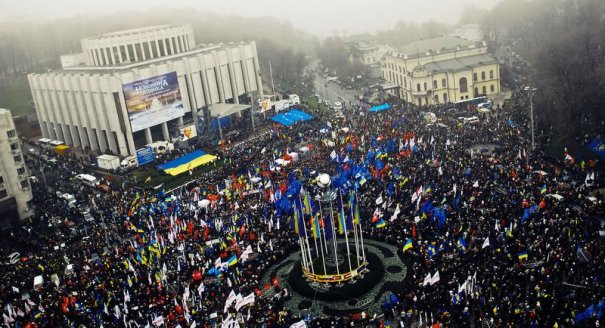
In response, on January 19, over 100,000 people defied the laws by gathering in Independence Square, the rallying point for antigovernment protests. The demonstrations were met with a harsh crackdown by the security forces. Ukraine now faces dangerous instability unless the opposition and the European Union act quickly and wisely.
The new laws ban protesters from wearing protective and camouflage gear and from occupying public buildings. The Automaidan convoy of cars in which protesters drove to support the demonstrations is to be forbidden. Yanukovych also brought in a Ukrainian version of the “foreign agent” rule that Russian President Vladimir Putin introduced in 2012. Under this regulation, nongovernmental organizations that are supported by Western funding will lose their nonprofit tax status.
Certain Internet sites will be blocked, and the government will be able to control social networks. The aim is clearly to limit the opposition’s ability to call demonstrations. Officials and police officers who were blamed for the violence during the riots of November 30 will be acquitted. Serhiy Lyovochkin, Yanukovych’s chief of staff, who opposed the violence, was sacked.
In short, instead of pursuing any kind of dialogue with the opposition, Yanukovych has chosen harsh measures to suppress the prodemocracy movement. That is a dangerous miscalculation, because it risks radicalizing the opposition.
In response, the opposition should stand united against the new laws, capitalizing on the fact that Yanukovych is revealing his real political instinct: authoritarianism. But the opposition is riven with divisions, as if it has learned nothing from the bitter disputes that spoiled the prodemocracy Orange Revolution of 2004. So far, the opposition’s various leaders haven’t even been able to agree on a common candidate to run against Yanukovych in next year’s presidential election.
Nor can they agree on how to respond to Yanukovych’s latest crackdown. One opposition politician, former interior minister Yuriy Lutsenko, who is in the hospital recovering from a nasty beating by riot police, has called for a nationwide resistance movement “to assault the ruling gang.”
The imprisoned former prime minister, Yulia Tymoshenko, proposed legal action against the measures. A group of civil society organizations has called for some kind of national resistance.
The longer these divisions continue, the more the nationalist Svoboda party, with its penchant for violence, is likely to gain support. Increased backing for more extreme views could discredit moderate voices and could be used by Yanukovych to justify his clampdown.
Now is the time for the opposition to join forces and agree on a long-term economic, social, and political reform strategy for their country. Otherwise, the EU support that the democracy movement so urgently needs will evaporate. Time is of the essence.
There is a consensus in Europe that Yanukovych is interested in one thing only: remaining in power. Yet his ambitions are increasingly dependent on Russia. In December, Putin rescued Ukraine’s finances by buying $15 billion of Ukrainian bonds and reducing the price of Russian energy exports to the country.
But that help comes with a price tag. Last week, Yanukovych told his Deputy Prime Minister Yuriy Boyko to speed up joint ventures with Russia. The secret deal that Yanukovych struck with Putin last month to prevent an economic crisis has paved the way for Russian takeovers of Ukrainian companies.
That is hardly likely to please Ukraine’s wealthy oligarchs, who are based in the east of the country. They may be pro-Russian, but they do not want their businesses to be taken over by their Russian counterparts or their country to lose control of important assets. Nor do they relish the idea of Ukraine joining Putin’s Eurasian Union, a pact that Putin has long sought to build to counter the EU’s influence in Eastern Europe. Ukraine’s membership in the Eurasian Union would mean Kiev’s subordination to the Kremlin.
So while Yanukovych now “owes” Putin, it is far from certain that the Ukrainian president has the support of the country’s oligarchs. In the meantime, the opposition should use this moment to clearly set out its political, social, and economic goals and explain them to the public.
The EU can help Ukraine by doing two things. First, it should embark on an aggressive public diplomacy campaign by stepping up its support for the opposition’s online and media presence, as well as for Ukraine’s civil society movements. Despite Yanukovych’s laws against Western funding for nongovernmental organizations, the EU should persist and defend the values it espouses.
Second, the EU should push forward with highly visible aid programs. These could include help for hospitals and clean water, measures to support the poor, school and university exchange programs, and anticorruption and rule-of-law campaigns.
There is time for the opposition and the EU to make a difference in Ukraine before the 2015 presidential election. Both should seize that chance.

Nonresident Senior Fellow, Carnegie Europe
Judy Dempsey is a nonresident senior fellow at Carnegie Europe
Recent Work
Judy Dempsey
Judy Dempsey
Carnegie does not take institutional positions on public policy issues; the views represented herein are those of the author(s) and do not necessarily reflect the views of Carnegie, its staff, or its trustees.

With its public finances in shambles, the far right polling at 35 percent ahead of the 2027 presidential election, and a growing protest movement, is France’s crisis a threat to the EU’s geopolitical awakening?

Rym Momtaz, ed.

Ahead of a tough winter for Ukraine, Donald Trump’s swing back toward Russia bodes ill. But instead of panicking, Kyiv’s European allies are focusing on action.
Rym Momtaz

While the EU and European governments are embracing the much-lauded middle-power moment, this entails three difficult conundrums.

Richard Youngs

Much has been said of the changes Brussels is trying to make to the EU enlargement process. Here’s why gradual integration might—or might not—be the answer.

Dimitar Bechev

The European Commissioner for Trade is headed to China. But after President Xi’s bridge-building visit to Washington, can a more isolated EU overcome Beijing’s stranglehold on critical raw materials? Who will blink first?
Rym Momtaz, ed.