

Commentary
Nathalie Tocci, Jan Techau
{
  "authors": [
    "Jan Techau"
  ],
  "type": "commentary",
  "blog": "Strategic Europe",
  "centerAffiliationAll": "",
  "centers": [
    "Carnegie Endowment for International Peace",
    "Carnegie Europe"
  ],
  "collections": [],
  "englishNewsletterAll": "",
  "nonEnglishNewsletterAll": "",
  "primaryCenter": "Carnegie Europe",
  "programAffiliation": "",
  "programs": [],
  "projects": [],
  "regions": [
    "Eastern Europe",
    "North America",
    "United States",
    "Russia",
    "Ukraine",
    "Western Europe",
    "Europe"
  ],
  "topics": [
    "Democracy",
    "Foreign Policy",
    "EU",
    "Security",
    "Civil Society"
  ]
}
Source: Getty
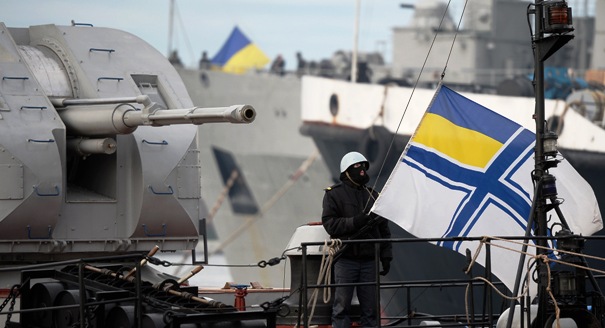
The West has limited options for dealing with Russian interference in Ukraine. The best way forward may be to accept permanent low-intensity rivalry with Moscow.
With U.S. President Barack Obama visiting Europe and an emergency G7 meeting having taken place in The Hague, the heated debate about the West’s proper response to Russian power politics is entering the next round.
Policymakers and pundits have recommended many courses of action. In reality, however, the EU and the United States have only two options. First, they can return to the status quo ante. That would put Kiev under Moscow’s de facto control on both domestic and external matters. Or, second, they can invest heavily in the new government in Kiev and be prepared to engage in a permanent simmering conflict with Russia in Eastern Europe.
Over recent weeks, Russia’s goal in Ukraine has become all too clear: it wants to regain previous levels of political and economic control over a country it has always considered its own. Russian President Vladimir Putin cannot allow Western liberal democracy to flourish on his doorstep. The Kremlin must also demonstrate that the unexpected power shift in Kiev was an accident, and that Moscow is still the final geopolitical arbiter in the region.
According to this logic, occupying and annexing Crimea is not a sufficient reply to recent events. Moscow may not need to invade the rest of Ukraine, but it must attempt to reinstall a Kremlin-friendly regime in Kiev. To this end, it will do its utmost to ensure the failure of the current interim government and the new team due to come in after a presidential election scheduled for May 25. As a consequence, Putin will perceive every Western attempt to help the new administration in Kiev as interference.
Some analysts have tried to break out of this logic by suggesting a third way that would avoid both a Ukraine under full Russian control and a permanent clash between the West and Russia. This would be a realist approach based on deescalation. It would rest on the assumption that Putin eventually realizes how costly his actions will be for him. That would lead him to accept a neutral Ukraine that can do what it wants as long as it does not join NATO—or the EU.But this third scenario is not much different from the first option above. Neutrality, despite having the air of nonpartisanship, also needs to be defended when threatened. Is the West ready for that? Accepting Ukrainian neutrality and then leaving the country to its own devices would, in reality, amount to letting Russia have its own way.
Let me be clear: I think that offering Ukraine NATO membership is a bad strategic idea. But so too is a deal that banks on Russia’s willingness to accept genuine neutrality for Ukraine. A grand bargain that would make Russia refrain from interfering in Ukrainian domestic affairs in return for nonmembership in NATO is entirely unrealistic.
The real realist’s option is to put Ukrainian NATO membership to sleep but to be fully prepared to compete with Moscow for influence in Kiev. The West should do everything it can to give Ukrainians the right to decide their own fate. That means investing fully in Ukraine’s democratic process, helping its economy, and assisting in setting up an inclusive constitutional process—with full cultural and linguistic rights for minorities. But the West must also be ready to swallow Russian accusations of Western aggression and escalation.
The West’s options are not great. If it gives up on Ukraine and hands Russia the exclusive right to interfere in the country’s internal affairs, the West would endanger its own interests and reward Russian aggression. It would also betray its values and the people who find those values so attractive that they are prepared to risk their lives for them.
Alternatively, the West can accept Russia’s meddling while claiming for itself a similar right to meddle in Ukrainian affairs by helping the country to get its act together. That would probably lead to a permanent confrontation with Russia of some sort. But it would also demonstrate that the West is willing to accept some of Russia’s core interests while not simply embracing all of them.
Such an approach would already be a compromise, but it seems to be the only one that gives Ukrainians a say in their own future, and not just relegate them to a minor role on the sidelines of a big geopolitical chess game.
At the current crucial moment in the Ukraine crisis, the West needs to decide whether it is prepared to play the Ukraine issue out over the long term. The consequence would be permanent, low-intensity rivalry with Russia over the country’s future. But that may be the only way the Ukraine crisis can still produce a somewhat bearable outcome.

Director, Europe Team, Eurasia Group
Techau is director with Eurasia Group's Europe team, covering Germany and European security from Berlin. Previously, he was director of Carnegie Europe.
Recent Work

Nathalie Tocci, Jan Techau
Jan Techau
Carnegie does not take institutional positions on public policy issues; the views represented herein are those of the author(s) and do not necessarily reflect the views of Carnegie, its staff, or its trustees.
Europe has an interest in supporting Armenian leader Nikol Pashinyan as he tries to make peace with neighbors and loosen ties with Russia. But it is depersonalized support in the long term, not quickfire flash, that will win the day.

Thomas de Waal
Following Ursula von der Leyen’s gaffe equating Turkey to Russia and China, relations with Ankara risk deteriorating even further. Without better, more consistent diplomatic messaging, how can the EU pretend to be a geopolitical power?

Sinan Ülgen
Closer EU-UK ties could help address urgent European concerns. But is the EU ready for rapprochement with the United Kingdom?

Rym Momtaz, ed.
Europe has been standing by while its Southern neighborhood is being redrawn by force. To establish a path to peace between Israel and Lebanon, it’s time for Europeans to get involved with hard power.
Rym Momtaz
In Ukraine, Gaza, and Iran, AI warfare has come to dominate, with barely any oversight or accountability. Europe must lead the charge on the responsible use of new military technologies.

Raluca Csernatoni